
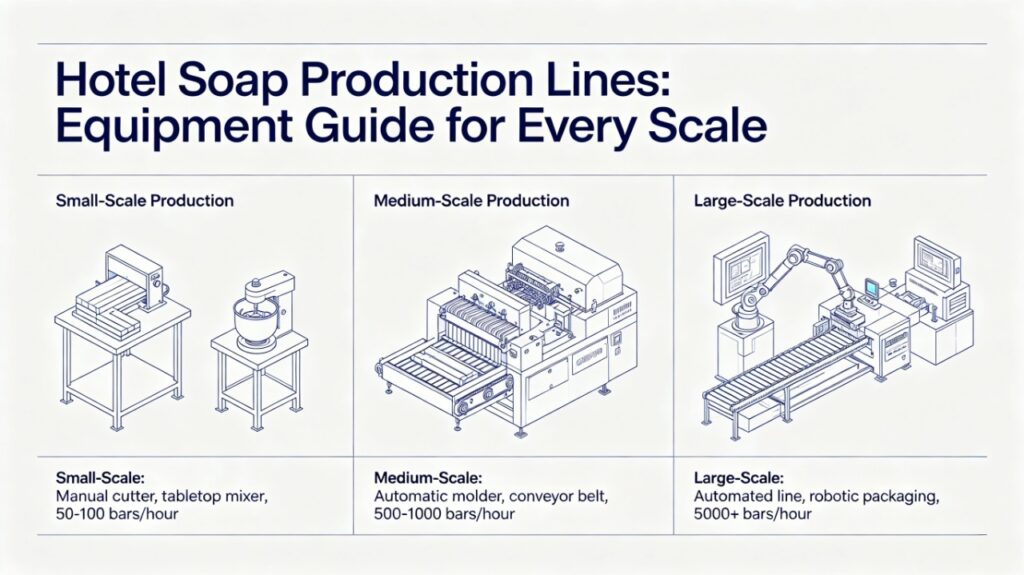
Hotel amenity soap is a high-margin, fast-turnover segment — but the production line that makes a 10-gram guest bar looks very different from one that churns out 100-gram household bars. Get the configuration wrong and you pay for it in rework, packaging waste, and costly downtime.
This guide breaks down every major equipment stage, compares line configurations by output scale, and gives you the numbers you need to make a confident sourcing decision.
What Makes Hotel Soap Production Different
Hotel and travel-format soap (typically 10–30 g per bar) imposes tighter tolerances than standard household soap:
- Weight precision: Hospitality contracts often specify ±0.5 g tolerance per bar — three to four times stricter than household-grade.
- Surface finish: Guest bars must be smooth, crack-free, and embossed to spec. Any visual defect is a brand rejection.
- Fragrance consistency: Hotels specify fragrance load at 1–3% of bar weight; dosing accuracy directly affects guest experience.
- Packaging variety: Individual wrapping (pleat, band, or pillow), multi-bar boxed sets, and travel kits may all run on the same line.
A correctly configured hotel soap line addresses all four constraints simultaneously — this is where equipment selection becomes critical.
Core Equipment Stages: From Saponification to Shipping
A complete hotel soap production line runs through six sequential stages. Each stage has dedicated equipment, and the bottleneck at any one stage caps the entire line’s output.
Stage 1 – Saponification & Blending
Fats, oils, lye, and additives are reacted and blended into raw soap base. For hotel soap, this stage typically uses a continuous saponification reactor rather than batch kettles, because:
- Continuous reactors maintain tighter pH and moisture control (±0.2% vs. ±1.5% in batch).
- Inline fragrance dosing pumps integrate at this stage for consistent scent distribution.
- Output is directly fed to the refining train without manual transfer.
Key parameters at this stage:
| Parameter | Entry-Level Line | Mid-Range Line | Industrial Line |
|—|—|—|—|
| Saponification method | Semi-batch kettle | Continuous tubular | Continuous multi-stage |
| Capacity (soap base) | 50–150 kg/hr | 200–600 kg/hr | 800–2,000 kg/hr |
| pH control tolerance | ±1.5 | ±0.5 | ±0.2 |
| Fragrance dosing accuracy | Manual addition | Inline pump, ±2% | Inline pump, ±0.5% |
| Typical equipment cost | $5,000–$18,000 | $20,000–$45,000 | $50,000–$120,000 |
Stage 2 – Refining, Drying & Milling
Raw soap base exits saponification at 20–30% moisture. For hotel-grade bars, moisture must be reduced to 10–14% and the soap must be homogenized to a fine, consistent texture.
- Vacuum dryer / crutcher dryer: Removes moisture under vacuum to prevent color degradation in premium formulations.
- Three-roll mill: Grinds and homogenizes soap noodles to ensure fragrance and colorant are evenly distributed — critical for consistent bar color.
- Sigma mixer / amalgamator: Blends additives (moisturizers, dyes, titanium dioxide) into the base.
Stage 3 – Extrusion & Cutting
The bar soap extrusion and cutting line is the heart of hotel soap production. For small-format bars (10–30 g), the cutter must achieve higher cuts-per-minute than standard lines:
| Specification | Small Format (10–30 g) | Standard Format (80–125 g) |
|—|—|—|
| Extruder output diameter | 18–35 mm | 40–65 mm |
| Cutting speed | 120–300 cuts/min | 60–150 cuts/min |
| Weight tolerance | ±0.5 g | ±1.5 g |
| Servo drive control | Required | Recommended |
| Bar surface temperature at cut | ≤30°C | ≤35°C |
| Cooling conveyor required? | Yes (mandatory) | Often optional |
A cooling conveyor between the extruder and the stamping press is non-negotiable for small hotel bars — warm soap deforms under stamping pressure and causes embossing defects.
Stage 4 – Stamping & Embossing
Hotel soap dies carry the property logo, brand name, or decorative motif. Stamping precision determines whether the embossed image is sharp or blurred:
- Hydraulic stamping presses (50–100 kN): Standard for hotel bars; die pressure 2–4 MPa; cycle rate 60–120 bars/min.
- Servo stamping presses: ±0.1 mm positional repeatability; preferred for fine logo detail; 20–30% higher unit cost.
- Die temperature control: Chilled dies (15–20°C) reduce soap adhesion and extend die life by 40–60%.
Stage 5 – Wrapping & Packaging
This is typically the most labor-intensive stage in small-format soap production — and the one where automation delivers the fastest ROI. The soap packaging line for hotel amenities covers three formats:
| Format | Equipment Type | Speed | Typical Use |
|—|—|—|—|
| Pleat wrap (paper/foil) | Pleat wrapping machine | 200–500 bars/min | Premium hotel bars |
| Band wrap (paper band) | Band wrapping machine | 150–350 bars/min | Mid-range amenity bars |
| Pillow pack (film) | Pillow packing machine | 200–600 bars/min | Budget/travel packs |
| Multi-bar box (2–6 bars) | Cartoning machine | 40–120 boxes/min | Gift sets, travel kits |
Pleat wrapping is the dominant format for 4- and 5-star hotels because it mimics artisan gift wrapping while protecting bar edges during transport.
Stage 6 – Case Packing & Palletizing
High-volume hotel soap contracts ship in master cartons of 100–500 bars each. The automated packing and palletizing system handles:
- Automatic case erecting, loading, and sealing.
- Pallet pattern programming for different carton sizes.
- Stretch wrapping for export-ready loads.
At 300+ bars/minute output, manual case packing becomes the bottleneck within weeks. Automated end-of-line systems pay back in 8–14 months at mid-scale volumes.
Line Configuration by Output Scale
Use this table to match your hotel soap contract volume to the right line configuration:
| Scale | Daily Output | Bar Format | Line Config | Capital Investment | Staff Required |
|—|—|—|—|—|—|
| Entry-level | 50,000–120,000 bars/day | 20–30 g | Batch saponification + semi-auto extruder + manual wrap | $45,000–$90,000 | 8–12 operators |
| Mid-range | 150,000–400,000 bars/day | 10–30 g | Continuous saponification + servo extruder + auto pleat wrap | $120,000–$280,000 | 5–8 operators |
| Industrial | 500,000–1,500,000 bars/day | 10–50 g | Full-continuous line + multi-head packaging + auto palletizing | $350,000–$750,000 | 4–6 operators |
> Note: Daily output assumes 20-hour production (two 10-hour shifts) with 88% line efficiency.
ROI Analysis: Hotel Soap vs. Household Soap
Hotel soap commands a significant price premium that accelerates equipment payback:
| Metric | Household Soap (100 g) | Hotel/Amenity Soap (20 g) |
|—|—|—|
| Average selling price (ex-works) | $0.08–$0.15/bar | $0.12–$0.35/bar |
| Raw material cost per bar | $0.03–$0.06 | $0.01–$0.02 |
| Gross margin (typical) | 35–45% | 50–65% |
| Annual revenue at 200k bars/day | $5.8M–$10.9M | $8.8M–$25.6M |
Sample ROI Model — Mid-Range Hotel Soap Line
Assumptions: 200,000 bars/day × 300 days/year = 60 million bars/year; average ex-works price $0.22/bar.
| Item | Value |
|—|—|
| Annual revenue | $13,200,000 |
| Raw material cost (42% of revenue) | $5,544,000 |
| Labor cost (5 operators × $18,000/yr) | $90,000 |
| Energy + utilities | $120,000 |
| Maintenance + consumables | $85,000 |
| Annual gross profit | $7,361,000 |
| Equipment investment | $200,000 |
| Payback period | ~10 months |
Hotel and hospitality supply contracts typically run 2–5 years — once you secure a contract, the recurring revenue stream makes the payback calculus very favorable.
Key Buying Considerations
Before requesting a quote, confirm these five parameters with your equipment supplier:
1. Bar weight range: Confirm the extruder and cutter can handle your smallest format (e.g., 10 g) without die changeover.
2. Die compatibility: Ask whether your logo or embossing design is included in the standard tooling package or quoted separately.
3. Film/paper compatibility: Different packaging films (OPP, BOPP, wax paper, foil-laminate) require different sealing temperatures — verify with the packaging machine OEM.
4. Fragrance-resistant seals: Fragrances degrade standard silicone seals in extruder heads; request food-grade or fragrance-resistant materials.
5. Line integration: Request a complete line layout drawing showing conveyors, reject stations, and inspection points before finalizing the configuration.
According to Statista’s global bar soap market data, the hotel amenity segment grew at 5.8% CAGR from 2020–2024, outpacing the broader bar soap market (3.1%). Hospitality industry projections from the International Hotel Association indicate global hotel rooms will increase by 12% through 2028, directly driving amenity soap demand. Equipment sourcing decisions made now will position manufacturers to capture that contract pipeline ahead of competitors.
For technical standards governing soap composition and testing, refer to ISO Technical Committee TC 91 (Surface Active Agents), which covers the analytical methods that major hotel brands use to qualify soap suppliers.