
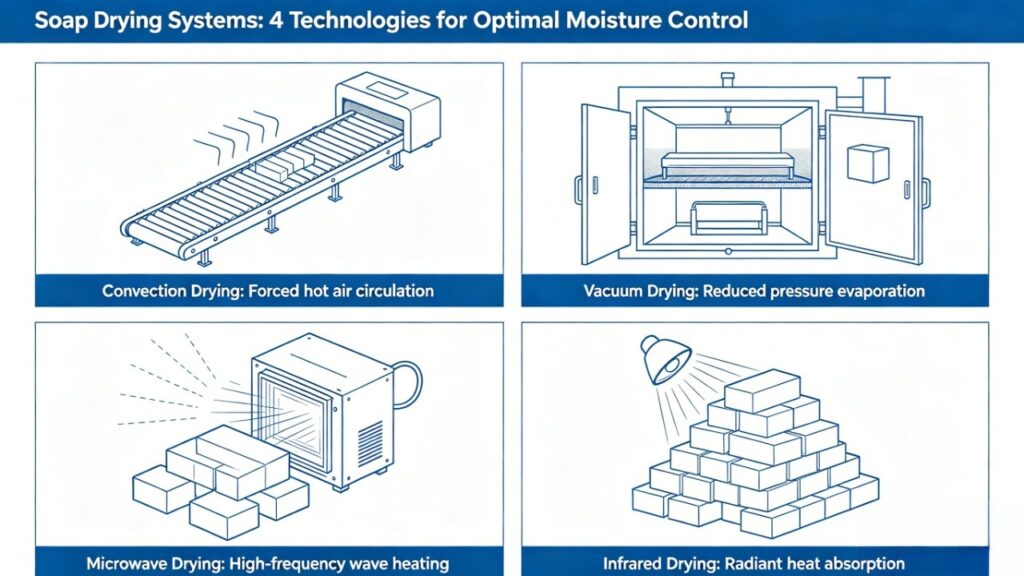
Why Drying Matters in Soap Production
Moisture content is the make-or-break variable in soap manufacturing. Too much water remaining in the finished bar compromises density, lathering performance, and shelf life. Too little creates brittleness and cracking during packaging. Achieving the precise moisture target—typically 10–14% for toilet bars—requires the right drying technology matched to your production volume and soap formulation.
For manufacturers evaluating new equipment or upgrading legacy lines, selecting a drying system involves balancing energy efficiency, throughput, product quality, and capital cost. This guide breaks down the four dominant drying technologies used in industrial soap production, with technical parameters, energy benchmarks, and ROI analysis for each.
Convective Air Drying: The Industry Standard
Convective drying uses heated air circulated through a chamber or tunnel to evaporate moisture from extruded or milled soap noodles. This method dominates mid-scale soap production globally due to its straightforward design and proven reliability.
The process passes soap noodles (typically 3–5 mm particle size after refining) through a tunnel dryer operating at 60–90°C. Residence time ranges from 45 minutes to 3 hours depending on initial moisture content and target final moisture. A standard tunnel dryer with 12-meter length handles 500–2,000 kg/hour of soap noodles.
Convective dryers work best with:
- Neutral soap bases processed through conventional saponification
- Toilet soap and laundry soap with standard formulations
- Production scales of 500–3,000 kg/hour
The energy consumption for convective drying typically falls between 800–1,200 kJ per kilogram of water evaporated. Modern units incorporate heat recovery systems that capture exhaust heat to preheat incoming air, improving efficiency by 25–35%.
Recommended for: Mid-scale manufacturers with standard product lines who prioritize proven technology and straightforward maintenance.
Vacuum Drying: Premium Quality at Higher Cost
Vacuum drying operates under reduced pressure (typically 30–80 kPa absolute), allowing moisture to evaporate at significantly lower temperatures—often 40–60°C. This gentle process preserves fragrance compounds and active ingredients better than convective methods, making it ideal for premium cosmetic and specialty soaps.
The lower temperature operation also reduces thermal degradation of natural oils and botanical additives. Vacuum dryers achieve moisture targets in 20–40 minutes per batch, versus hours for tunnel systems. However, batch processing limits throughput, and vacuum systems require more sophisticated vacuum pumps and pressure vessels.
Key parameters for vacuum soap dryers include:
- Operating pressure: 30–80 kPa
- Drying temperature: 40–60°C
- Batch size: 200–1,000 kg
- Cycle time: 30–90 minutes per batch
Energy consumption runs 1,500–2,500 kJ/kg water evaporated due to vacuum pump requirements, though the lower temperature can offset this with cheaper heat sources.
Recommended for: Premium soap producers, cosmetic manufacturers, and brands emphasizing natural or temperature-sensitive ingredients.
Fluidized Bed Drying: High Speed for Fine Particles
Fluidized bed drying suspends soap particles in a rising stream of heated air, maximizing surface area exposure and dramatically accelerating drying. This technology excels when processing fine soap flakes, powder, or highly processed noodles with high surface-area-to-volume ratios.
The fluidization process creates intense mixing that produces uniform moisture distribution across particles. Drying times collapse to 5–15 minutes compared to hours for tunnel systems. A fluidized bed dryer handling 1,000–5,000 kg/hour achieves moisture reduction from 25–30% down to 10–12% with minimal product degradation.
Fluidized bed systems require:
- Pre-crushed or milled soap noodles (particle size 0.5–3 mm)
- Careful air velocity control (typically 1–3 m/s)
- Dust collection systems for fine particle recovery
- Precise humidity monitoring to prevent over-drying
Energy consumption ranges from 600–900 kJ/kg water evaporated—among the most efficient of soap drying technologies.
Recommended for: High-volume producers of standardized soap products who need maximum throughput and consistent product quality.
Infrared Drying: Targeted Heating for Surface Moisture
Infrared (IR) drying uses electromagnetic radiation to heat soap surfaces directly, driving moisture from the interior through conduction. IR systems work exceptionally well for thin soap sheets, stamped bars, or as a finishing step after primary drying methods.
Short-wave IR (wavelength 1–3 μm) penetrates 1–2 mm into soap surfaces, creating rapid surface heating. This makes IR ideal for “skin drying”—removing surface moisture to prevent sticking in downstream packaging operations. Combined with a primary convective or fluidized bed system, IR finishing can reduce total drying time by 15–25%.
Typical IR dryer specifications:
- Emitter temperature: 800–1,500°C
- Wavelength range: 1–3 μm (short-wave) or 3–8 μm (medium-wave)
- Belt speed: 5–20 m/min
- Power density: 10–50 kW/m²
Energy efficiency is high because heat transfers directly to the product without heating surrounding air. However, IR drying requires careful control to avoid surface scorching and is best suited for relatively flat, uniform products.
Recommended for: Producers needing rapid surface drying, high-speed packaging lines, or manufacturers seeking to boost output from existing drying systems.
Drying Technology Comparison
| Technology | Throughput | Temp Range | Energy (kJ/kg H₂O) | Capital Cost | Best For |
|————|———–|————|——————-|————–|———-|
| Convective Tunnel | 500–2,000 kg/hr | 60–90°C | 800–1,200 | $50K–$200K | Standard toilet/laundry soap |
| Vacuum Dryer | 100–500 kg/hr (batch) | 40–60°C | 1,500–2,500 | $80K–$300K | Premium cosmetics, natural soaps |
| Fluidized Bed | 1,000–5,000 kg/hr | 50–80°C | 600–900 | $70K–$250K | High-volume, standardized products |
| Infrared Finishing | 500–3,000 kg/hr | Surface 80–120°C | 400–700 | $20K–$80K | Packaging prep, finishing step |
Calculating ROI for Drying System Investments
When evaluating drying technology upgrades, manufacturers should model three scenarios based on their specific product mix and production volume.
Scenario A: Upgrading from legacy tunnel dryer to modern heat-recovery system
- Additional investment: $30,000–$80,000
- Energy savings: 25–35% ($15,000–$50,000/year at $0.10/kWh)
- Throughput improvement: 10–15%
- Payback period: 1.5–3 years
Scenario B: Adding fluidized bed as primary dryer for expansion
- Investment: $100,000–$200,000
- Capacity addition: 1,000–2,000 kg/hour
- Revenue impact: $500,000–$1,200,000/year at $0.50/kg margin
- Payback period: 1–2.5 years
Scenario C: Installing vacuum dryer for premium line launch
- Investment: $150,000–$300,000
- Premium product margin uplift: $1.00–$3.00/kg
- Minimum viable production: 200 kg/day premium line
- Payback period: 2–4 years
For most mid-scale soap manufacturers, upgrading existing convective drying with heat recovery and modern controls delivers the fastest ROI. Manufacturers planning capacity expansion should evaluate fluidized bed technology for its superior throughput and energy efficiency.
Conclusion
Drying is a critical process step that directly affects product quality, production efficiency, and operating costs. The right technology depends on your product mix, volume requirements, and quality specifications. Convective tunnel drying remains the workhorse for standard soap production, while vacuum, fluidized bed, and infrared systems serve specialized needs.
Whatever technology you choose, ensure your drying system integrates properly with upstream saponification and downstream processing. Consistent moisture control throughout the production line is what separates professional manufacturers from amateur operators.
Ready to optimize your soap drying process? Contact our engineering team for a custom drying system design tailored to your production requirements. We provide complete production line configurations including saponification, drying, and packaging equipment with full installation and commissioning support.
→ Explore our saponification equipment for upstream process solutions
→ View our bar soap production machines for integrated production lines
→ Learn about soap packaging systems for downstream finishing