
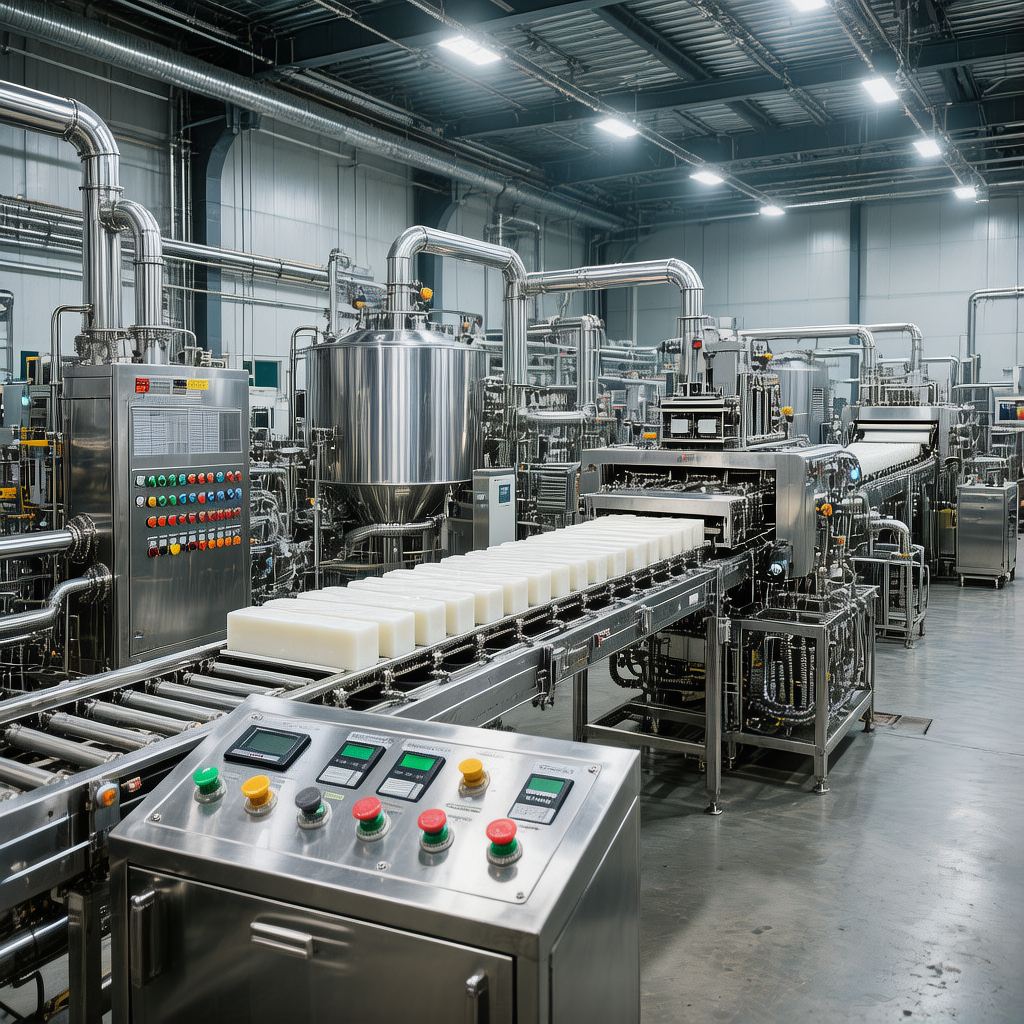
Industry Analysis · April 2026
Published: April 27, 2026 | Sources: Accio Business Research · Business Research Insights · Calmops Manufacturing Intelligence · IndexBox · Made-in-China | STING Industry
Executive Summary: As the global soap and detergent market accelerates toward USD 252.9 billion by 2035 (6.5% CAGR), soap equipment manufacturers face a dual imperative: adopt AI-driven smart manufacturing to stay competitive, while meeting growing demand from Southeast Asia, the Middle East, and Africa for affordable, modular, and highly automated production lines. In 2026, intelligent factory integration has become the baseline qualification for serious equipment suppliers — no longer a differentiator, but a market entry requirement.
| $144B Global Soap & Detergent Market, 2026 |
6.5% Market CAGR 2026–2035 (BRI) |
8.4% Soap Equipment CAGR to 2033 (Accio) |
7.2% Liquid Soap Equipment CAGR to 2036 |
1. Market Context: A $144 Billion Industry in Structural Transformation
The global soap and detergent market entered 2026 at a valuation of USD 144.05 billion, with projections reaching USD 252.93 billion by 2035 — a compound annual growth rate of 6.5% (Business Research Insights, April 2026). This growth is not driven by volume alone: the underlying product mix is shifting toward antibacterial formulations, organic ingredients, and eco-certified product lines, each of which demands more precise, flexible, and programmable production equipment.
On the equipment side, the soap production line market is expanding at 8.4% CAGR through 2033 (Accio Business Research, April 2026) — outpacing the consumer goods market it serves. The divergence reflects a fundamental dynamic: as product complexity increases, the machinery required must become correspondingly more sophisticated.
Three structural shifts are reshaping equipment demand in 2026:
- Antibacterial and organic soap demand surged 42% globally, requiring equipment capable of handling sensitive botanical and pharmaceutical-grade active ingredients.
- Eco-friendly formulation adoption rose 38%, requiring machinery compatible with plant-based, biodegradable raw materials and recyclable packaging workflows.
- Liquid detergent adoption grew 34% over the past three years — directly driving demand for liquid soap filling and mixing lines as a high-priority capital investment category.
2. AI and Smart Manufacturing: No Longer Optional
The integration of AI and Industry 4.0 technologies into soap manufacturing has crossed a critical threshold in 2026. A comprehensive analysis of smart factory implementations across the manufacturing sector (Calmops Manufacturing Intelligence, March 2026) reveals measurable ROI patterns that are well-documented and reproducible across equipment types.
2.1 Predictive Maintenance: The Highest-ROI Entry Point
For soap equipment operators, unplanned downtime remains the single largest source of preventable cost. AI-powered predictive maintenance systems — integrating vibration analysis, thermal imaging, electrical signal monitoring, and oil analysis — are demonstrating consistent results:
| Performance Metric | Improvement Range | Implication for Soap Lines |
|---|---|---|
| Unplanned downtime reduction | 30 – 50% | Fewer disruptions to 24/7 continuous plodder and mixer operations |
| Maintenance cost reduction | 20 – 35% | Lower spare parts consumption; optimized service intervals |
| Equipment service life extension | 20 – 40% | Higher ROI on capital-intensive extrusion and stamping equipment |
| OEE improvement | 5 – 15% | Better throughput utilization across multi-shift production schedules |
| Investment payback period | 12 – 18 months | Accessible ROI timeline for SME equipment buyers |
Key insight: A 12–18 month payback period makes AI-enabled predictive maintenance accessible even for mid-scale soap manufacturers operating 2–3 production lines. The ROI case is no longer theoretical — it is documented and replicable.
2.2 AI Quality Control: Replacing the Human Eye
AI-powered vision systems for inline quality inspection are being deployed across soap stamping, cutting, and packaging stages in 2026. The performance advantage over manual inspection is quantifiable:
| Inspection Method | Defect Detection Rate | False Positive Rate | Speed vs. Manual |
|---|---|---|---|
| AI Vision System | >90% | <5% | 10× faster |
| Manual Inspection | 60 – 70% | Variable (fatigue-dependent) | Baseline |
Quality-related production costs fall by 30–50% with AI vision systems, while customer complaints decrease by 40–60% — a combined impact that dramatically improves the economics of high-volume bar soap production.
2.3 Smart Factory Implementation: A Staged Journey
Calmops’ analysis identifies a four-phase implementation roadmap for soap equipment buyers:
- Phase 1 (6–12 months): Sensor deployment, data infrastructure, and first AI applications — typically predictive maintenance on primary plodder and mixer units.
- Phase 2 (12–24 months): AI integration with MES/ERP systems; expanding coverage to cutting, stamping, and packaging lines.
- Phase 3 (24–36 months): Cross-functional optimization including energy management, batch scheduling, and supplier quality integration.
- Phase 4 (36+ months): Autonomous operations with self-optimizing process parameters and AI-driven product development support.
3. Regional Demand Analysis: Where the Growth Is
Asia Pacific remains the dominant and fastest-growing regional market, accounting for 46% of global market share in 2026. But growth is increasingly distributed across four distinct geographic clusters:
| Region | Market Driver | Equipment Demand Profile | Key Markets |
|---|---|---|---|
| Asia Pacific | Urbanization + middle-class expansion; liquid soap adoption | High-speed automated bar soap lines; liquid filling systems | China (8.6% CAGR), India (8.3%), Southeast Asia |
| Africa | New manufacturing infrastructure; hygiene demand growth | Affordable modular lines; SME-scale semi-auto equipment | Nigeria, Egypt, Ethiopia, Kenya |
| Middle East | Premium hygiene demand; halal-certified formulation growth | Flexible modular lines; small-batch specialty equipment | UAE, Saudi Arabia, Turkey |
| Southeast Asia | Export platform development; local brand manufacturing | Liquid soap lines + bar soap automation hybrid configs | Vietnam, Indonesia, Thailand |
A key finding from the IndexBox South-Eastern Asia Soap Market Report (March 2026) is that the region’s FMCG production base is undergoing a structural shift from import dependency toward domestic manufacturing capability — directly creating demand for affordable, export-grade soap production equipment from established suppliers in China and India.
4. Equipment Supplier Landscape: Differentiation Through Intelligence
The global soap equipment supplier base in 2026 is bifurcating along a clear axis: those who have integrated smart manufacturing capabilities, and those who have not. The competitive evaluation criteria have evolved significantly:
- Automation level: PLC/HMI control systems with IoT connectivity and real-time monitoring are now expected as standard on mid-range and above equipment.
- Modular configurability: Buyers demand production lines that can be reconfigured for different soap types, batch sizes, or ingredient profiles without major retooling.
- After-sales service capability: Remote diagnostics, spare parts availability, and commissioning support are weighted heavily — particularly for buyers in Africa, Southeast Asia, and the Middle East.
- International compliance: CE certification, RSPO-compatible ingredient handling, and food-grade material standards are increasingly required for access to European and premium market supply chains.
- Energy efficiency: With energy costs rising across manufacturing regions, low-energy consumption specifications have moved from “nice to have” to procurement-stage requirements.
Chinese soap equipment manufacturers have positioned themselves strongly in the global mid-market. An April 23, 2026 release from Zhengzhou Fanda Machinery (EINPresswire) highlights a representative trend: the company supplies complete production lines from single units to full facilities, specifically targeting SMEs in rapidly industrializing regions at accessible capital costs — combining competitive pricing with improving automation capability.
5. Liquid Soap Equipment: The Blue Ocean of 2026
Within the broader soap equipment market, liquid soap production lines stand out as the fastest-growing and most competitively uncrowded segment. Key data from Accio Business Research (April 2026):
- Liquid soap equipment CAGR: 7.2% through 2036 — significantly above the overall bar soap equipment growth rate.
- Application scope: handwash, shower gel, shampoo, dishwashing liquid — a much broader addressable market than traditional bar soap equipment.
- Asia Pacific demand is particularly strong, driven by the shift from bar soap to liquid formats across household and commercial end-users.
- Technology requirements include modular mixing systems capable of handling viscosity variations, precise ingredient dosing, and integration with flexible filling and capping lines.
Strategic note: Equipment buyers considering capacity expansion in 2026 should evaluate liquid soap production lines as a priority category — not just as a product extension, but as a distinct business opportunity with stronger demand growth and lower competitive intensity than the bar soap equipment segment.
Conclusion: The Competitiveness Equation Has Changed
In 2026, the soap equipment industry is no longer competing on hardware durability alone. The new competitive equation integrates automation maturity, smart manufacturing capability, regional service coverage, and modular flexibility into a single value proposition. Three takeaways stand out:
- AI and IoT integration deliver verifiable ROI within 12–18 months — sufficient justification for capital allocation across all but the smallest operations.
- Liquid soap equipment represents the highest-growth opportunity in the near term, with broad geographic demand and comparatively limited supplier specialization.
- Emerging market buyers in Africa, Southeast Asia, and the Middle East are becoming structurally important customers — suppliers must develop genuine regional support infrastructure to serve them effectively.
For soap equipment manufacturers and buyers navigating this environment, the strategic imperative is clear: invest in intelligence, build flexibility into your production architecture, and align your geographic capabilities with where the next billion bars of soap will be made.
Sources: Accio Business Research (April 21, 2026) · Business Research Insights – Soap & Detergent Market Report #BRI119740 (April 13, 2026) · Calmops Manufacturing Intelligence – AI in Manufacturing 2026 (March 10, 2026) · IndexBox – South-Eastern Asia Soap Market Report (March 2026) · Made-in-China Industry Analysis · EINPresswire / National Law Review – Zhengzhou Fanda Machinery Press Release (April 23, 2026) · soapmakingmachine.com – Soap Production Equipment in 2026 (April 7, 2026)
© 2026 STING Industry · www.sting-industry.com · All market data cited from third-party research sources.