
1. Market Snapshot: Where the Numbers Stand
The global soap production equipment market continues to expand at a measured but resilient pace. According to data compiled from multiple market intelligence sources, the sector’s fundamentals remain intact despite macroeconomic headwinds in early 2026.
| Market Segment | Current Value (2025–2026) | Projected Value | CAGR |
|---|---|---|---|
| Soap Making Machine (Global) | USD 300–500M (2024–2025) | USD 450–700M (2033) | 5.5–6.0% |
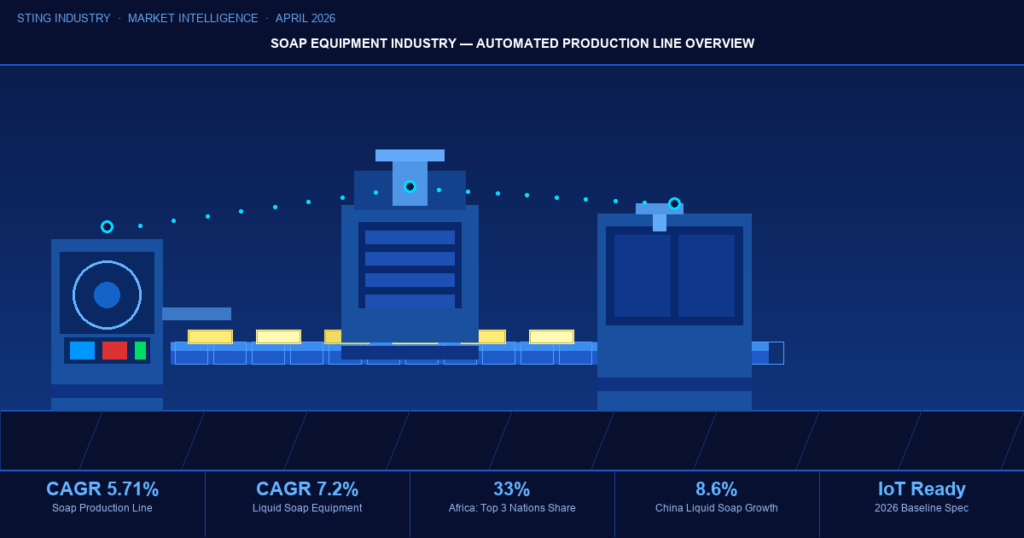
| Soap Production Line (Overall) | USD 50.5B (2025) | USD 79.4B (2033) | 5.71% |
| Liquid Soap Equipment (Global) | USD 23.3B (2025) | USD 36.7B (2036) | 7.2% |
| Bar Soap Equipment Sub-segment | USD 3.12B (2026) | USD 3.45B (2035) | ~1.1% |
| Africa Soap & Detergent Market | Developing | USD 57.2B, 36M t (2035) | 3.2% |
The data confirms a structural divergence: liquid soap equipment is growing nearly twice as fast as bar soap machinery, driven by rising hygiene consumption habits across Asia-Pacific, Africa, and the Middle East. Equipment buyers focused exclusively on bar soap stamping lines may be underinvesting in the faster-growing segment.
2. This Week’s Key Dynamics: Three Forces Reshaping the Market
2.1 Trade Tariff Pressure Reshapes Cross-Border Equipment Procurement
The most significant short-term disruptor for the soap equipment sector in April 2026 is the evolving US tariff landscape. According to UNCTAD’s Global Trade Update (April 2026), global trade volume growth in Q1 2026 was partly inflated by price increases rather than genuine volume expansion — a signal that cost-push pressures are filtering through supply chains.
For soap equipment buyers and exporters, this creates several practical implications:
- Higher landed cost for imported machinery — particularly for US-bound shipments of Chinese-manufactured production lines, where additional Section 301 and reciprocal tariffs apply.
- Supply chain rerouting activity — some buyers are exploring sourcing from Southeast Asian equipment suppliers or negotiating direct factory-to-buyer contracts to avoid tariff exposure.
- Quicker procurement decisions — buyers in stable markets (Europe, GCC, Africa) are accelerating purchase timelines to lock in pre-tariff pricing from established Chinese manufacturers.
For established exporters like Chinese soap equipment manufacturers, this environment creates a dual opportunity: accelerated demand from non-US markets combined with urgency-driven orders from buyers seeking to close deals before further policy shifts.
2.2 Africa’s Manufacturing Expansion Generates Equipment Demand
Africa is emerging as one of the most structurally compelling markets for soap equipment investment in 2026. According to IndexBox’s March 2026 market report, the continent’s soap and detergent production sector is expanding at a 3.2% CAGR — but this headline figure masks a more dynamic equipment investment story.
| Country | Production Volume (2022) | Africa Share | Equipment Investment Focus |
|---|---|---|---|
| Nigeria | 4.0 million tonnes | Leading | SME-scale mixing & stamping upgrades |
| Egypt | 2.2 million tonnes | Major | Liquid soap filling lines; export-grade quality |
| Ethiopia | 1.7 million tonnes | Growing | Entry-level semi-automatic production |
| South Africa / Kenya | Export-oriented | Cluster | Flexible multi-format lines; packaging integration |
Three countries — Nigeria, Egypt, and Ethiopia — account for 33% of Africa’s total soap production volume. Critically, large local manufacturers in these markets are now actively investing in automation and energy-efficient lines to compete with multinational brands on cost-per-unit. This creates a demand profile that favors modular, mid-capacity lines over entry-level batch equipment.
2.3 Liquid Soap Equipment: The Fastest-Growing Sub-Segment
The liquid soap equipment segment is outperforming the broader machinery market by a significant margin. With a global CAGR of 7.2% through 2036, and China and India recording regional growth rates of 8.6% and 8.3% respectively, liquid soap filling and mixing lines represent the sector’s most active investment category.
Search trend data from Accio confirms that “high-speed soap filling and packaging production line” queries reached a peak in February 2026, followed by sustained interest into April. The key drivers of this demand surge are:
- Post-pandemic hygiene retention — liquid soap adoption has structurally increased in institutional, hospitality, and household sectors across emerging markets.
- Premium and specialty formulations — organic, sulfate-free, and dermatologically tested liquid soaps require precision mixing equipment with temperature control and ingredient dosing accuracy.
- Refillable packaging formats — e-commerce and sustainability trends are driving demand for bulk liquid soap equipment capable of producing refill-format products.
- SME market entry — smaller operators in Africa, Southeast Asia, and the Middle East are entering liquid soap manufacturing with USD 2,000–20,000 semi-automatic lines.
3. Technology Focus: What Buyers Are Specifying in 2026
Equipment procurement specifications have shifted meaningfully over the past 12 months. Buyers across all market segments are increasingly specifying the following capabilities as standard — not premium — requirements:
| Capability | Why It’s Now Standard | Production Line Impact |
|---|---|---|
| PLC-based control systems | Labor cost reduction; quality consistency | Reduces operator dependency per shift |
| IoT connectivity | Remote monitoring; predictive maintenance | Reduces unplanned downtime by 20–35% |
| Quick-changeover (QCO) design | SKU proliferation; smaller batch runs | Changeover time <30 min between formats |
| Plant-based material compatibility | Natural soap market growth | Requires stainless steel; low-temp processing |
| Integrated packaging interface | End-to-end efficiency; footprint reduction | Eliminates secondary handling bottlenecks |
The most strategically significant shift is the mainstreaming of IoT connectivity. Previously a feature reserved for high-end production lines, remote monitoring and OEE (Overall Equipment Effectiveness) dashboards are now expected even in mid-tier soap machinery by buyers in Egypt, Nigeria, Indonesia, and Vietnam.
4. Emerging Market Demand Breakdown
Demand for soap production equipment is increasingly concentrated in markets outside Western Europe and North America. The following regional dynamics are shaping order flows in Q2 2026:
- Middle East & North Africa (MENA): Rapid urbanization and institutional procurement (hospitality, healthcare, food service) are driving demand for high-capacity bar soap and liquid soap lines. Egypt, Saudi Arabia, and the UAE are active importing markets.
- Sub-Saharan Africa: Nigeria and Kenya are the primary markets for SME-grade semi-automatic lines. South Africa’s export-oriented manufacturers are upgrading to flexible multi-SKU systems.
- South & Southeast Asia: India (8.3% CAGR) and Vietnam are the leading growth markets for liquid soap equipment. Indonesia’s consumer goods sector is expanding capacity in private-label soap production.
- Latin America: Brazil and Colombia are active markets for mid-range automated soap production lines, particularly for premium natural soap brands.
5. Market Challenges Worth Monitoring
Despite broadly positive demand conditions, three structural challenges are worth tracking through the remainder of 2026:
- Raw material input cost volatility: Tallow, palm oil derivatives, and specialty surfactants remain subject to commodity price swings. Equipment buyers are seeking lines with rapid formula-switching capabilities to hedge single-input dependency.
- Compliance cost escalation: Environmental regulations in the EU and increasingly in Southeast Asia are raising the bar for wastewater treatment, energy consumption reporting, and chemical handling. Equipment without built-in compliance features is becoming harder to sell into regulated markets.
- Skilled operator shortages: In many emerging markets, the move to automated equipment outpaces the availability of trained operators. This is increasing demand for equipment with simplified HMI interfaces and remote technical support capabilities.
Conclusion
The soap equipment sector in April 2026 is defined by a convergence of accelerating structural demand and shifting procurement logistics. The liquid soap equipment boom shows no signs of deceleration, Africa’s manufacturing sector is becoming a genuine equipment destination market, and IoT-enabled automation is transitioning from a differentiator to a baseline specification.
For equipment manufacturers and exporters, the near-term priority is clear: position modular, digitally-connected production lines toward buyers in MENA, Sub-Saharan Africa, and South/Southeast Asia — markets where demand is growing fastest and where tariff exposure is minimal compared to US-bound trade. Buyers who delay procurement decisions in these regions risk higher landed costs and longer lead times as order backlogs build through Q3 2026.
Sources: Accio Business Insights (April 2026) · IndexBox Market Research (March 2026) · soapmakingmachine.com Industry Analysis (April 2026) · Business Research Insights · Future Market Insights · Verified Market Research · UNCTAD Global Trade Update (April 2026) · ProMarket Reports