
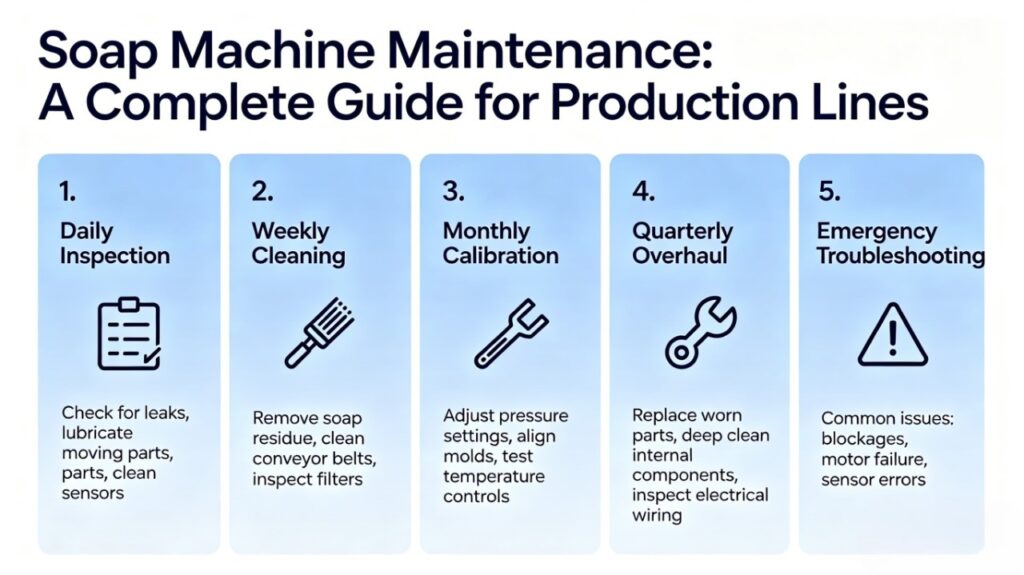
Unexpected downtime costs soap manufacturers far more than a well-planned maintenance program ever will. When a critical machine stops mid-shift, you lose not just production hours—you lose batch consistency, rush-order fulfillment, and customer trust. Yet in many facilities, maintenance is still reactive: fix it when it breaks.
This guide takes a different approach. We cover the full maintenance lifecycle for industrial soap production lines—from daily operator checks to annual overhauls—so you can build a program that keeps equipment running, extends service life, and drives down cost per bar.
Whether you operate a continuous saponification line or a semi-automated bar soap production setup, the principles here apply. Let’s get into it.
2. Maintenance Schedule by Equipment Zone
Soap production lines typically span five equipment zones, each with distinct maintenance requirements.
2.1 Saponification & Mixing Zone
This zone handles the most aggressive chemistry: hot lye, fatty acids, and steam at 80–120 °C. Corrosion and seal degradation are the primary failure modes.
Daily checks:
- Verify agitator seal integrity (no drips or steam leaks)
- Confirm jacket temperature uniformity (±2 °C tolerance)
- Inspect all valve seats for weeping
Weekly tasks:
- Flush pH probes and recalibrate
- Grease agitator shaft bearings (food-grade grease, NLGI Grade 2)
- Check impeller blade clearance (spec: 2–5 mm gap from vessel wall)
Monthly tasks:
- Inspect and replace worn PTFE gaskets
- Test safety relief valves
- Clean heat exchanger plates (descale if water hardness > 200 ppm)
> 💡 For detailed saponification equipment specifications and configuration options, see our saponification equipment page.
2.2 Bar Soap Forming & Plodder Zone
The plodder (extruder) is the heart of the forming line. It operates under continuous high-pressure, high-friction conditions.
| Component | Inspection Interval | Wear Indicator | Action Threshold |
|—|—|—|—|
| Extrusion screw flights | Monthly | Flight clearance > 0.8 mm | Replace or reface screw |
| Barrel liner | Quarterly | ID ovality > 0.5 mm | Replace liner |
| Die plate | Weekly | Bar surface scoring | Polish or replace |
| Cone seal | Monthly | Soap bypass at cone | Replace cone seal |
| Drive gearbox oil | Every 2,000 hrs | Viscosity change, metal particles | Oil change + filter |
| Cutter wire/blade | Daily | Irregular cut face | Replace wire/blade |
Weekly:
- Lubricate plodder gearbox with manufacturer-specified gear oil (ISO VG 220 typical)
- Check breaker plate screen for plugging (especially with perfumed noodles)
- Inspect worm shaft end float (max 0.3 mm axial play)
> Explore our full range of bar soap machines and extrusion line configurations.
2.3 Soap Cutting & Stamping Zone
Cutters and stamping presses endure cyclic mechanical stress. The main failure modes are blade dulling, die wear, and hydraulic seal leaks.
Daily:
- Inspect cutting blade edge condition (visual + bar face quality check)
- Verify stamp registration accuracy (bar weight ±0.5 g tolerance)
- Check hydraulic oil level in stamping press reservoir
Weekly:
- Sharpen or rotate cutting blades
- Clean soap accumulation from die faces
- Lubricate all guide rails and linear bearings
Quarterly:
- Replace hydraulic seals on stamping cylinder
- Check die alignment (perpendicularity < 0.05 mm)
- Torque all fasteners to specification
2.4 Soap Packaging Zone
Packaging equipment runs at high cycle rates (up to 300 bars/min on flow wrappers) and is sensitive to film tension, heat, and mechanical timing.
| Machine Type | Key Maintenance Points | Frequency |
|—|—|—|
| Pleat/fold wrapper | Sealing jaw temperature calibration | Daily |
| Pillow pack wrapper | Film tension and tracking alignment | Daily |
| Cartoning machine | Glue system purge and nozzle clean | Per shift |
| Case packer | Vacuum cup condition, gripper pressure | Weekly |
| Shrink tunnel | Conveyor chain lubrication, heater element check | Weekly |
> For complete packaging line configurations and technical specifications, visit our soap packaging equipment overview.
All packaging machines — quarterly:
- Full electrical panel inspection (connection torque, breaker health)
- Motor bearing vibration analysis (target: < 2.8 mm/s RMS at bearing housing)
- Replace worn conveyor belts and drive chains
2.5 End-of-Line Palletizing Zone
Palletizers and shrink wrappers have lower cycle rates but handle heavier loads. Focus areas are structural integrity and pneumatic/hydraulic systems.
Monthly:
- Inspect robotic arm joints for play (replace worn pivot bushings)
- Check pallet layer pattern accuracy (±5 mm tolerance)
- Lubricate all pneumatic actuator rod seals
Quarterly:
- Full pneumatic system leak test (pressure drop < 5% over 10 min)
- Inspect conveyor roller bearings for roughness
- Update palletizing pattern programs after any product changeover
4. Spare Parts Management
Carrying the right spare parts eliminates most emergency downtime. The key is distinguishing between three spare part categories:
Tier 1 — Consumables (always in stock):
- Cutting wires and blades
- Sealing jaw Teflon tape and gaskets
- O-rings and shaft seals for agitators
- Filter screens for plodder breaker plates
- Packaging film splicing tape
Tier 2 — Wear parts (2–4 units on hand):
- Plodder cone seals and die plates
- Stamping dies (one full set)
- Conveyor belts (one spare length per machine)
- Agitator impeller blades
- Hydraulic cylinder seal kits
Tier 3 — Critical spares (1 unit, long lead time):
- Plodder screw (lead time: 8–16 weeks)
- Main gearbox for high-speed wrapper
- PLC control card for key machines
- Agitator gearbox (complete unit)
Spare parts investment benchmark by line size:
| Line Capacity | Recommended Spare Parts Budget | As % of Equipment Value |
|—|—|—|
| < 500 kg/hr | $8,000–$15,000 | 3–5% | | 500–1,500 kg/hr | $20,000–$40,000 | 3–5% | | > 1,500 kg/hr | $50,000–$100,000 | 2–4% |
Maintaining this inventory typically reduces unplanned downtime by 70–80% compared to ordering parts only when failures occur.
6. ROI Analysis: The Business Case for Structured Maintenance
Let’s model the return for a mid-size soap plant running a 800 kg/hr continuous line.
Baseline (reactive maintenance):
- Annual unplanned downtime: 150 hrs × $800/hr = $120,000 lost production
- Emergency repairs and premium parts: $22,000
- Equipment lifespan: 8–10 years before major rebuild
- Total annual maintenance burden: ~$142,000
With structured PM program:
| Investment | Year 1 Cost |
|—|—|
| CMMS software (10 users) | $7,200 |
| Spare parts inventory build-up | $25,000 (one-time) |
| Maintenance technician training | $3,500 |
| Operator PM training | $2,000 |
| Total Year 1 investment | $37,700 |
Year 1 savings:
- Downtime reduction (150 hrs → 30 hrs): $96,000 saved
- Emergency repair cost reduction: $16,000 saved
- Extended equipment life (2–3 additional years × $15,000 amortization): $30,000–$45,000 value
- Total Year 1 savings: $112,000–$157,000
Net first-year ROI: 197–316%
Simple payback: 2.9–4.0 months
From Year 2 onward, the spare parts inventory is already built, dropping annual PM investment to $12,000–$18,000—with savings maintained.
According to industry data from the Statista soap and cleaning products industry overview, the global bar soap market is projected to grow steadily through 2028, increasing competitive pressure on manufacturers to optimize production costs. Maintenance efficiency directly contributes to cost per bar—typically by $0.003–$0.008/bar at medium production volumes.
For equipment standards and performance benchmarking, the ISO Technical Committee TC 91 (Surface Active Agents) provides relevant guidance on soap production processes and testing methods. Additionally, the ASTM D12 Committee on Soaps and Other Detergents publishes test methods widely used to validate equipment output quality.