
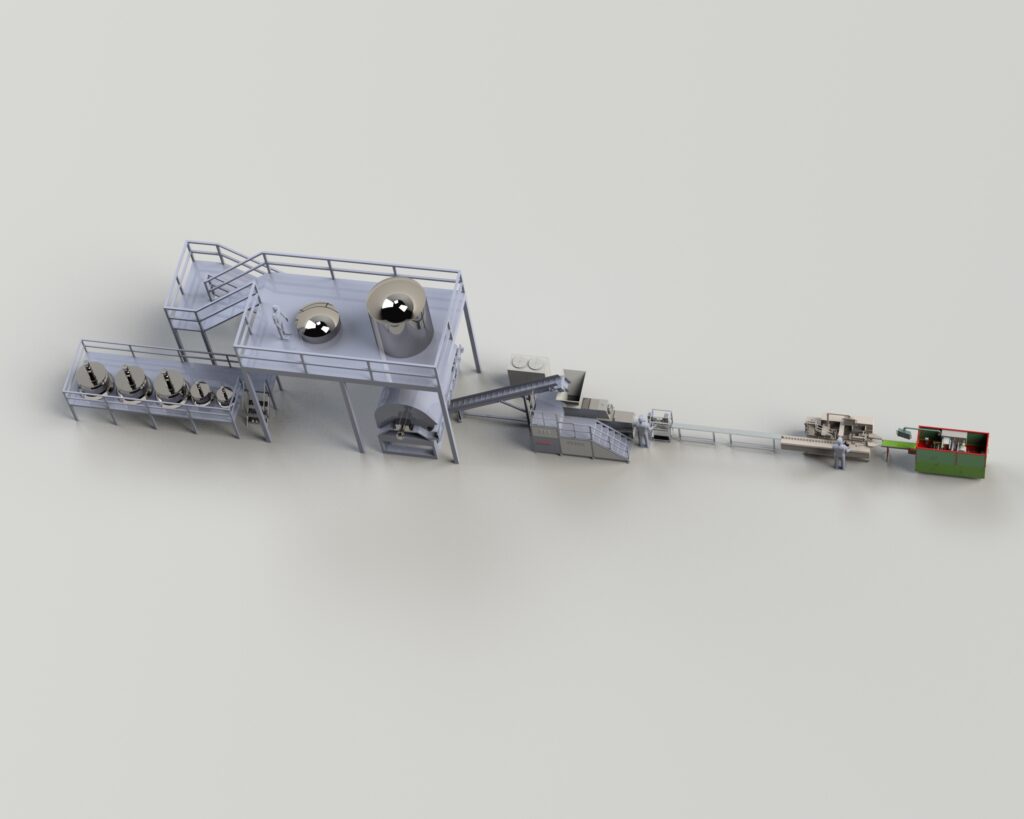
The global soap making machine market is accelerating. With a projected CAGR of 11% through 2033 and market value expected to climb from USD 509 billion in 2025 to USD 794 billion by 2033, equipment manufacturers and soap producers alike are navigating a trifecta of pressures: rising raw material costs, intensifying sustainability requirements, and the competitive necessity of automation.
This article examines the three structural forces shaping the soap equipment market in April 2026.
1. The Automation Race Is Already Underway
Demand for automated soap production equipment is no longer driven by efficiency aspirations alone — it is now a baseline competitive requirement. Google Trends data recorded a peak in searches for “high-speed soap filling and packaging lines” in February 2026, reflecting active procurement activity rather than passive research interest.
The technology profile of modern soap lines has shifted considerably:
- IoT-integrated control systems that monitor mixing ratios, temperature, and line speed in real time
- AI-assisted quality control for defect detection and batch consistency
- Predictive maintenance modules that reduce unplanned downtime by 20-35% (Cognitive Market Research, 2026)
- Rapid changeover architecture enabling SKU switching in under 30 minutes
For mid-scale manufacturers targeting 5,000-50,000 bars per day, semi-automatic lines with programmable logic controllers (PLCs) now represent the dominant investment category. Fully robotic lines are increasingly accessible to producers at the 100,000+ bars/day threshold.
2. Raw Material Supply Chains Are Being Restructured
Palm oil accounts for 70-80% of total operating costs in a typical soap manufacturing plant (IMARC Group, 2026). This concentration makes supply chain decisions critical — and in 2026, those decisions are being made under new constraints.
Asia remains the dominant supplier of soap noodles, controlling over 70% of global export volume:
| Country | 2024 Export Value | Key Advantage |
|---|---|---|
| Indonesia | ~USD 485 million | Largest palm oil base; low-cost production |
| Malaysia | ~USD 300 million | RSPO certification; preferred by EU/NA buyers |
| India | Regional scale | Production flexibility; South Asia focus |
The critical shift in 2026 is the growing buyer requirement for RSPO (Roundtable on Sustainable Palm Oil) certification. European and North American importers are increasingly mandating certified sustainable palm oil as a sourcing prerequisite. Blockchain-based traceability tools are also entering procurement workflows, allowing soap producers to verify origin claims at the batch level.
3. Market Fragmentation Is Expanding the Equipment Opportunity
The global bar soap segment was valued at USD 3.12 billion in 2026 (Business Research Insights), but growth is distributed across increasingly distinct product categories:
- Moisturizing and skin-care bars (leading segment)
- Antibacterial and medicated formulations
- Organic and artisanal handmade soaps
- Low-allergen variants for sensitive skin
- Multi-function formats (2-in-1 body and hair)
This fragmentation is driving strong demand for modular, reconfigurable equipment. The organic soap segment is particularly significant: valued at USD 7.57 billion in 2026 and growing at 5.86% CAGR (Mordor Intelligence).
Regional Outlook
Asia-Pacific leads new production capacity investment, with China and India recording liquid soap equipment adoption rates of 8.6% and 8.3% CAGR respectively through 2036. North America continues steady growth, driven by hygiene compliance requirements across healthcare and food service sectors.
Key Takeaways for Manufacturers in 2026
| Factor | 2026 Status | Equipment Implication |
|---|---|---|
| Automation demand | Accelerating (CAGR 11%) | Invest in PLC/IoT-enabled lines |
| Raw material sustainability | RSPO becoming mandatory | Ensure equipment handles plant-based inputs |
| Product fragmentation | Accelerating across all segments | Prioritize modular, rapid-changeover architecture |
| Supply chain traceability | Blockchain adoption growing | Equipment must support batch-level data logging |
| Asia-Pacific expansion | China/India leading growth | Regional support capability is a procurement criterion |
Data sources: Accio Business Insights (April 2026), Business Research Insights (March 2026), IMARC Group (2026), OleochemicalsAsia / Chemtradeasia (January 2026), Cognitive Market Research (2026), Mordor Intelligence (2026).