
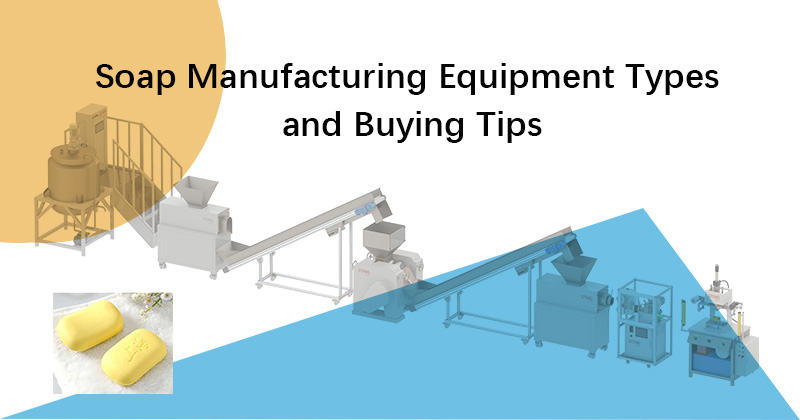
Soap making machines vary greatly depending on production scale and product type (handmade soap, industrial soap, or liquid soap), ranging from household starter kits to industrial assembly lines producing hundreds of kilograms per hour.
Common Types of Soap Making Equipment
A complete soap production line usually consists of multiple functionally independent machines, although all-in-one compact models are also available:
- Mixers & Reactors: Used for blending oils, lye, and additives (fragrances, colorants). Industrial-grade models typically employ stainless steel reactors with heating jackets.
- Roll Mills: Refine the soap base through three rotating rollers, resulting in a smoother texture and more uniform mixing.
- Plodders / Extruders: The core equipment for solid soap. It extrudes the soap mixture into continuous bars via screw compression. Two-stage vacuum plodders effectively remove air bubbles from the soap and improve hardness.
- Cutters: Precisely cut the extruded soap bars into fixed-length loaves.
- Stampers: Press brand logos or patterns onto soap blocks, available in manual, semi-automatic, and fully automatic models.
- Wrapping Machines: Automatically wrap, label, or box soap products.
Purchasing Considerations
- Material Requirements: Since soap production involves strong alkalis (caustic soda), all parts in contact with materials must be made of 304 or 316 stainless steel to prevent corrosion and ensure hygiene.
- Product Form: Solid toilet soap requires extrusion and cutting equipment; for hand wash, body wash, and similar liquid products, high-shear mixers and liquid filling lines are needed.
- Power Compatibility: Industrial equipment generally requires three-phase electricity (380V). Confirm that your factory’s power supply can support this before purchasing.
soap make machine ,soap making machine,soap production machine,toilet soap making machinery,soap machine,small production machine,soap line,soap production line,bathing soap making machinec,small soap plodder machine