
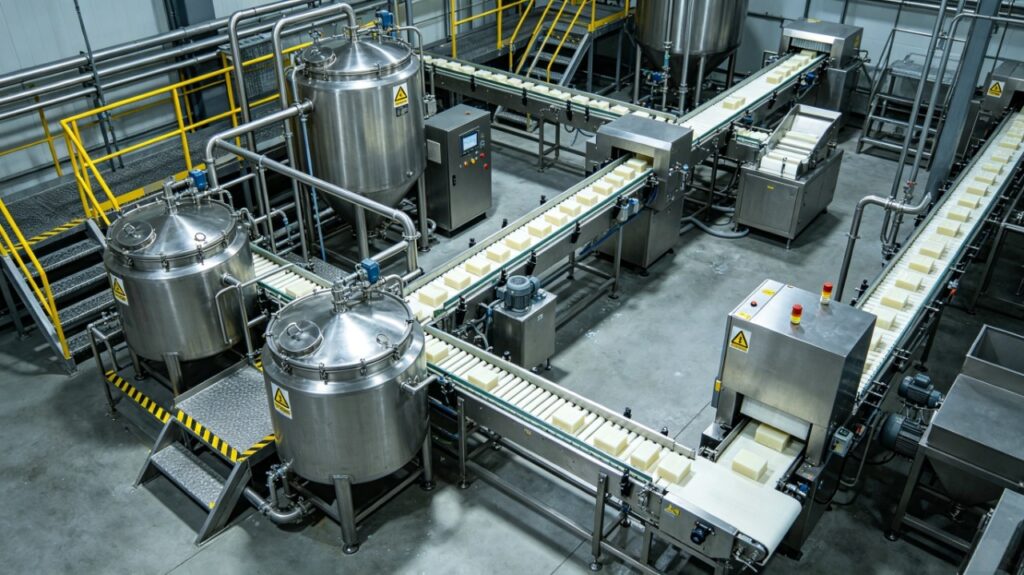
Industrial soap manufacturing involves hot caustic materials, high-speed machinery, and flammable substances. Yet safety is often the last item budgeted for—until an incident forces the issue. This guide covers the essential safety practices every soap factory operator needs, from raw material handling to finished-product palletizing.
Whether you run a 100 kg/h startup line or a 2,000 kg/h fully automated plant, the safety principles are the same. What changes is the scale, complexity, and regulatory scrutiny.
1. Chemical Hazard Management: Lye, Caustic Soda, and Fats
The most dangerous materials in any soap plant are the alkaline reagents—sodium hydroxide (NaOH) for bar soap and potassium hydroxide (KOH) for liquid soap. Both are highly corrosive, exothermic when dissolved, and capable of causing severe chemical burns on contact.
Caustic Soda (NaOH) — Key Hazard Data
| Parameter | Value |
|———–|——-|
| UN Number | UN 1823 (solid) / UN 1824 (solution) |
| Flash Point | Non-flammable |
| Dangerous Reaction | Reacts violently with water (exothermic); reacts with aluminum to release H₂ gas |
| Skin/Eye Exposure | Causes deep tissue burns; minimum first-aid: 15-minute water flush |
| TLV-C (ACGIH) | 2 mg/m³ (ceiling, not to be exceeded at any time) |
| Required PPE | Chemical-splash goggles, face shield, PVC gloves, chemical-resistant apron and boots |
Safe Handling Protocols
- Dissolve caustic slowly into cold water—never add water to dry NaOH. Always pour the solid into the water, stirring continuously, to control heat evolution.
- Store NaOH in sealed, clearly labeled HDPE containers away from moisture and incompatible materials (acids, aluminum, zinc).
- Maintain an emergency eyewash station within 10 seconds’ walking distance of any area where caustic is handled—this is a legal requirement under OSHA 29 CFR 1910.151 and equivalent EU/ASEAN regulations.
- Track all caustic deliveries and usage with a chemical inventory log; conduct monthly reconciliation.
Fats and Oils — Fire Risk
Rendered animal fats and some vegetable oils have flash points between 250°C and 320°C. While not classified as flammable liquids, overheated fat can ignite and sustain a grease fire. Keep fat melting tank temperatures below 180°C, install over-temperature cutoffs, and never use water to extinguish a fat fire (use Class K / wet chemical extinguishers).
3. Fire, Explosion, and Ventilation Controls
Soap plants that process high-glycerin inputs, operate solvent-based transparent soap lines, or use propylene glycol additives must treat fire and explosion risk as a primary engineering concern.
Hazardous Zone Classification
| Zone | Location | Atmosphere | Required Equipment Rating |
|——|———-|————|————————–|
| Zone 1 | Within 1 m of solvent storage/dispensing (transparent soap lines) | Occasional explosive atmosphere | Ex d or Ex e (ATEX Cat. 2G) |
| Zone 2 | 1–3 m of solvent dispensing | Infrequent explosive atmosphere | ATEX Cat. 3G minimum |
| Non-hazardous | Main production floor (no solvents) | Non-flammable | Standard industrial |
| Non-hazardous | Fat melting area (no solvents) | Non-flammable | Standard industrial |
For plants without solvent use (most bar soap facilities), fire risk is manageable through standard industrial controls:
- Ventilation: Maintain minimum 10 air changes per hour in enclosed mixing and melting areas. Install exhaust fans at low levels near floor drains where heavy caustic mist can accumulate.
- Fire suppression: Install sprinkler coverage over the entire production floor. Fat cooking areas require Class K suppression; electrical panels require gaseous systems (CO₂ or clean agent).
- Hot work permit: Issue a written permit for any welding, cutting, or grinding work in the production area. Clear a minimum 10-meter radius of combustibles before commencing.
- No smoking + antistatic footwear policies must be enforced at all entry points.
5. Emergency Response Preparedness and ROI of Safety Investment
Safety infrastructure is not just a compliance cost—it is a business risk management tool. A single lost-time injury in a soap plant typically costs $20,000–$80,000 in direct costs (medical, compensation, investigation) and 3–10× that in indirect costs (downtime, retraining, brand damage, regulatory penalties).
Emergency Response Requirements
- Emergency stop (E-stop) buttons: Located at each major machine and along every production aisle; tested weekly.
- Spill kits: Caustic-rated absorbent (not standard sawdust) at each mixing station. Minimum 50-liter capacity per kit.
- First aid station: Stocked and inspected monthly; at least one certified first-aider per shift.
- Emergency response plan (ERP): Written, site-specific plan covering chemical spill, fire, explosion, and medical emergency. Drill quarterly.
- Incident reporting system: All near-misses and incidents logged within 24 hours; root cause analysis completed within 5 working days.
Safety Investment Benchmarks and ROI
| Safety Investment Category | Typical Capital Cost | Expected Risk Reduction | Est. Payback Period |
|—————————|———————|————————|———————|
| Full LOTO program (procedures + hardware) | $2,000–$5,000 | 60–80% reduction in maintenance injuries | < 6 months |
| Machine guarding audit + upgrades | $5,000–$20,000 | 70–90% reduction in caught-in/struck-by incidents | 6–18 months |
| Chemical handling infrastructure (PPE + eyewash + spill kits) | $3,000–$8,000 | Prevents avg. $40K+ chemical burn claim | Immediate on first incident avoided |
| Ventilation upgrade | $8,000–$25,000 | Reduces respiratory illness and fire risk | 12–36 months |
| Safety management system (ISO 45001 certification) | $15,000–$40,000 (total program cost) | 20–40% overall incident rate reduction; enables export market compliance | 2–4 years |
For compliance references applicable to export markets, see the ILO Occupational Safety and Health guidelines and ISO 45001:2018 — Occupational Health and Safety Management Systems.