
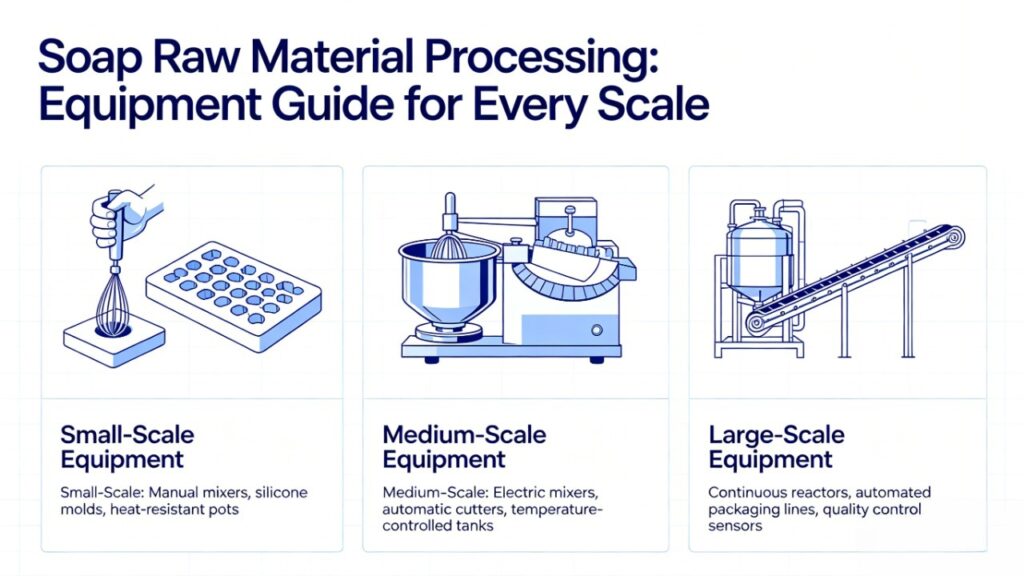
Raw materials make or break your soap. You can invest in the most advanced saponification reactor and finishing line on the market, but if your fats arrive contaminated, your lye is poorly mixed, or your feedstock temperature fluctuates, the finished bars will be inconsistent—or worse, fail quality checks entirely.
This guide covers the full upstream equipment chain: what it does, how to size it, and what to look for when evaluating suppliers. Whether you’re setting up a 500 kg/day artisan facility or a 5,000 kg/day industrial plant, the preprocessing logic is the same. Scale changes; the principles don’t.
Fat Melting and Heating Equipment
Most vegetable and animal fats arrive as solid or semi-solid blocks. Palm oil, tallow, and coconut oil all solidify below ~25°C. Before they can be pumped or dosed, they must be melted and held at the correct temperature for saponification—typically 60–80°C depending on the oil blend.
Types of Melting Equipment
| Equipment Type | Best For | Temperature Range | Capacity Range |
|—|—|—|—|
| Steam-jacketed tank | Palm oil, tallow, RBD oils | 60–95°C | 500 L–20,000 L |
| Electric heating tank | Smaller operations, clean power | 60–90°C | 200 L–5,000 L |
| Plate heat exchanger | Continuous flow operations | 50–120°C | 1,000–50,000 L/hr |
| Hot water coil tank | Low-cost option, lower precision | 55–80°C | 500 L–10,000 L |
Key selection criteria:
- Insulation quality: Tanks should have at least 50mm mineral wool or polyurethane foam insulation to reduce heat loss during holding periods.
- Agitation: A slow-speed paddle or anchor agitator (5–20 RPM) ensures uniform temperature throughout the tank. Without agitation, stratification causes cold spots.
- Material: Food-grade 304 stainless steel for edible-grade soap feedstock; carbon steel with epoxy lining is acceptable for industrial soap grades.
- Outlet valve design: Bottom-mounted butterfly or ball valves with flush seating prevent material buildup in dead zones.
For operations running two or more shifts, most factories maintain a pre-melt buffer tank between the delivery tank and the reactor feed pump. This ensures the reactor is never starved due to delivery delays.
Metering, Dosing, and Flow Control
The saponification reaction has a fixed stoichiometry: for every 1 kg of fat, a precise mass of NaOH is required (the saponification value varies by oil type—palm oil SAP value ≈ 0.141, coconut oil ≈ 0.190). Consistent product quality depends entirely on accurate dosing of both feedstreams.
Dosing Equipment Options
| Equipment | Accuracy | Flow Range | Best Application |
|—|—|—|—|
| Gear pump + flow meter | ±0.5–1% | 10–5,000 L/hr | Medium to large plants |
| Peristaltic pump | ±1–2% | 0.1–300 L/hr | Small plants, corrosive fluids |
| Diaphragm dosing pump | ±0.3–0.5% | 1–2,000 L/hr | High-precision lye dosing |
| Coriolis mass flow meter | ±0.1–0.2% | Wide range | High-accuracy systems |
Best practice: Pair a positive displacement pump (gear or diaphragm) with a Coriolis or magnetic flow meter and a PLC feedback loop. This combination maintains ±0.5% dosing accuracy even when tank levels and viscosity change throughout the shift.
Temperature compensation is often overlooked. Oils at 60°C have measurably different densities than at 80°C. A volumetric pump without temperature correction will introduce systematic dosing errors. Specify mass-based flow control wherever possible.
ROI Analysis: Investing in Upstream Equipment
Manufacturers sometimes underspend on preprocessing, viewing it as “just storage tanks and pumps.” This is a costly mistake. The table below shows how proper upstream equipment investment pays back across different plant scales.
| Plant Scale | Basic Setup Cost | Optimized Preprocessing Add-on | Annual Savings (waste reduction + consistency gains) | Simple Payback |
|—|—|—|—|—|
| 500 kg/day | $15,000 | +$8,000 | $6,000–$9,000/yr | 10–16 months |
| 1,500 kg/day | $35,000 | +$18,000 | $18,000–$28,000/yr | 8–12 months |
| 5,000 kg/day | $90,000 | +$45,000 | $55,000–$80,000/yr | 7–10 months |
Where the savings come from:
- Reduced waste: Precise dosing eliminates saponification failures and off-spec batches (typically 1–3% of output at under-equipped plants)
- Lower energy costs: Insulated, temperature-controlled tanks reduce reheating cycles
- Labor savings: Automated dosing and monitoring replace 1–2 operator hours per shift
- Longer equipment life: Correct feedstock temperatures reduce wear on reactor agitators and pumps
The upstream investment typically costs 20–35% of the total line budget but accounts for 60–70% of quality consistency outcomes.
Get Your Preprocessing System Right From Day One
Preprocessing equipment isn’t glamorous. It doesn’t appear in product photos, and customers don’t ask about it. But every batch of soap that passes quality control—or fails it—traces back to how well the raw materials were prepared.
If you’re planning a new soap production line or upgrading an existing one, the preprocessing section deserves as much attention as any downstream machine.
Our team at STING has supplied complete soap production lines to manufacturers across Africa, Southeast Asia, and the Middle East. We can help you size and specify the right upstream equipment for your output target, raw material mix, and budget.
📩 Contact us today to discuss your projec or reach out via our product pages for a detailed equipment proposal and quotation.