
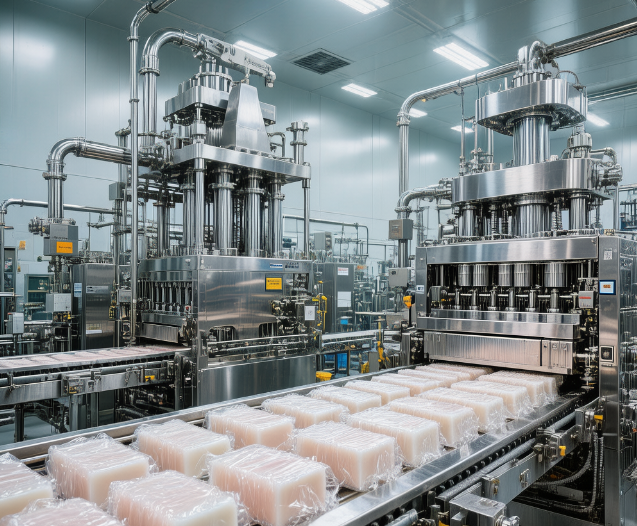
1. Market Sizing in 2026: Converging Forecasts Confirm Robust Growth
Multiple research firms have published updated forecasts for the soap production line and equipment market in the first half of 2026. While absolute values vary by methodology and scope, the directional consensus is unambiguous: the market is growing steadily, and automation-adjacent segments are pulling ahead of the overall rate.
| Metric | Value | CAGR | Source |
|---|---|---|---|
| Soap Production Line Market (2025) | USD 50.90B | 5.6%–8.4% | Spherical Insights / Cogn. Market Research |
| Soap Production Line (2035) | USD 88.05B | 5.6% | Spherical Insights (May 2026) |
| Liquid Soap Market (2025–2036) | USD 23.0B → USD 49.7B | 7.2% | Accio |
| Bath Soap Market (2026–2034) | USD 25.48B → USD 34.94B | 3.6% | Accio |
| Handmade Soap Market (2026–2035) | USD 0.18B → USD 0.31B | 6.64% | Business Research Insights |
| Automation Equipment Segment | N/A | 11.0% | Industry consensus |
| Sustainable Mfg. Equipment (2026) | USD 253.5B → USD 310.2B (2035) | 2.3% | GM Insights (Jan 2026) |
The CAGR spread between automation equipment (11%) and the overall production line market (5.6%–8.4%) signals that manufacturers are investing disproportionately in smart, connected, and self-monitoring systems. This premium growth is concentrated in IoT-enabled lines, AI-driven quality control, and predictive maintenance modules — capabilities that command higher unit prices and deliver measurable ROI through downtime reduction and yield optimization.
2. The Automation Landscape: From Peak Interest to Operational Deployment
Google Trends data shows that search interest for “high-speed soap filling and packaging line” hit a normalized peak score of 100 in February 2026 — the highest reading on record. This is not idle curiosity. The signal translates directly into procurement activity, particularly in Asia-Pacific where factory expansions are underway at scale.
The automation push is being driven by four converging pressures:
- Labor cost escalation. Fully automatic lines covering mixing, filling, cutting, stamping, and packaging now target 100,000+ bars/day capacity, reducing per-unit labor costs by 40–60% compared to semi-automatic configurations.
- Quality consistency mandates. AI-driven quality control systems — using inline vision inspection and gravimetric dosing — are being adopted across high-capacity lines to reduce defect rates below 0.5%.
- Predictive maintenance economics. The global predictive maintenance market is projected to reach USD 91 billion by 2033. For soap equipment operators, this means sensor-equipped plodders, cutters, and packaging lines that alert operators to bearing wear, motor anomalies, or temperature drift before unplanned stoppages occur.
- Regulatory compliance automation. RSPO certification traceability, EU packaging waste directives, and FDA GMP requirements are pushing equipment OEMs to integrate blockchain-capable batch tracking directly into PLC architectures.
On the competitive front, the equipment landscape remains fragmented but is consolidating at the high end. European OEMs — SAS Soap Machines (Milan), Mazzoni LB (Bologna), and Binacchi & Co. (Parma) — continue to dominate premium installations across 100+ countries. Chinese manufacturers including Nantong Sting Machinery and Jinan Yuxiang Machinery are capturing mid-market share with cost-effective automation solutions, while Indian firms such as Adhisakthi Projects and Sakun Engineers serve the high-volume, price-sensitive segment across South and Southeast Asia.
3. The Handmade Soap Paradox: Small-Scale Growth at Industrial Speed
While the automation narrative dominates industry headlines, the handmade soap segment presents a counterintuitive growth story that has direct implications for equipment manufacturers. The global handmade soap market is estimated at USD 0.18 billion in 2026, growing at 6.64% CAGR toward USD 0.31 billion by 2035 — a rate that outpaces the mature bath soap segment (3.6% CAGR) by a wide margin.
Several data points from Business Research Insights illustrate why this matters for equipment suppliers:
| Statistic | Value | Implication for Equipment Makers |
|---|---|---|
| Consumers avoiding chemical soaps | 74% | Demand for natural formulation lines with minimal processing |
| Cold Process (CP) market share | 45% | Equipment that preserves glycerin without industrial drying steps |
| Online/Digital retail sales share | 58% | Small-batch packaging equipment for e-commerce fulfillment |
| Brands adopting vegan formulations | 57% | Flexible mixing systems for varied botanical ingredient inputs |
| Producers citing quality inconsistency | 41% | Semi-automatic precision equipment for artisanal scale-up |
The critical insight is that 41% of handmade soap producers report inconsistent product quality due to manual production methods, and 42% cite high production costs as a barrier to scaling. These pain points create a clear market opening for semi-automatic, small-batch production equipment — compact mixing and molding systems that deliver industrial precision at artisanal scale. The organic soap market, valued at USD 7.57 billion in 2026, further validates that this is not a niche trend but a structural shift in consumer preference.
4. Green Manufacturing Economics: From Compliance Cost to Competitive Advantage
The sustainable manufacturing equipment market — spanning all industrial sectors — is valued at USD 253.5 billion in 2026 and projected to reach USD 310.2 billion by 2035 (2.3% CAGR), according to GM Insights. While the soap equipment segment represents a fraction of this total, the regulatory and market forces driving green manufacturing are directly reshaping soap production line design and procurement criteria.
Key developments in the green manufacturing space that affect soap equipment buyers include:
- EU Net Zero Industry Act. Mandating 40% domestic clean tech production by 2030, this regulation incentivizes European soap manufacturers to invest in energy-efficient production lines with renewable energy integration — creating export demand for equipment that meets EU environmental standards.
- AI-driven energy management. Real-time monitoring of energy consumption per unit of soap produced is becoming a standard PLC feature. Digital twin simulations allow operators to optimize production parameters before physical implementation, reducing waste and energy costs by an estimated 12–18%.
- Circular economy equipment design. Equipment designed for durability, recyclability, and closed-loop material recovery is gaining preference in procurement processes. Modular designs that allow incremental upgrades — rather than full line replacement — align with both sustainability goals and capital efficiency.
- Third-party certification leverage. ISO 14001 and Cradle to Cradle certifications are increasingly embedded in supplier selection criteria, particularly among multinational FMCG companies that source soap equipment for global facility networks.
5. Regional Dynamics: The Three-Speed Market
Regional growth rates for soap equipment demand diverge significantly, creating what is effectively a three-speed market:
| Region | Growth Rate | Primary Demand Driver | Equipment Priority |
|---|---|---|---|
| Asia-Pacific | 8.3%–8.6% | Urbanization, hygiene awareness, SME expansion | Cost-effective automation, modular lines |
| North America | 7.8% | Institutional demand, compliance upgrades | Smart monitoring, energy-efficient systems |
| Europe | Moderate (3–5%) | Green Deal compliance, premium formulations | Sustainability-certified, precision dosing |
| India | 8.3% | Middle-class growth, domestic FMCG expansion | High-volume, semi-auto to full-auto transition |
| Middle East & Africa | Emerging | Halal certification, greenfield facilities | Turnkey solutions, halal-compliant lines |
China and India continue to lead in volume terms, but the equipment requirements differ substantially. Chinese manufacturers are investing in fully automated, high-speed lines to serve both domestic consumption and export markets. Indian buyers, by contrast, are predominantly upgrading from semi-automatic to fully automatic configurations, creating strong demand for modular conversion kits that retrofit existing lines with PLC controls, servo-driven cutters, and automated packaging stations.
6. Technology Watch: What’s New in Soap Equipment Engineering
Spherical Insights’ mid-2026 analysis of the top 30 companies in the global soap production line market highlights several notable technical developments:
- Rapid changeover systems. The “rapid changeover revolution” in bar soap lines is addressing product fragmentation — the shift from single-SKU high-volume runs to multi-SKU shorter batches. Magnetic die plates, servo-adjustable cutter gaps, and recipe-driven PLC parameter loading are reducing changeover times from hours to under 15 minutes.
- Modular liquid soap filling. Equipment configurations that allow easy addition of fragrance injectors, active ingredient dosing modules, or viscosity adjustment stations without stopping production are in strong demand across Asia-Pacific, where functional soap variants (antibacterial, vitamin-enriched, skin-specific) are proliferating.
- MidSolid Press & Pour capacity expansion. In April 2026, MidSolid Press & Pour doubled its manufacturing capacity, explicitly targeting enhanced private-label capabilities — a signal that contract manufacturing of soap is itself becoming a growth market that requires flexible, multi-format equipment.
- Blockchain traceability integration. Equipment OEMs are embedding RSPO palm oil traceability and raw material sourcing verification into batch management systems, responding to EU deforestation regulation and consumer demand for supply chain transparency.
7. Outlook: A Stratified Market Demands Stratified Equipment Strategies
The soap equipment market in mid-2026 is no longer a monolith. It is stratifying into three distinct but interconnected competitive arenas:
Arena 1 — Scale Automation. High-speed, fully automatic lines serving multinational FMCG manufacturers and large domestic producers. Equipment priorities: throughput (100K+ bars/day), predictive maintenance, energy efficiency, and regulatory compliance. Growth rate: 11% CAGR.
Arena 2 — Flexible Production. Modular, multi-format lines capable of handling bar soap, liquid soap, and specialty formulations on the same platform. Equipment priorities: rapid changeover, recipe management, and scalable capacity. Growth rate: 7–8% CAGR.
Arena 3 — Artisanal & Sustainable. Semi-automatic, small-batch systems serving organic, handmade, and eco-certified brands. Equipment priorities: natural formulation compatibility, precision dosing of botanical ingredients, and minimal processing footprints. Growth rate: 6.6% CAGR (handmade) with the broader sustainable manufacturing equipment market providing additional tailwinds.
For equipment manufacturers, the strategic imperative is clear: a single product line cannot serve all three arenas effectively. The most competitive OEMs in 2026 are those that have developed differentiated platforms — or at minimum, modular base architectures — that can be configured for each segment without requiring ground-up engineering for every customer request.
With the market on track to reach USD 88 billion by 2035, the equipment companies that align their R&D and go-to-market strategies with this three-arena framework will be best positioned to capture disproportionate value from the next decade of soap industry growth.