
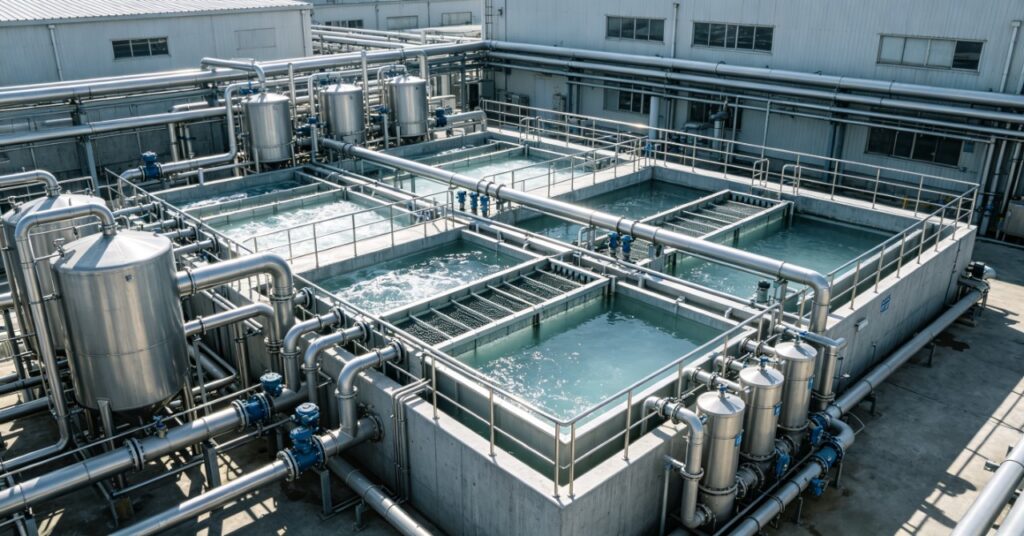
Soap manufacturing generates wastewater that is far more complex than municipal sewage. A single batch saponification reactor can discharge effluent with BOD levels 50–100 times higher than domestic wastewater, loaded with residual fats, lye, surfactants, and suspended solids. Without proper treatment, that effluent will violate discharge permits, trigger regulatory fines, and—in many markets—shut down your operation entirely.
This guide breaks down the treatment technologies, equipment specifications, and investment models you need to build a compliant, cost-effective effluent treatment plant (ETP) for a soap production facility. Whether you run a 100 kg/hr artisan-scale line or a 2,000 kg/hr integrated plant, the principles are the same; only the equipment scale changes.
Why Soap Wastewater Is Different
Soap effluent is chemically distinct from most industrial wastewater streams. Understanding what you’re dealing with is the first step to choosing the right treatment system.
Primary pollutants in soap manufacturing effluent:
- Free fatty acids (FFAs) and oils/grease — from saponification reactions, lye-refining wash water, and equipment cleaning
- Alkalis (NaOH/KOH residuals) — high pH (often 10–13) from lye carryover and caustic rinses
- Total Dissolved Solids (TDS) — salts generated as by-products of saponification
- Biochemical Oxygen Demand (BOD) and Chemical Oxygen Demand (COD) — from organic raw material carryover
- Suspended Solids (SS) — soap particles, wax, and particulate carry-over from filling and washing operations
- Surfactants — synthetic detergent ingredients in laundry or syndet bar lines
Typical soap effluent characteristics before treatment:
| Parameter | Raw Soap Effluent | Typical Discharge Limit (WHO/EU) |
|—|—|—|
| pH | 10–13 | 6.5–8.5 |
| BOD₅ (mg/L) | 800–2,500 | 30–50 |
| COD (mg/L) | 1,500–5,000 | 125–250 |
| Oil & Grease (mg/L) | 200–600 | 10–15 |
| Total Suspended Solids (mg/L) | 300–800 | 35–60 |
| Surfactants (mg/L) | 50–300 | 0.5–2 (MBAS) |
Sources: WHO Effluent Quality Guidelines; EU Water Framework Directive 2000/60/EC
The gap between raw effluent and discharge limits is large. A well-designed ETP typically needs 95–99% BOD removal and a pH correction of 4–7 units.
Core Treatment Stages and Equipment
A complete ETP for a soap factory typically runs through four sequential treatment stages. Each stage targets a specific class of pollutants.
Stage 1 — Primary Treatment: Screening and Equalization
Purpose: Remove large solids, stabilize flow and load variations before downstream treatment.
| Equipment | Function | Key Spec |
|—|—|—|
| Bar screen / rotary drum screen | Capture soap chips, packaging fragments | Aperture 1–3 mm |
| Grease trap / API oil-water separator | Skim free-floating fats and oils | Retention time 20–30 min |
| Equalization tank | Buffer peak loads; homogenize pH and concentration | HRT 8–24 hr; mixing with submersible agitator |
| pH neutralization reactor | Dose dilute H₂SO₄ or CO₂ to reduce alkalinity | Target pH 7–8.5 before biological stage |
Equipment sizing rule: Equalization tank volume = average daily flow (m³/day) × peak-to-average ratio (typically 2.5–3.5 for batch soap lines). A 500 kg/hr production line generating ~8 m³/hr of effluent requires a 60–80 m³ equalization tank.
Stage 2 — Physicochemical Treatment: DAF and Coagulation
Purpose: Remove emulsified fats, colloidal particles, and suspended solids that pass primary screens.
Dissolved Air Flotation (DAF) is the workhorse of soap effluent treatment. It is far more effective than gravity settling for emulsified soap-water systems because soap molecules actively prevent fat droplets from coalescing.
- Operating principle: Pressurized water (40–80 psi) is supersaturated with air, then released at the DAF inlet; micro-bubbles (10–100 µm) attach to fat/SS particles and float them to the surface for skimming.
- Coagulation/flocculation: Aluminum sulfate (alum) or polyaluminum chloride (PAC) is dosed upstream of DAF at 50–150 mg/L to destabilize emulsions and form settleable flocs.
DAF unit parameters by plant scale:
| Plant Scale (kg/hr) | Effluent Flow (m³/hr) | DAF Surface Area (m²) | Power Draw (kW) | Capital Cost (USD) |
|—|—|—|—|—|
| 100–200 | 1.5–3 | 4–8 | 2–4 | $8,000–$18,000 |
| 200–600 | 3–10 | 8–20 | 4–11 | $18,000–$45,000 |
| 600–1,200 | 10–20 | 20–40 | 11–22 | $45,000–$90,000 |
| 1,200–2,000 | 20–35 | 40–70 | 22–38 | $90,000–$160,000 |
A well-operated DAF system with coagulation can achieve:
- Oil & Grease removal: 85–95%
- Suspended Solids removal: 80–92%
- BOD removal (primary): 40–60%
Stage 3 — Biological Treatment: Activated Sludge or MBR
Purpose: Biologically degrade dissolved organic matter (BOD/COD) to meet discharge limits.
Two technologies dominate at soap factory scale:
Option A — Conventional Activated Sludge (CAS)
The most widely deployed biological treatment system globally. Wastewater passes through an aeration tank where a mixed microbial culture oxidizes BOD, followed by a secondary clarifier that settles and recycles sludge.
- BOD removal efficiency: 90–97%
- HRT (hydraulic retention time): 6–12 hours
- Sludge production: 0.3–0.5 kg SS per kg BOD removed
- Best for: plants >300 kg/hr; stable flow; ≥3 dedicated operators
Option B — Membrane Bioreactor (MBR)
Combines biological treatment with ultrafiltration membrane separation. No secondary clarifier needed; the membrane provides a physical barrier that produces near-potable effluent quality.
- BOD removal efficiency: 98–99.5%
- Effluent TSS: <5 mg/L (vs. 20–30 mg/L for CAS)
- Footprint: 40–60% smaller than equivalent CAS system
- Capital cost premium: 30–50% more than CAS
- Best for: water-scarce regions; strict discharge limits; plants with reclaimed water reuse goals
Biological treatment comparison:
| Criteria | Activated Sludge (CAS) | Membrane Bioreactor (MBR) |
|—|—|—|
| BOD Removal | 90–97% | 98–99.5% |
| Footprint | Larger | 40–60% smaller |
| Capital Cost | Baseline | +30–50% |
| Energy Use | 0.3–0.5 kWh/m³ | 0.8–1.5 kWh/m³ |
| Operator Skill Required | Moderate | High |
| Effluent Reuse Potential | Limited | High (process water, cooling) |
| Sludge Generation | High | 30–50% less |
Stage 4 — Polishing and Sludge Handling
Purpose: Final removal of residual surfactants, color, and odor; dewater and dispose of sludge.
- Activated carbon filtration or ozone dosing: Reduces surfactant concentrations (MBAS) from 10–30 mg/L to <0.5 mg/L; eliminates color and odor
- Sand/multimedia filters: Polish TSS to <10 mg/L before discharge or reuse
- Sludge dewatering: Belt press or centrifuge reduces sludge moisture from 97–98% (wet sludge) to 75–80% (dewatered cake), cutting volume and disposal cost by 5–10×
- Dewatered cake disposal: Co-composting with agricultural waste (high fat content = energy-rich compost feedstock), incineration, or landfill depending on local regulation
Equipment Selection Criteria by Plant Scale
The right ETP configuration depends on three variables: daily effluent volume, local discharge limits, and reuse ambitions.
| Plant Capacity | Daily Effluent | Recommended ETP Configuration | Approximate ETP Capital Cost (USD) |
|—|—|—|—|
| 50–150 kg/hr | 5–15 m³/day | Screen + grease trap + equalization + DAF + aerobic reactor (SBR) | $25,000–$60,000 |
| 150–500 kg/hr | 15–50 m³/day | Screen + API separator + equalization + DAF + CAS + sand filter | $60,000–$160,000 |
| 500–1,200 kg/hr | 50–120 m³/day | Screen + DAF + equalization + CAS or MBR + AC filter + sludge dewatering | $160,000–$380,000 |
| 1,200–2,000 kg/hr | 120–200 m³/day | Full ETP with MBR + reclaimed water system + online monitoring | $380,000–$700,000 |
Notes:
- ETP cost = 8–15% of total production line CAPEX is a widely used industry benchmark
- Operating cost typically runs $0.8–$2.5 per m³ of treated effluent, depending on technology and local energy prices
- Zero Liquid Discharge (ZLD) systems are available but add 40–60% to ETP cost; warranted only in water-scarce locations or where discharge fees are very high
ROI and Compliance Investment Analysis
Soap factories often resist ETP investment because the payback is less visible than production equipment. The analysis below reframes the economics.
Scenario: 400 kg/hr soap production line, Southeast Asia/Africa market
| Cost Category | Without ETP (Penalty Exposure) | With Compliant ETP |
|—|—|—|
| Regulatory fine risk (annual) | $15,000–$80,000 | $0 |
| Discharge fee (if permitted, 30 m³/day) | $0 | $12,000–$25,000/yr |
| Production shutdown risk (5 days/yr) | $40,000–$120,000 lost revenue | Minimal |
| Water reuse savings (MBR, 30% recycle) | $0 | $8,000–$18,000/yr |
| Brand/export market access premium | Not achievable | Enables ISO 14001, GMP compliance |
| ETP capital cost | — | $80,000–$130,000 |
| Simple payback period | — | 18–30 months |
Key cost drivers to optimize:
1. Equalization tank sizing — Oversizing by even 20% significantly lowers downstream unit sizes and operating costs
2. DAF coagulant selection — Switching from alum to PAC typically cuts coagulant dose by 30–40% and reduces sludge volume
3. Aeration system efficiency — Fine-bubble diffusers use 30–50% less energy than coarse-bubble for the same oxygen transfer rate
4. Sludge handling — A belt press paying $18,000–$35,000 typically saves $12,000–$25,000/yr in disposal costs vs. liquid sludge haulage
For a deeper look at how the production line upstream affects effluent quality and volume, see our guide on saponification equipment selection—proper reaction completeness is the single largest factor in reducing organic load in effluent.
Regulatory Compliance and Monitoring
ETP investment without a monitoring and reporting system is only half the job. Most markets now require continuous or periodic effluent monitoring as a condition of the discharge permit.
Minimum monitoring requirements for soap factory ETP:
- Online pH meter and flow meter — mandatory in most jurisdictions; data logged to compliance records
- Periodic lab sampling — BOD, COD, oil/grease, TSS typically monthly; surfactants (MBAS) quarterly
- Sludge disposal manifests — chain-of-custody documentation for dewatered cake
- Discharge permit renewal — annual self-monitoring reports in most markets
International standards and frameworks applicable to soap factory effluent:
- ISO 5667-3: Water Quality — Sampling Guidance — defines effluent sampling procedures
- US EPA NPDES Effluent Guidelines (Soap and Detergent Category 40 CFR Part 417) — the most comprehensive industry-specific discharge standard globally
Factories supplying export markets (EU, US, GCC) increasingly need to demonstrate environmental compliance as part of supplier qualification. An ISO 14001-certified EMS supported by a functional ETP is rapidly becoming a procurement prerequisite.