
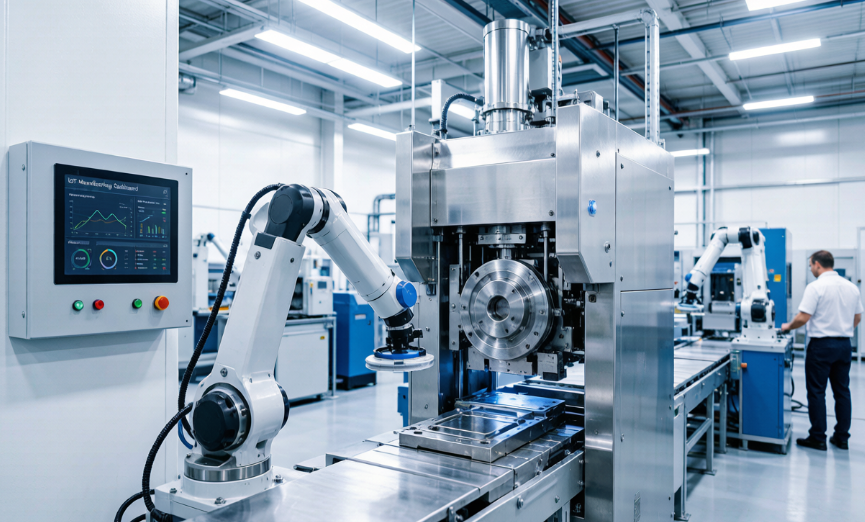
Summary: As July 2026 closes, the soap equipment industry faces a dual pressure point: crude palm oil prices hovering near RM4,577/tonne with El Niño threats tightening the 2027 supply outlook, while stamping machine precision and automation efficiency emerge as the critical competitive differentiators. This article synthesizes the latest palm oil market data, stamping machine segment dynamics, and automation adoption benchmarks to map the H2 2026 equipment procurement landscape.
1. The Landscape: Three Forces Converge
Late July 2026 finds soap manufacturers navigating three simultaneous forces: raw-material cost escalation driven by palm oil supply dynamics, equipment precision requirements intensifying across the stamping segment, and automation efficiency shifting from competitive advantage to operational baseline. The global soap production line market, valued at USD 50.95 billion in 2025 and projected to reach USD 79.38 billion by 2033 (CAGR 5.7%), continues its structural expansion — but the distribution of value is tilting decisively toward precision and digitization rather than sheer throughput.
The stamping machine segment alone — valued at USD 222.3 million in 2026 by Research & Markets, growing at 6.1% CAGR to USD 357 million by 2034 — exemplifies the broader shift: buyers are no longer evaluating machines on speed alone. Die-changeover time, pressure consistency across multi-cavity configurations, and IoT-enabled quality tracking now dominate procurement criteria. Meanwhile, 38% of equipment manufacturers now integrate AI-based monitoring systems achieving 19% defect-detection improvement, and 54% are developing eco-friendly machinery with 22% energy reduction targets (Kingpin Market Research, 2026).
2. Palm Oil: The Cost Anchor Tightening
Crude palm oil (CPO) — the primary feedstock for soap manufacturing — closed early July 2026 at RM4,577/tonne on Bursa Malaysia, supported by firmer crude oil prices and escalating geopolitical tensions in West Asia (ChemAnalyst, July 8, 2026). The Malaysian Palm Oil Council (MPOC) projects July prices in the RM4,400–RM4,650 range, with upside risk from a strengthening El Niño pattern that could reduce global palm oil output by 2–5% year-on-year by 2027.
June 2026 data from the Malaysian Palm Oil Board (MPOB) revealed a mixed supply picture:
| Metric | June 2026 | May 2026 | MoM Change |
|---|---|---|---|
| CPO Production | 1.64M tonnes | 1.52M tonnes | +8.08% |
| Total Stocks | 2.54M tonnes | 2.43M tonnes | +4.78% |
| Exports | 1.20M tonnes | 1.13M tonnes | +6.19% |
| CPO Futures (Sep 2026) | RM4,609/tonne (July 8 close) | +RM62 | |
The structural driver behind elevated prices extends beyond seasonal production cycles. Indonesia’s B50 biodiesel mandate — implemented July 1, 2026 — is diverting an estimated 17.6 million kiloliters of CPO from export markets into domestic fuel blending. Combined with Malaysia’s progression toward B15, the net effect is a permanent reduction in the exportable palm oil surplus available to oleochemical and soap manufacturers. FOB Malaysian port prices for RBD Palm Oil stood at USD 1,135/MT and CPO at USD 1,103/MT as of July 3, 2026 (Mars Oleochemicals).
Implication for Equipment Buyers: Elevated and volatile palm oil costs increase the payback period for raw-material waste. Equipment with precise gravimetric dosing, low-scrap stamping, and real-time yield monitoring delivers higher ROI when feedstock costs RM4,500+/tonne. Expect procurement RFPs to weight material efficiency above nameplate throughput through H2 2026.
3. Stamping Precision: The USD 222M Segment Under Transformation
The soap stamping machine segment — often overlooked as a commodity finishing step — is undergoing its most significant technology upgrade cycle in a decade. Research & Markets values the segment at USD 222.3 million in 2026, growing to USD 357 million by 2034 at 6.1% CAGR, while MarkWide Research cites USD 187.4 million growing to USD 285.77 million by 2035 at 4.80% CAGR. The variance reflects different segmentation boundaries, but the directional signal is consistent: stamping is outpacing broader equipment growth.
| Stamping Technology | Market Share (2026) | Key Advantage | Primary Adopters |
|---|---|---|---|
| Rotary Stamping | ~45% | High throughput, consistent impression depth | Large-scale FMCG producers |
| Cam-based / Pneumatic | ~35% | Precision die geometry, custom branding | Mid-tier & private-label manufacturers |
| Electric / Servo-Electric | ~20% | Energy efficiency, ±0.5% pressure accuracy | EU & Japan premium lines; fastest-growing |
Three demand-side shifts are accelerating the stamping upgrade cycle:
- Private-label SKU proliferation: Contract manufacturers serving supermarket and pharmacy chains are managing 40–60% more SKUs than three years ago. Rapid-die-changeover systems that reduce tooling time from 2–4 hours to 15–30 minutes are becoming purchase prerequisites (MarkWide Research, 2026).
- Regulatory surface-contact compliance: REACH mandates in Europe and FDA cosmetic GMP guidelines in the US are tightening material composition requirements for stamping dies and product-contact surfaces, triggering replacement cycles for legacy equipment in export-oriented workshops.
- Artisanal-to-industrial convergence: Boutique organic soap brands scaling from 5,000 to 50,000 bars/week are discovering a “missing middle” in stamping equipment — manual presses are too slow, and full industrial rotary lines are overcapitalized. Electric-pneumatic hybrid architectures are filling this gap.
Indian manufacturers — including Kailash Engineering Works, Adhisakthi Projects, and Sakun Engineers — are actively promoting multi-cavity and pneumatic stamping models for 2026 production planning, supported by India’s PLI scheme incentives for domestic machinery manufacturing. Concurrently, Italian leader SAS Mariani updated its Condor 200 soap press and Savonpack America bundler in 2025, signaling that even established players see stamping as a line-integration play rather than a standalone machine sale.
4. Automation Efficiency: From Pilot to Production Standard
The automation adoption curve in soap manufacturing has crossed a meaningful threshold in 2026. Kingpin Market Research’s innovation survey of soap production line manufacturers reveals a clear technology hierarchy:
| Innovation Category | Adoption Rate | Performance Gain |
|---|---|---|
| Eco-friendly / energy-efficient machinery | 54% | 22% energy consumption reduction |
| Modular production architecture | 49% | 18% flexibility improvement; 3–4 processes integrated |
| AI-based monitoring & quality control | 38% | 19% defect detection improvement |
| Multi-functional equipment (3–4 processes) | 34% | 17% space reduction |
| Reduced-maintenance system design | 32% | 21% maintenance frequency reduction |
| High-speed extrusion units | 30% | 25% output increase |
| Customizable/configurable production lines | 28% | 23% diverse product requirement coverage |
| Digital control panels / HMI upgrades | 26% | 20% operational accuracy improvement |
Source: Kingpin Market Research, Soap Production Line Market Report 2026.
A notable pattern: sustainability-driven innovation (54%) now outpaces pure throughput innovation (30%). The implication is clear — buyers are prioritizing total cost of ownership (energy + maintenance + changeover + waste) over nameplate capacity. This is consistent with broader industrial equipment trends: Spherical Insights’ 2026 analysis of the Top 30 soap production line companies identifies “IoT and smart monitoring systems” and “energy-efficient machinery” as two of the top three market-shaping trends, alongside automation.
The liquid soap equipment sub-segment continues to grow faster than bar soap, at 7.2% CAGR through 2036 (Future Market Insights), driven by Asia-Pacific adoption (China 8.6%, India 8.3%) and North American healthcare/hospitality compliance requirements.
5. Regional Demand Signals: Where the Orders Are
| Region | Equipment CAGR | Demand Driver | Procurement Signal |
|---|---|---|---|
| China | 8.6% | Liquid soap capacity expansion; smart-city hygiene infrastructure | High-speed filling & packaging; IoT-enabled lines |
| India | 8.3% | PLI scheme incentives; domestic machinery procurement shift | Multi-cavity stamping; semi-automatic lines |
| North America | 7.8% | Healthcare/hospitality compliance; private-label expansion | FDA GMP-compliant; modular reconfigurable lines |
| Southeast Asia | 6.2% | Industrialization; proximity to palm oil feedstock | Full-line turnkey; saponification-to-finishing |
| Europe | 5.2% | REACH compliance upgrades; energy-cost-driven retrofits | Servo-electric stamping; energy-recovery systems |
| MEA | 5.3% | Population growth; hygiene infrastructure investment | Cost-competitive semi-automatic; local support |
Sources: Accio, Future Market Insights, MarkWide Research, Spherical Insights. CAGRs reflect liquid/bar soap equipment combined where available; regional segmentation varies by source.
6. H2 2026 Procurement Checklist: Seven Decision Criteria
For soap manufacturers evaluating equipment investments in the second half of 2026, the following seven criteria should anchor any procurement decision:
- Material yield rate: At RM4,500+/tonne CPO, a 2% yield improvement on a 5,000-tonne/year line saves RM450,000 annually. Demand gravimetric dosing and real-time yield monitoring as standard, not optional.
- Die-changeover time: Target ≤ 20 minutes for multi-SKU lines. The cost of a 2-hour changeover at 250 production days/year is approximately 500 lost production hours — equivalent to 21 full days.
- Energy consumption per tonne: Modern 2,000 kg/h lines consume approximately 0.043 kWh/kg versus 0.107 kWh/kg for legacy 300 kg/h lines (60.3% reduction). Verify vendor energy curves across your target throughput range.
- AI/vision QC integration readiness: 38% of new equipment now ships with AI-based defect detection. If your line will run 3+ SKUs with distinct visual specifications, specify vision QC at purchase — retrofitting costs 2–3× more.
- Modularity for formulation pivots: Plant-based and biodegradable formulations require different mixing, molding, and stamping parameters. Modular architectures allow recipe changes without full-line retooling.
- Regulatory documentation package: For export-oriented lines, verify CE + FDA dual-certification readiness upfront. Multi-jurisdiction validation adds 6–12 months to procurement timelines when addressed retroactively.
- Regional service & spare parts availability: With supply chains restructuring, in-region technical support is no longer a nice-to-have. Evaluate mean time to parts delivery (not just machine specs) before committing.
7. Conclusion: Precision Beats Throughput
Late July 2026 marks a procurement inflection point for the soap equipment industry. The era of “more bars per hour” as the default buying criterion is ending. Three structural shifts are converging:
- Raw-material economics now favor precision over speed — every percentage point of yield matters when CPO trades above RM4,500.
- Stamping technology is moving from commodity finishing to a precision engineering discipline, with electric and servo-electric architectures gaining share at 15–20% annual replacement rates in premium markets.
- Automation adoption has reached a tipping point where AI monitoring, modular architecture, and energy efficiency are baseline expectations — not differentiators.
Equipment buyers who anchor their H2 2026 procurement decisions on material efficiency, changeover agility, and regulatory readiness will be better positioned to absorb the palm oil cost cycle and the next wave of formulation innovation. Those who buy on throughput alone risk paying for capacity they cannot profitably fill.
Data Sources
ChemAnalyst — Palm Oil Market Update, July 2026
Malaysian Palm Oil Board (MPOB) — June 2026 Supply & Demand Data
Malaysian Palm Oil Council (MPOC) — July 2026 Price Outlook
Bernama — CPO Futures Market Reports, July 8 & 10, 2026
Mars Oleochemicals — Daily Palm Oil Price, July 3, 2026
Research & Markets — Soap Stamping Machine Market Outlook 2026–2034
MarkWide Research — Soap Stamping Machine Market 2026–2036
Kingpin Market Research — Soap Production Line Market Report 2026
Spherical Insights — Top 30 Companies in Soap Production Line Market 2026–2035
Accio Business Insights — Soap Making Machine Market Overview 2026
Future Market Insights — Liquid Soap Equipment & Electric Soap Dispenser Reports
Morgan Reed Insights — Electronic Soap Dispenser Market 2026–2035
PW Consulting / Pmarketresearch — Soap Mixing Machines & Soap Stamping Machine Markets