
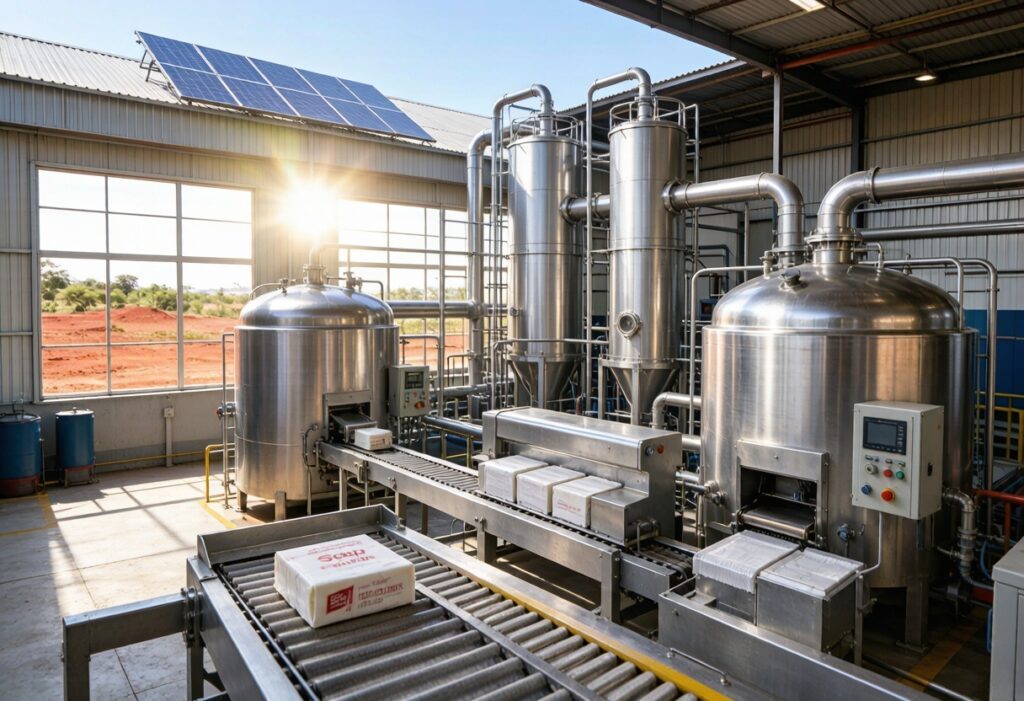
A modern continuous saponification plant equipped with 5 MW rooftop solar, closed-loop water recycling, and integrated soap finishing — the new baseline for African greenfield soap investments in H2 2026.
Executive Summary: Late August 2026 confirms Sub-Saharan Africa as the fastest-growing soap equipment capex destination globally. Three landmark investments reshape the regional map: Rafa Corporation signs Nigeria’s first 10-TPH continuous saponification plant plus two 4-TPH finishing lines (signed July 28, 2026; Ogun State, 15 ha, 2000+ jobs, 5 MW solar hybrid); Unilever expands its Khanyisa Liquids Factory in Boksburg, South Africa to scale toward R1.4 bn (USD ~76 M) capacity for Sunlight, OMO, Comfort and Handy Andy; Heshima Soap’s 216,000 L/month Dodoma facility now anchors East Africa’s premium bar/liquid segment. Combined with Africa-wide detergent market CAGR of 11.3% and a liquid-detergent sub-segment CAGR of 19.7% — multiples of the global 5.7% baseline — this week’s analysis maps the equipment-vendor landscape, AfCFTA trade-policy effect, and the H2 2026 procurement checklist tailored to African conditions (voltage-stability, water-recycling, modularity for remote serviceability).
1. Why Africa Now: The 11.3% CAGR vs. Global 5.7% — A Structural Divergence
For most of the past decade the soap equipment industry has been an Asia-led story, with China and India absorbing the bulk of capacity expansion. The data through mid-2026 confirms a third pole is forming: Sub-Saharan Africa is now growing at more than double the global average, and at almost three times the rate of European replacement demand.
| Region / Segment | 2026 Baseline | Forecast Horizon | Projected | CAGR |
|---|---|---|---|---|
| Africa total detergent + soap demand (AMI/PTH) | USD 67.2 B cumulative to 2030 | 2030 | — | 11.3% |
| Africa liquid detergent sub-segment (AMI/PTH) | — | 2030 | — | 19.7% |
| Africa laundry pods sub-segment (AMI/PTH) | — | 2030 | — | 28.4% |
| Africa laundry detergent liquid market (IndexBox) | — | 2035 | — | 4.5–6.5% |
| SADC consumer soap/detergent (IndexBox) | South Africa 51% consumption / 80% production share | 2035 | — | Outpaces global avg. |
| Global soap production line (Accio) | USD 50.95 B | 2033 | USD 79.38 B | 5.7% |
| Global liquid soap equipment (FMI) | USD 24.8 B | 2036 | USD 49.7 B | 7.2% |
* Africa liquid detergent 19.7% CAGR is the headline figure for equipment vendors: liquid lines deploy roughly twice the equipment content per kg of finished product compared with bar lines, and the African premium concentration trend favors unit-dose, refill-pouch, and pod formats that require specialised dosing-and-packaging modules. Sources: AMI/PTH Africa 2026 Report; IndexBox SADC Detergents Report 2026; Accio Business Insights; Future Market Insights.
2. The Three Landmark Investments Reshaping August 2026
Eight weeks of late-Q3 deal flow concentrate on a single theme: capacity localisation at industrial scale. The smaller “semi-automatic” lines that dominated 2022-2024 African capex are giving way to integrated, turnkey continuous plants supplied by turnkey vendors from India and China, alongside European high-spec finishing equipment for premium SKUs. The three projects below collectively exceed USD 200 million in announced equipment investment.
| Project | Capacity | Equipment Scope | Sustainability Feature |
|---|---|---|---|
| Rafa/Starium Detergents FZE — Ogun State, Nigeria Signed July 28, 2026; supplier MIL India |
10 TPH continuous saponification + vacuum drying; 2 × 4 TPH finishing lines (combined 18 TPH) | Continuous saponification plant integrated with continuous vacuum cooling/drying plant; modern noodle conveying; automated stamping. Expansion complements existing 80,000 t/yr powder detergent line (Alaro City). | 5 MW solar hybrid; closed-loop water recycling; net-zero roadmap to 2030; 80% local-fabricated machinery share |
| Unilever Khanyisa Liquids Factory — Boksburg, South Africa R1.4 bn (~USD 76 M) expansion announced July 7, 2026 |
150,000 t/yr household & fabric-care liquids (Sunlight, OMO, Comfort, Handy Andy, Domestos) | High-speed liquid filling lines; multi-format dosing (bottle, refill pouch, drum); integrated bottling automation for the SADC and rest-of-Africa supply network. | Existing facility already operates below maximum capacity to absorb forecast growth; on-site solar and rainwater recovery targeted in expansion phase |
| Heshima Soap Industries — Dodoma, Tanzania (Tambukareli) Operational Jan 2026; supplier China LOVO Industry |
216,000 L/month liquid & 50+ t/month bar soap across 7 SKUs | Fully automatic integrated saponification + vacuum drying + three-roll mill + plodder + cutter + stamper + wrapper, supporting both bar and liquid formats from a single facility. | Local palm-oil sourcing closes the upstream supply loop; 50+ direct jobs created; reduces import dependency for central-Tanzania household segment |
The three projects together illustrate how African capex is bifurcating. Nigeria/South Africa anchor tier-1 industrial capacity with continuous-loop, solvent-recovery, vacuum-drying architectures supplied by vendors such as MIL India (Mech-Tech) and established European finishing lines. East Africa and the Sahel are absorbing tier-2 integrated semi-automatic lines from Chinese turnkey suppliers, with the trade-off being lower capex but also lower throughput and reduced recyclability. Both tiers are viable for the H2 2026 procurement cycle; the differentiator is the local service-and-spares network, not the unit cost.
3. The Equipment Vendor Matrix: Who Supplies African Greenfields Today
Africa’s soap equipment vendor map is consolidating around five regional supply clusters. Each cluster has a distinct value proposition — Indian vendors lead on turnkey-process engineering, Chinese vendors on cost-engineered modularity, Italian/German vendors on finishing-line precision, and South African vendors on after-sales proximity for the SADC market.
| Origin Cluster | Representative Vendors | Typical Capex Range (USD) | Differentiator vs. African Demand |
|---|---|---|---|
| India (turnkey process) | MIL India; Suman Syndets (35+ yrs, 20+ Ethiopia installs); Rameshwar Steel Fab; Adhisakthi; Soaptec; Sakun Engineers; Geofire; Amarnath Engineering | USD 1.5–12 M per project (10 TPH max, mass-flow + SCADA) | Highest single-line continuous capacity at the lowest dollar/tonne; biodiesel-derived methyl-ester feedstock know-how; established engineering teams with multi-decade African commissioning records |
| China (modular cost-engineered) | LOVO Industry (Henan, active across Ghana, S. Sudan, Congo, Tanzania, Chad); ZZBNT (Henan); Shijiazhuang Ruisheng (Hebei, 30+ countries); Yangzhou ZhiTong; Nantong Sting; Guangzhou Yuxiang; Jinan Yuxiang; Wuxi Jiangnan | USD 100 K–3 M per line (50–5,000 L mixers; 100–500 kg/h integrated lines) | Compact footprint, ISO 9001 base quality, low spares cost, fast shipment (Tianjin / Shanghai / Qingdao ports); weaker in continuous saponification above 2 TPH; trade-finance friendly |
| Italy / Germany (premium finishing) | SAS Soap Machines (Mariani, 1934); Binacchi & Co.; Mazzoni LB; ACMA; Soaptec Italia | USD 5–35 M per premium line (2–8 TPH) | Used by multinationals for premium SKUs entering SADC premium retail; superior recipe control and finishing consistency; longest machine service life (15–25 yrs) |
| South Africa (in-region service) | Local fabricators serving Unilever, Sunlight, and P&G contract manufacturers; Engineering Council of SA registered plant integrators | USD 200 K–2 M per project (SME + regional tier) | Same-day or next-day service response across SADC; familiar with Eskom voltage fluctuation, water-quality variability, and local certification (SANS 1828 / NRCS) requirements |
| Brazil / LATAM (cross-tropics expertise) | Select integrators with prior Angola / Mozambique deployments | USD 500 K–5 M per project | Tropical-climate engineering, Portuguese-language after-sales; narrower vendor base, but high affinity for lusophone African markets (Angola, Mozambique, Cape Verde) |
4. Three African Sub-Region Capex Profiles for H2 2026
The data supports three distinct equipment-investment profiles by sub-region. Each profile implies a different procurement checklist and vendor-selection logic.
| Sub-Region | Demand CAGR (2026–2035) | Capex Profile | Typical Project Size |
|---|---|---|---|
| West Africa (Nigeria, Ghana, Côte d’Ivoire, Senegal) | 4–6% (private-label expansion) | Heavy industrial capex — Rafa benchmark; 5–10 TPH continuous saponification + multi-line finishing. Equipment content per project high (USD 5–25 M). | USD 5–25 M |
| East Africa (Kenya, Tanzania, Uganda, Ethiopia, Rwanda) | 5–7% (urbanisation + formal retail) | Mid-tier turnkey — Heshima benchmark; integrated bar+liquid line at 100–500 kg/h; preference for semi-automatic or fully-automatic with quick-change tooling. | USD 200 K–3 M |
| Southern Africa (South Africa, Zambia, Zimbabwe, Namibia, Mozambique) | 3–4% (mature + currency headwinds) | Replacement-cycle + premium-tier — Unilever Khanyisa benchmark; large-volume liquid lines, premium finishing equipment, automated packaging. | USD 2–80 M (Khanyisa-class) |
A fourth, smaller profile — CENTRAL AFRICA (DRC, Congo-Brazzaville, Cameroon) — is the strongest emerging market for capacity replacement at import-parity economics. LOVO Industry’s recent Congo-Brazzaville shipment (Jan 2026) and multiple DRC enquiries recorded by ZZBNT and Suman Syndets point to a steady, sub-USD 1 M project pipeline through 2026–2027.
5. AfCFTA’s Quiet Impact on Equipment Procurement Logic
The African Continental Free Trade Area (AfCFTA), fully operational since 2025 with progressively lower tariff schedules, is not a direct soap-equipment regulation. But its secondary effects are reshaping the equipment buying logic for any African manufacturer planning to export within the continent:
- 01
Intermediate-goods trade up 22.3% YoY (AMI): Equipment fabricators within AfCFTA jurisdictions increasingly source sub-assemblies from continental partners rather than overseas. This reduces spare-parts lead time but raises provenance-documentation requirements for buyers — RSPO, AfCFTA Certificate of Origin, and SADC harmonised standards are becoming routine.
- 02
Local-content rules multiplying: Multiple African countries (Kenya, Nigeria, Egypt, South Africa) have implemented import-substitution strategies with 15–25% duties on finished detergents while granting equipment-import duty relief to local manufacturers. Rafa’s claim of “80% machinery sourced from local fabricators” is therefore not merely a CSR statement — it is a tariff-arbitrage play that nets a 15-25% unit-cost advantage.
- 03
Low-phosphate regulatory tightening: Kenya and Nigeria amended phosphate-content standards in 2025, pushing low-phosphorus / phosphorus-free formulation reformulation. Reformulation R&D investment is up 17.1% YoY (AMI), and equipment must adapt to handle new surfactant systems (more viscous, more corrosive to mild steel — SS316L contact surfaces increasingly mandatory).
- 04
Cold-water-soluble formats accelerating: Pilot cities for cold-water-soluble laundry sheets recorded 35.6% repurchase rates (AMI). For equipment buyers this implies a new packaging-and-dosing sub-segment requiring different sealing technology from conventional bar or liquid lines.
6. Sustainability Benchmarks: From Heat Recovery to 95% Water Reuse
The 2026 African greenfield plant is not a 1990s plant reskinned with a PLC. The technology baseline has shifted in three measurable ways that buyers should now require at the specification stage.
| Sustainability Metric | 2023 Baseline | 2026 African Greenfield Standard | Operational Example |
|---|---|---|---|
| Process-water recycling rate | 60–70% | 90–95% | Rafa Ogun State plant claims 95% closed-loop process water |
| Renewable-energy share (solar hybrid) | 2–5% (diesel-gen backup) | 20–40% | Rafa 5 MW solar hybrid cuts carbon footprint by 40%; Unilever Khanyisa roof-top PV phase in expansion |
| Heat-recovery / waste-heat reuse | Ad-hoc | 30% boiler-cost reduction | IHI / Sunamp Central Bank Mini at Shabondama Soap (Kitakyushu) delivered 30% capex reduction and <1 yr CO₂ payback; heat-as-a-service model now commercially deploying |
| Glycerine recovery (crude/technical/USP) | 30–45% yield | 75–90% yield | NIR in-line sensing + advanced refining; byproduct sold as pharma-grade (USP USD 700–1,100/MT, B40 mandate 100 kg/MT biodiesel co-feed) |
| Local-fabrication share | 10–30% | 70–80% | Rafa claims 80%; reduces import-duty burden, qualifies for AfCFTA intra-African sourcing benefits, supports backward-integration policy compliance |
| Carbon footprint per ton output (vs. 2023 baseline) | 100 (reference) | 55–60 | Rafa targets net-zero by 2030; Unilever 100% renewable-energy roadmap extends to Khanyisa expansion |
* Heat-recovery technology crosses continents: Sunamp’s Central Bank Mini deployed at Japan’s Shabondama Soap factory cut boiler equipment costs by 30% and achieved CO₂ payback in under one year. The tech is now commercially available for heat-as-a-service deployment at African scale, particularly relevant where Eskom grid instability (South Africa), electricity tariffs (USD 0.10–0.18/kWh in Nigeria, USD 0.22/kWh in Tanzania) and gas-flaring restrictions make waste-heat reuse a hard-economic-rather-than-sustainability-only decision.
7. H2 2026 Procurement Checklist: 8 African-Specific Specifications
An equipment specification written for a European plant will under-perform in most African conditions. This checklist focuses on Africa-specific failure modes that surface as lost throughput 18-24 months after commissioning.
| # | Specification | African-Specific Rationale |
|---|---|---|
| 01 | Wide-voltage drive electronics (300–480 V, ±25%) | Eskom load-shedding, Nigerian grid instability, and remote-diesel operation require drives that survive ±25% voltage sags without tripping |
| 02 | SS316L contact surfaces (not SS304) on saponification reactors and storage tanks | Low-phosphorus reformulation corrosion; locally-sourced NaOH/KOH carries chlorides that pit SS304 within 12-18 months |
| 03 | Closed-loop water recycling ≥90% with on-site tertiary treatment | Utility-water scarcity in Sahel/Lake Chad basin; municipal supply unreliability in Lagos/Johannesburg/Tshwane |
| 04 | Solar-hybrid ready electrical architecture (≥40% renewable-shareable) | 5–7 kWh/m²/day solar irradiance across sub-Saharan Africa; rebate programmes in South Africa, Kenya (feed-in tariff), Egypt (NPTCP) |
| 05 | Modular tool-and-die quick-changeover (≤15 min) | SKU proliferation for multi-format plants (bar + liquid + pod); 50+ SKUs at Heshima demonstrates the complexity |
| 06 | Remote-diagnostics (IoT/4G with offline failover) | Vendor service engineers often 6-12 hrs away; predictive-maintenance signals avoid 3-7 day MTTR on critical equipment |
| 07 | Regional compliance documents: AfCFTA origin cert; SANS 1828 / NRCS (SADC); KEBS / SONCAP / NAFDAC-ready documentation | Fast-track customs clearance; reduce post-shipment compliance gaps; protect against tariffs & seizure in cross-border trade |
| 08 | Heat-recovery ready waste-heat capture points on saponification reactor and vacuum dryer exhausts | Thermal-storage-as-a-service commercially available; new ROI typically 12-18 months with carbon-credit adders |
Conclusion
The structural story for soap equipment in H2 2026 is no longer centred on Asia. Sub-Saharan Africa — driven by import-substitution industrial policy, the AfCFTA’s tariff-rebalancing effect, demographic growth, and aggressive formulation reformulation — is now the third pole of the global soap-equipment investment map. Capex is bifurcating between West African tier-1 continuous-loop plants (Rafa benchmark), East African turnkey mid-capacity installations (Heshima benchmark), and Southern African replacement-and-expansion projects at scale (Unilever Khanyisa benchmark). Equipment vendors who localise after-sales networks, qualify against SADC/AfCFTA standards, and embrace wide-voltage + water-recycling + renewable-energy-ready specifications will capture disproportionate share of the next 24 months of deal flow. Those who continue to ship standard Chinese or European specifications without regional adaptation will be undercut on both price and lifecycle cost.
Data sources: AMI / PTH Africa Laundry Detergent Industry Outlook 2026; IndexBox SADC Detergents and Washing Preparations Market Report 2026; Punch Newspapers (Jul 28, 2026) and Nairametrics (Jul 29, 2026) on Rafa Corporation; ThisDayLive / NigeriaLive24 on Starium Detergents FZE; ShovelReady on Unilever Khanyisa expansion (Jul 7, 2026); Webhaptic Intelligence Nigeria Detergents 2026; Suman Syndets, Rameshwar Steel Fab, ZZBNT Machinery, Shijiazhuang Ruisheng, and LOVO Industry vendor profiles; Sunamp / IHI Central Bank Mini (Shabondama Soap Kitakyushu case study); Accio Business Insights; Future Market Insights.