
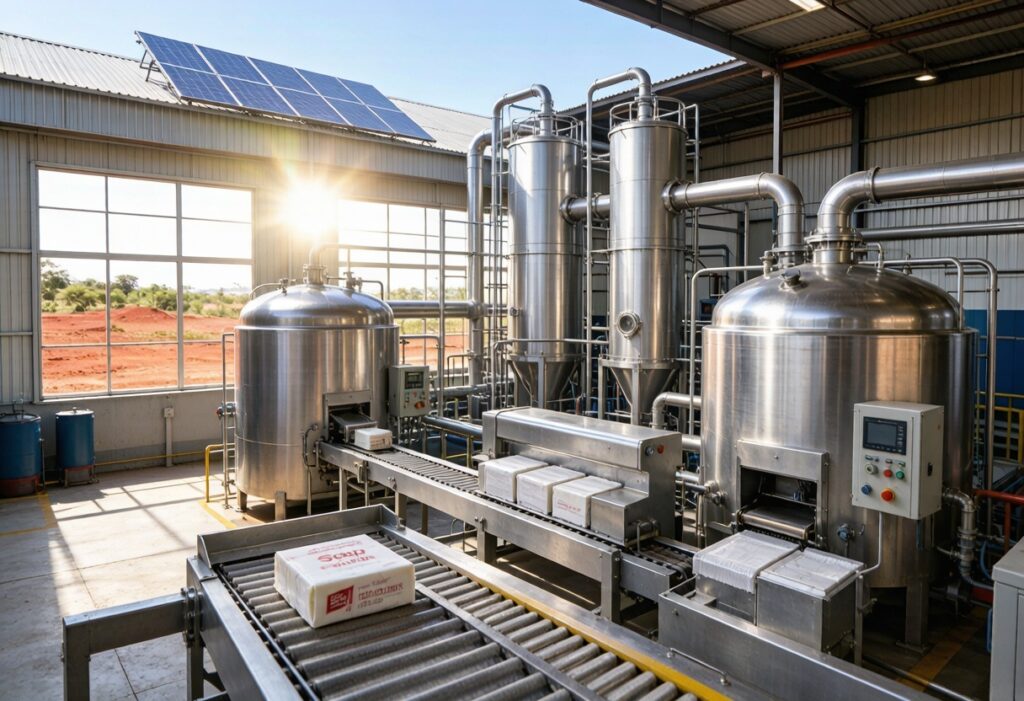
Executive Summary: While 2026’s soap-equipment headlines have been dominated by liquid-line expansion and African capacity booms, a quieter structural shift is now hitting the order books: the solid-format turn. Shampoo bars, syndet bars, conditioner bars and bath additives — once an artisanal niche — have been validated at scale by L’Oréal (Garnier plant-forward bars) and P&G (Pantene, Herbal Essences bar and refill campaigns). The market numbers now justify dedicated industrial lines: the global shampoo bar market stands at USD 1.53 billion (2025) heading to USD 2.97 billion by 2034 at 7.8% CAGR (Growth Market Reports), while the equipment side — solid shampoo injection lines alone — grows faster still, from USD 668.1 million (2025) to USD 1,434.6 million by 2034 at 9.1% CAGR, well above the 5.7% global soap production-line baseline. This week’s analysis maps the four solid-bar formulation architectures to the machinery they require, benchmarks hydraulic/pneumatic press economics (800–1,200 units/hour automated vs 100–300 manual; 8–12 month ROI at 5,000 units/day), details the twin-screw compounding specs behind syndet noodle production, and closes with a Q4 2026 procurement checklist for manufacturers weighing entry into solid formats.
1. Why Solid Formats, Why Now: Four Forces Converging in Late 2026
The solid-format category has moved from farmer’s-market curiosity to mainstream retail fixture in under five years. Four forces explain the timing of the current equipment demand wave:
- Big-brand validation. Garnier (L’Oréal) has launched plant-forward bars, and P&G has brought bars to Pantene and Herbal Essences alongside refill campaigns. When multinationals invest in a format, they fund shopper education — how to use, store and store a bar — which benefits every smaller brand on the adjacent shelf. Category skepticism is no longer the barrier; execution is.
- Plastic-free as default expectation. For a growing share of buyers in North America and Europe, plastic-free is now a purchase precondition rather than a premium feature. Solid formats deliver the most visible elimination of packaging plastic of any personal-care format.
- Sulfate-free and label scrutiny. Consumer label-reading favors milder cleansing systems. Soap-based bars run alkaline (pH 9–10) and can leave hair rough; syndet (synthetic detergent) bars at pH 5–7 have become the default technical route for color-treated and sensitive-hair positioning — and they require completely different production equipment from traditional soap lines.
- Regulatory tightening (MoCRA) and the amenity channel. The US Modernization of Cosmetics Regulation Act has expanded FDA oversight of cosmetics — pushing brands toward documented, GMP-aligned manufacturing. Meanwhile travel and hospitality demand favors compact, leak-proof solid formats, opening a distinct amenity-sized volume tier with its own equipment profile.
2. The Market Numbers: Bars Outpace the Broader Equipment Market
| Market / Segment | 2025 Baseline | Forecast | CAGR |
|---|---|---|---|
| Global shampoo bar market (Growth Market Reports) | USD 1.53 B | USD 2.97 B (2034) | 7.8% |
| Solid shampoo injection line equipment (Growth Market Reports, June 2026) | USD 668.1 M | USD 1,434.6 M (2034) | 9.1% |
| Bath bomb / solid-format press machines (Accio supplier-network analysis) | USD 120 M+ valuation | through 2028 | 7.2% |
| Global soap production line, all formats (Accio) | USD 50.95 B | USD 79.38 B (2033) | 5.7% |
| Global liquid soap equipment (FMI, for comparison) | USD 24.8 B | USD 49.7 B (2036) | 7.2% |
* The equipment category is growing faster than the finished-goods category it serves (9.1% vs 7.8%) — the classic signature of a format industrializing: capacity is being built ahead of demand as artisanal and semi-manual production is replaced by automated lines. Automatic lines already account for 54.5% of injection-line equipment value (2025), with semi-automatic and manual systems making up the remainder.
3. Formulation Determines Machinery: The Four Solid-Bar Architectures
“Solid bar” is not one product — it is four distinct formulation architectures, each demanding a different production route. Selecting the wrong equipment class for the intended formulation is the most common and expensive failure mode we observe in new entrants.
| Bar Architecture | pH / Chemistry | Core Equipment Route | Positioning & Notes |
|---|---|---|---|
| Cold-process soap bar | Alkaline (pH 9–10), true saponification | Kettle/static mix → block curing → cutting → stamping; traditional soap-line territory | Natural/artisanal positioning; low capital entry; long cure cycles limit throughput |
| Glycerin-based bar | Near-neutral, humectant-rich | Melt-and-pour or press-and-pour molding lines; temperature-controlled pouring heads | Mildness/sensitive-scalp claims; clarity and embeds are visual differentiators |
| Syndet bar (synthetic detergent) | Balanced pH 5–7, mild surfactant system | Twin-screw compounding/extrusion of syndet noodles → plodding/extrusion → cutting → press/stamp | The growth engine: color-treated hair, sulfate-free claims; closest cousin to toilet-soap finishing — the retrofit opportunity for existing soap plants |
| Clay / herbal / hybrid bar | Variable; active-laden | Powder dosing + hydraulic/pneumatic compression (bath-bomb-class presses with dual-purpose molds) | Dandruff, hair-fall, sensitivity claims; requires precise dry/wet ingredient handling and dust extraction |
The commercially decisive row is the syndet bar. Its production route is architecturally similar to a toilet-soap finishing line — refine, plod, extrude, cut, stamp — but the chemistry is different in three ways that matter to equipment selection: pH-neutral, temperature-sensitive surfactant binders (typically SCI/sodium cocoyl isethionate based) replace saponified fat; precise gravimetric dosing of additives (actives, oils, fragrance at 0.5–3%) replaces crude crutching; and tighter temperature windows during extrusion prevent binder degradation. This is why the twin-screw compounding stage — borrowed from polymer and food processing — has become the technical heart of industrial syndet bar production.
4. The Equipment Landscape: Twin-Screws, Injection Lines and Presses
A complete industrial solid-format line has three blocks. Upstream, co-rotating twin-screw compounding extruders produce the syndet noodle or extruded cleanser mass: current-generation machines use modular “building-block” screw and barrel sections (L/D ratios of 32–72), self-wiping intermeshing geometry that prevents hot spots in residence-time-sensitive surfactant blends, torque ratings around 15 N·m/cm³, and throughput scaling from 2 kg/h pilot units to over 12,000 kg/h for large compounders. Barrel liners in nickel-base alloys and HIP-processed screw elements extend wear life, and newer induction heating systems cut compounding energy by up to a third versus resistance-band heating.
Midstream, plodders, cutters and stampers — familiar to any soap finishing-line operator — shape the bar, with servo-electric drives now standard for weight consistency. Downstream, dedicated injection lines (the fastest-growing equipment category at 9.1% CAGR) and hydraulic/pneumatic presses handle molded formats: shampoo bars, conditioner bars, bath bombs and shower fizzers. Cross-pollination from adjacent industries is accelerating capability: pharmaceutical-equipment makers have adapted capsule-filling precision dosing and blister-packing technology to solid cosmetics — dosator-based filling for bath-bomb mixtures with dust extraction, and blister or card-based secondary packaging that protects moisture-sensitive solid formats while satisfying retail-ready presentation requirements.
| Metric | Manual / Lever Press | Pneumatic Press | Hydraulic / Servo Automatic |
|---|---|---|---|
| Throughput | 50–400 units/day | ~120 units/hour per operator | 800–1,200 units/hour |
| Typical price band (2026 listings) | USD 650–2,600 | USD 1,300–4,500 | USD 6,999–55,000 (20–150 T) |
| Pressure consistency | Operator-dependent | Good; 60–80 PSI regulated | ±0.1% uniformity; density deviation ≤2% |
| Energy | Negligible | ~5 kWh average | ~8 kWh hydraulic; servo cuts waste up to 18% |
| Weight/shape consistency | Low | Moderate | ≥98% during qualification trials |
| Maintenance & life | Mold cleaning daily | Seal lubrication monthly | 10–15% of price/year; 8–12 yr life; pump swap ~5 yr |
| Indicative ROI | Immediate but capped | < 12 months | 8–12 months at 5,000 units/day |
* 65% of new press purchases now specify semi- or fully-automatic hydraulic systems over manual units. Dual-purpose tooling is a growing differentiator: several Chinese OEMs (Henan, Gongyi, Guangzhou clusters) offer interchangeable die plates that press shampoo bars, bath bombs and shaped fizzers on one frame. Sources: Accio supplier-network analysis 2026; vendor listings (Nanjing Mia, Henan Ocean, Shandong Baofa, Shanghai Lihu, Furis Machinery).
5. CapEx Tiers: From USD 650 Benchtop to USD 1M+ Turnkey
| Tier | CapEx Band | Equipment Scope | Fit |
|---|---|---|---|
| T1 — Entry / Proof of Market | USD 650–2,600 | Manual or pneumatic press, benchtop mixer, hand molds | Startups, indie brands <500 units/day, contract-packing trials |
| T2 — Scaling Artisanal | USD 2,600–8,000 | Industrial pneumatic/hydraulic press with multi-mold plates; 200–500 units/hour | Wholesale fulfillment, first retail listings, 3PL-ready volumes |
| T3 — Industrial Press Cell | USD 13,000–45,000 | Servo-hydraulic press (20–150 T), dosing/mixing front-end, dust extraction, blister/card packaging | Established brands adding solid lines; contract manufacturers; 5,000+ units/day |
| T4 — Dedicated Syndet Line | USD 80,000–1M+ | Twin-screw compounding + noodle handling + finishing (plodder/cutter/stamper) + injection/molding + automated secondary packaging; GMP documentation | FMCG majors, private-label specialists, toll manufacturers serving multiple brands |
6. Regional Demand Matrix: Where the Solid-Format Orders Come From
| Region | Shampoo Bar Revenue Share | Injection-Line Equipment Share | Demand Signal (H2 2026) |
|---|---|---|---|
| North America | 32.5% (2025) | 25.8% | Largest finished-goods market; indie-brand ecosystem drives T1–T2 equipment; MoCRA compliance premium on documented lines |
| Asia-Pacific | Fastest-growing, 9.2% CAGR to 2034 | 38.2% — largest equipment hub | Manufacturing center of gravity (China, Japan, Korea, India); twin-screw and press OEM clusters; rising domestic eco-conscious demand |
| Europe | ~27% | 21.7% | Zero-waste retail and strict cosmetic regulation; refill/packaging-free formats favor solid SKUs; GMP/CE documentation decisive |
| Latin America & MEA | Emerging | Emerging | Retail infrastructure improving; hospitality amenity demand a practical entry point; price-sensitive T1–T2 press imports dominate |
7. The Hospitality & Circular Angle: Amenity Formats and On-Site Recycling
Two adjacent niches round out the solid-format equipment story. First, amenity sizing: hotel and travel formats differ from retail bars in weight, shape and packaging — specify tooling early, because amenity runs often justify compact dedicated lines rather than shared retail tooling. Second, on-site soap recycling: hotel chains pursuing zero-waste certifications are deploying compact refiner-plodder units (from ~USD 2,000) that reprocess guest soap and trimmings into re-extruded bars, while industrial-scale integrated recycling lines that collect, refine and re-extrude factory soap scrap sell in the USD 43,000–45,000 band. Both niches reuse core soap-equipment competencies — refining, plodding, extrusion — and represent incremental addressable volume for vendors already serving the bar-soap value chain.
8. What This Means for Soap-Equipment Manufacturers
For established bar-soap line builders, the syndet boom is the closest thing to a retrofit market the industry has seen in a decade. The finishing end (plodders, cutters, servo stampers, wrappers) transfers almost directly; the gap sits upstream and in process control:
- Twin-screw competency or partnership. Syndet noodle compounding lives in the polymer/food processing world (modular screws, self-wiping geometry, nickel-alloy liners). Line builders without this in-house should partner rather than re-engineer.
- Temperature and pH discipline. Surfactant binders degrade outside narrow windows; extrusion-zone temperature control and documentation become sales-critical specs, not options.
- Dosing precision. 0.5–3% active/fragrance additions demand gravimetric dosing at ±0.1–0.5% — pharma-grade habits that most soap crutchers have never needed.
- Regulatory file readiness. MoCRA-expanded FDA oversight and EU cosmetic GMP mean customers now audit documentation packages (materials, cleanability, changeover validation) before purchase.
9. Q4 2026 Procurement Checklist: Solid-Format Lines
| # | Specification | Benchmark / Rationale |
|---|---|---|
| 1 | Formulation-equipment match | Confirm press/extruder class against intended bar chemistry (soap vs glycerin vs syndet vs hybrid) before any commitment |
| 2 | Automation level | Automatic systems = 54.5% of new injection-line value; 800–1,200 units/h vs 100–300 manual; ROI 8–12 months at 5,000 units/day |
| 3 | Pressure & density control | ±0.1% pressure uniformity; ≤2% density deviation; ≥98% weight/shape consistency in qualification trials |
| 4 | Tooling flexibility | Interchangeable multi-shape die plates; quick-change <15 min; amenity vs retail tooling sets; 100,000+ cycle mold life |
| 5 | Materials & cleanability | SS304/316 contact parts, seamless surfaces, easy disassembly for fragrance/color changeovers; GMP-compatible design |
| 6 | Moisture & packaging integration | Hygroscopic formulations demand blister/card or paper-based barrier packaging inline; verify compatibility with plastic-free formats |
| 7 | Compliance & documentation file | CE/UL electrical safety, ISO 9001 vendor QMS, MoCRA/GMP-ready documentation, 1–2 yr warranty, spare parts within 7 days |
Bottom line: the solid-format turn is no longer a niche bet. With finished-goods markets compounding at 7.8%, dedicated equipment categories at 9.1%, and multinational validation lowering consumer-adoption risk, Q4 2026 is a rational window for both brands adding solid SKUs and equipment vendors extending their portfolios. The winners on the machinery side will be those who respect the chemistry — pH-neutral, temperature-sensitive, precisely dosed — rather than treating the syndet bar as “just another soap bar.”
Data Sources & References
- Growth Market Reports — Shampoo Bar Market Report 2025–2034 (market size, CAGR, regional shares, product segmentation)
- Growth Market Reports — Solid Shampoo Injection Line Market Report 2034, data updated June 2026 (equipment market size, CAGR, automation share, regional split)
- MidSolid Press & Pour — Eight Trends Behind the Solid Shampoo and Conditioner Bar Boom, 2026 (category dynamics, big-brand validation, MoCRA)
- Accio Business Insights — Bath Bomb Press Machine supplier-network analyses, 2026 (market valuation, CAGR, automation shift, performance benchmarks, price bands)
- Accio — Soap Recycling Machine market report, August 2026 (mini refiner plodders, integrated recycling line pricing)
- World Food Services Journal / EIN Presswire — Furis Machinery Group expansion into bath and solid-cosmetics equipment, January 2026 (pharma-to-cosmetics technology cross-pollination)
- Vendor specifications — co-rotating twin-screw compounding extruders (SHJ series and comparable lines: modular L/D 32–72, 15 N·m/cm³ torque class, 2–12,000 kg/h range)
- Accio / Future Market Insights — Global soap production line and liquid soap equipment baselines (5.7% / 7.2% CAGR references)
Industry trend analysis prepared for the soap manufacturing equipment sector — late August 2026. Figures are drawn from cited third-party research and supplier-network data; verify critical specifications with vendors before procurement decisions.