
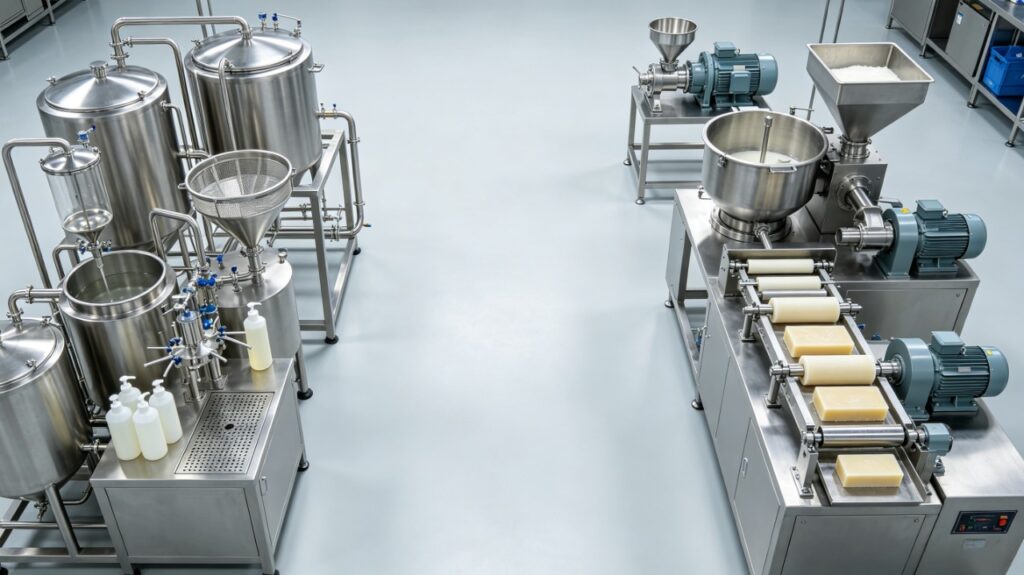
The global soap and detergent industry is evolving fast, with liquid soap and bar soap dominating consumer and commercial cleaning markets alike. While both products serve the same core purpose—effective cleansing—their manufacturing processes and equipment setups are vastly different. For soap factory owners, startup entrepreneurs, and production managers, understanding the key differences between liquid soap manufacturing equipment and bar soap manufacturing equipment is critical for budget planning, production scaling, space optimization, and product quality control.
Many new industry players mistakenly assume soap production equipment is universal for liquid and solid formulas. In reality, each product requires specialized machinery tailored to its unique saponification process, texture requirements, and finishing standards. In this guide, we break down the full equipment comparison, covering production workflows, core machine types, capital costs, operational efficiency, maintenance needs, and ideal use cases for both liquid and bar soap production lines.
1. Core Production Logic Difference: Foundation of Equipment Gaps
Before diving into specific equipment comparisons, it’s essential to grasp the fundamental production differences that drive all machinery design choices for liquid and bar soap.
Bar soap relies on sodium hydroxide saponification, producing a solid, moldable soap base that requires refining, extrusion, cutting, and stamping to form finished bars. Its production focuses on solid texture homogenization, moisture control, and precise shaping, with a post-production curing stage to enhance hardness and durability.
Liquid soap uses potassium hydroxide for saponification, creating a low-viscosity to viscous liquid formula. Its production prioritizes precise liquid mixing, homogenization, water purification, and sealed filling to ensure consistent texture, stable surfactant activity, and long shelf life without layering or precipitation.
These core chemical and physical differences result in two entirely distinct production line architectures, with zero cross-compatibility for key finishing equipment.
2. Full Equipment List Comparison: Liquid Soap vs Bar Soap Lines
We’ve organized the complete equipment configurations for both production lines, including core processing machines, auxiliary devices, and packaging systems, to highlight key differences and functional characteristics.
2.1 Bar Soap Manufacturing Equipment (Solid Soap Production Line)
Bar soap production features a mechanical, physical finishing workflow after saponification, focusing on refining solid soap noodles into uniform, smooth, shaped bars. The full equipment suite includes:
- Soap Mixer (Sigma Mixer): The core mixing device for bar soap production. It blends soap noodles, fatty acids, plant oils (palm kernel oil, shea butter), caustic soda solution, fragrances, and color additives into a uniform soap paste. Its low-speed, high-torque design avoids over-emulsification and ensures consistent paste homogeneity to prevent grainy finished products.
- Triple Roll Refining Mill: A specialized precision device exclusive to bar soap lines. It grinds and smooths coarse soap paste, eliminating particle inconsistencies and air bubbles to deliver a silky, flawless bar texture. This step directly improves the soap’s hardness and wear resistance.
- Soap Extruder (Plodder): Compresses refined soap paste into continuous, dense soap strips with standardized thickness and width. It removes residual air to prevent bar cracking during curing and use.
- Automatic Cutting Machine: Cuts extruded soap strips into fixed-length blanks with high dimensional accuracy, ensuring uniform weight for every finished bar.
- Soap Stamping Machine: Presses brand logos, patterns, and product information onto soap blanks, completing the final shaping process.
- Auxiliary & Packaging Equipment: Curing racks (for 24–72 hour drying and hardening), automatic wrapping machines, and carton sealing machines. All material-contact parts adopt 304/316 stainless steel to resist alkali corrosion and meet hygiene standards.
2.2 Liquid Soap Manufacturing Equipment (Fluid Soap Production Line)
Liquid soap production centers on liquid phase reaction, high-precision homogenization, and sterile sealed filling. Its equipment lineup focuses on formula stability and fluid consistency, with no extrusion or stamping machinery:
- Water Treatment System: A mandatory pre-processing device unique to liquid soap lines. It uses RO filtration and water softening technology to remove calcium and magnesium ions (controlling TDS ≤10ppm) that destabilize surfactants, preventing formula layering and spoilage. Modern systems adopt closed-loop water circulation to reduce water consumption by up to 50%.
- Vacuum Homogenizer Mixer: The core equipment for liquid soap production. Unlike bar soap’s low-speed mixer, this high-shear vacuum mixer performs integrated functions of heating, stirring, emulsifying, and homogenizing. It evenly blends surfactants, moisturizers, fragrances, and preservatives to create a smooth, stable liquid formula with no particle precipitation.
- Raw Material Metering System: Precision automatic dosing devices for liquid and powder raw materials, ensuring strict formula proportion accuracy—critical for consistent viscosity and cleansing power across batches.
- Filter & Defoaming Device: Filters fine impurities and eliminates mixing foam to ensure transparent, uniform liquid soap texture.
- Automatic Liquid Filling Machine: Adopts piston or gravity filling modes for different viscosity liquid soaps, supporting precise quantitative filling for bottles, pumps, and gallon containers.
- Auxiliary & Packaging Equipment: Capping machines, labeling machines, bottle washing sterilization equipment, and conveyor lines. The entire production process is sealed to avoid bacterial contamination.
3. Key Equipment Dimension Comparison (2026 Industry Standard)
To help factories make data-driven decisions, we summarize the core operational and economic differences between the two production line systems in a comparative framework.
| Comparison Dimension | Bar Soap Manufacturing Equipment | Liquid Soap Manufacturing Equipment |
| Core Process Focus | Solid refining, extrusion, molding, curing | Water purification, liquid homogenization, sealed filling |
| Key Core Machines | Sigma mixer, triple roll mill, plodder, stamping machine | RO water treatment system, vacuum homogenizer, precision filling line |
| Initial CAPEX | Medium; fewer automated stations, lower precision requirements | Higher; requires water treatment, high-precision metering and homogenization systems |
| Production Cycle | Long (3–5 days including curing) | Short (2–4 hours batch-to-finish, no curing needed) |
| Space Requirement | Large (needs dedicated curing workshop and rack storage area) | Compact (integrated pipeline design, no post-production curing space) |
| Daily Output Flexibility | Fixed batch output; difficult for small-batch customized production | Highly flexible; supports small-batch customization and large-scale continuous production |
| Maintenance Cost | Medium; wearing parts on extrusion and stamping components need regular replacement | Low; sealed pipeline structure reduces wear, only regular filter replacement required |
| Energy Consumption | High (long curing drying cycle, mechanical extrusion power consumption) | Low (short production cycle, efficient closed-loop energy utilization) |
4. Operational & Scalability Differences
4.1 Bar Soap Line: Stable Output, Low Flexibility
Bar soap equipment features mature, mechanical standardized workflows. Once the production parameters are set, the output quality is extremely stable, making it ideal for mass production of conventional toilet soap, laundry soap, and handmade soap. However, its flexibility is limited: switching product formulas or sizes requires adjusting multiple mechanical components, and the mandatory curing process leads to long inventory cycles and higher warehouse occupancy.
For small startups, semi-automatic bar soap lines are cost-effective with low technical thresholds, while fully automatic lines are more suitable for large factories with fixed mass production orders.
4.2 Liquid Soap Line: High Flexibility, Strong Customization
Liquid soap production equipment is highly versatile. The same homogenizer and filling line can produce hand soap, body wash, dish soap, and other liquid cleaning products by simply adjusting formulas and filling parameters. The continuous production mode shortens the entire production cycle from traditional 72 hours to 2.5–4 hours, greatly improving capital turnover efficiency.
In addition, modern liquid soap lines support intelligent closed-loop production, with real-time monitoring of water quality, temperature, and viscosity data, reducing manual errors and improving batch consistency. The only downside is higher upfront investment in water treatment and precision homogenization equipment.
5. 2026 Equipment Selection Guide: Which Line to Choose?
Choose Bar Soap Manufacturing Equipment If:
- You focus on eco-friendly, zero-plastic, low-cost daily cleaning products
- Your factory has sufficient warehouse space for product curing and storage
- You pursue stable mass production with low daily operational technical requirements
- Your target market is offline supermarkets, rural markets, and bulk commercial procurement
Choose Liquid Soap Manufacturing Equipment If:
- You want to launch multiple product lines (hand wash, body wash, dish soap)
- You need flexible small-batch customization and fast order delivery
- Your factory has limited production space and wants to optimize space utilization
- You target high-end consumer markets, online retail, and hotel commercial cleaning scenarios
- You pursue sustainable production with low water and energy consumption
6. Final Verdict & Industry Trend Outlook
There is no absolute “better” between liquid and bar soap manufacturing equipment—only more suitable for different business positioning. Bar soap equipment remains a cost-effective, stable choice for traditional mass production, with irreplaceable advantages in low-waste and eco-friendly product markets. Meanwhile, driven by consumer demand for diversified, convenient, and multi-functional cleaning products, liquid soap production lines are growing at a 7.2% annual CAGR, becoming the mainstream investment trend in the global soap manufacturing industry.
For new entrants, a hybrid solution is increasingly popular: deploying a small-scale semi-automatic bar soap line plus a flexible liquid soap line to cover both traditional and high-growth markets, maximizing product diversity and market adaptability with limited investment.
Key Takeaways
- Bar soap equipment focuses on mechanical molding and curing; liquid soap equipment prioritizes liquid homogenization and sterile filling.
- Liquid lines have higher upfront costs but shorter cycles, lower energy consumption, and stronger flexibility.
- Bar lines feature lower initial investment and higher stability but require larger space and longer production cycles.
- 2026 industry trends favor flexible, energy-saving liquid soap lines, while bar lines retain niche eco-friendly and mass-market advantages.