
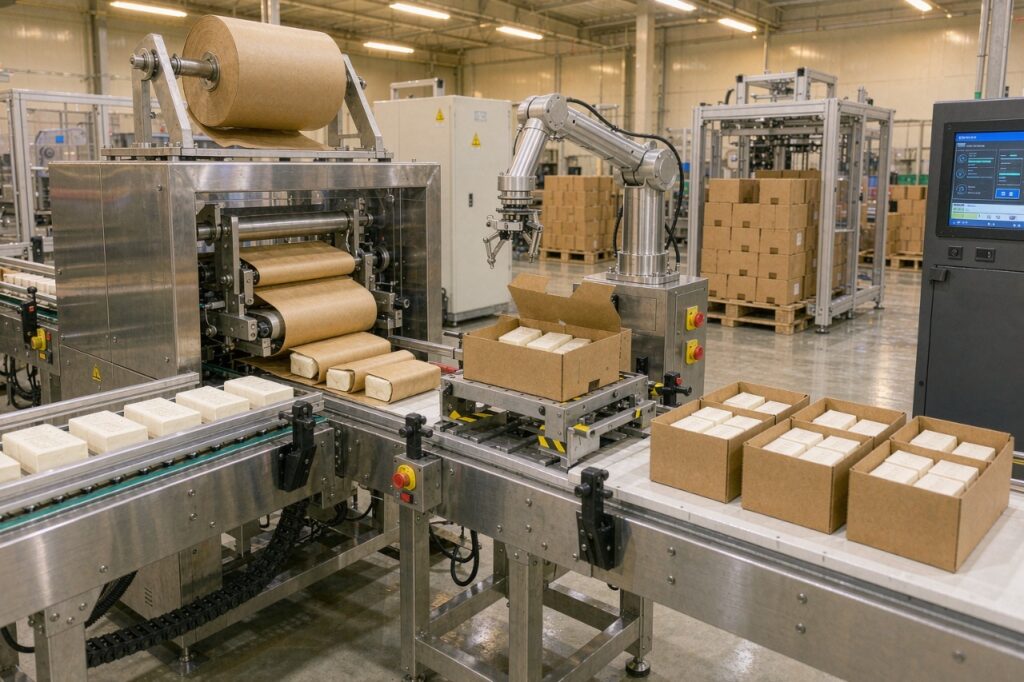
- The soap packaging machine market is sized at USD 1.2B (2024) → USD 2.3B by 2033 (7.1% CAGR) — outpacing the broader soap production line market (5.7% CAGR).
- Flow wrappers hold 51.4% of soap-specific packaging machinery revenue (USD 217.27M in 2025), followed by pleat wrappers (23.6%) and cartoners (16.2%).
- Paper has crossed the speed threshold: retrofit kits such as Syntegon’s paper-ON-form now run paper-based flow wraps with cold sealing at full line speed — no throughput penalty.
- Hotel pleat wrapping is the sharpest automation arbitrage — replacing a 320-bar/day manual station (7.1% defect rate) with a 40–50 bar/min machine at USD 8–9K.
- PACK EXPO Las Vegas (Sept 29–Oct 1, 2026) is the decision venue: P&G, Unilever, Colgate-Palmolive, Clorox and SC Johnson buyers will be on the floor three weeks from now.
1. Why the Dry End Is the New Bottleneck
Through 2024–2026 the soap equipment conversation concentrated on the wet end — saponification, vacuum drying, plodding, finishing. That investment wave raised bar output to levels where the constraint migrated downstream: the last thirty meters of the line — wrapping, pleating, cartoning, case packing — are now the limiting factor between a 2-TPH finishing line and a shipped pallet.
Three forces converged in 2026 to push the dry end up the capex priority list:
| Force | What Changed in 2026 | Equipment Consequence |
|---|---|---|
| Labor economics | Manual pleat-wrap stations still finish only ~320 bars/day/worker at 7.1% defects in hotel-amenity plants | Automatic pleat wrappers replace 5 workers; labor cost −55%, paper waste −68% |
| Sustainability compliance | Plastic-free retail formats + ISO 14001:2026 environmental management turning packaging into a compliance surface | Machines must run paper, recyclable mono-materials and biodegradable films without speed loss |
| E-commerce packaging | Bulk and multi-pack soap SKUs shipping direct-to-consumer at record volumes (Shopee/Tokopedia top sellers moving 5–9M units/month) | High-speed flow wrap + retail-ready cartoning demand rising at ~4.5% CAGR |
A confirmation signal arrived on September 1, 2026, when a Seoul municipal tender (2026 Functional Reinforcement Support Project) invited estimates for soap extruders, automatic soap molding machines and bath bomb presses for a sheltered-workshop production facility — small-value, but evidence that format-flexible forming-and-packing equipment demand now reaches down to social-enterprise scale (deadline Sept 11, 2026).
2. Market Sizing: Convergence Across Four Independent Scopes
Independent research houses scope the soap packaging machine market differently, but every scope shows growth above the 5.7% CAGR baseline of the overall soap production line market (USD 50.95B → USD 79.38B by 2033, Accio):
| Scope | 2024/25 Size | Forecast | CAGR |
|---|---|---|---|
| Soap packaging machine (Strategic Packaging Insights, Mar 2026) | USD 1.2B (2024) | USD 2.3B (2033) | 7.1% |
| Soap packaging machinery, strict soap-specific (PW Consulting, 2026) | ~USD 422.7M (2025) | Rising with format flexibility & IIoT retrofits | n/a |
| Fold wrapping machines (confectionery + personal care/soap) (PW Consulting) | USD 534.8M (2025) | USD 709.5M (2032) | 4.12% |
| Flow wrap machines, all industries (Future Market Report) | USD 12.55B (2025) | USD 21.98B (2033) | 7.26% |
| Overwrapping machines, all industries (Global Market Insights) | USD 2.0B (2025) | USD 3.8B (2035) | 6.4% |
The pattern mirrors what this series documented for liquid soap equipment (7.2%) and syndet injection lines (9.1%): packaging and format-conversion equipment is compounding faster than core process equipment — the classic signature of a mature industry extracting margin from differentiation rather than volume.
3. Machine-Type Anatomy: Flow, Pleat, Carton, Stretch
PW Consulting’s 2025 revenue split for soap-specific packaging machinery shows flow wrapping’s structural dominance — driven by compatibility with PE/PP/LDPE films and the pillow-pack workflow that fits both toilet and laundry bars:
| Machine Type | 2025 Revenue | Share | Primary Use in Soap Plants |
|---|---|---|---|
| Flow wrap | USD 217.27M | 51.4% | High-volume toilet/laundry bars, detergent bars; e-commerce multipacks |
| Pleat wrap | USD 99.50M | 23.6% | Round premium bars and hotel guest amenities; tight multi-pleat folds protect in transit |
| Cartoning | USD 68.32M | 16.2% | Premium/plastic-free brand presentation, retail-ready boxes, stackability |
| Stretch wrap | USD 37.42M | 8.9% | Bundle and pallet-level protection for export shipments |
Within fold-wrapping at large, automatic machines already hold 77.1% of the segment (2025) — automation saturation that the soap niche is now inheriting. And across the wider flow-wrap universe, horizontal machines dominate at 52.6% share with China holding 21.7% of the global market — the manufacturing gravity that Chinese soap-equipment exporters ride on.
4. Regional Demand: Where the Dry-End Capex Lands
| Region | Market Size (2024/25) | Growth Signal | Demand Character |
|---|---|---|---|
| Asia-Pacific | USD 400M (44.2% of soap packaging machinery) | China 8%, India 9% CAGR | Scale-driven end-to-end line buying; China, India, SEA plant expansions; e-commerce fulfillment |
| North America | USD 300M (17.7%) | US 6% CAGR | Reliability and after-sales emphasis; healthcare/hospitality hygiene compliance; PACK EXPO sourcing hub |
| Europe | USD 250M (23.0%) | Germany 5% CAGR | Compliance-driven modernization; packaging-waste regulation and sustainability mandates |
| Latin America | USD 150M | Expanding retail sector | Rising consumer awareness; retail-format diversification |
| Middle East & Africa | USD 100M | Slower pace, high potential | New capacity (Nigeria, Ghana, Tanzania) bundling packaging into greenfield lines rather than retrofitting |
The MEA pattern matters for equipment vendors: African greenfield projects profiled in this series (Rafa Nigeria, LOVO installations in Ghana, Congo-Brazzaville and Chad) increasingly specify the packaging section in the original line order rather than as a later upgrade — compressing the traditional five-year lag between process and packaging investment.
5. The Paper Transition: No More Speed Penalty
The single most consequential technology shift of 2026 in soap packaging is that paper-based flow wrapping reached full production speed. Syntegon’s paper-ON-form retrofit kit, paired with cold-sealing technology, lets existing and new horizontal flow wrappers process paper packaging without compromising speed or product safety — previously the defining trade-off of the plastic-to-paper switch.
The reference architecture for a fully paper soap line, demonstrated in Syntegon’s seamless bar-packaging system:
- WRW Flex compression roller — in-process adjustment of slab height/width, minimizing trim and product waste;
- Sigpack FIT infeed — contactless, format-flexible product feeding using Beckhoff XTS linear-motor transport;
- Sigpack HRM flow wrapper — paper-ON-form + cold sealing, with gentle feeding (FWV) that preserves the paper’s sensitive barrier layer at maximum speed;
- Sigpack TTM top-load cartoner — processes cardboard made from 95% recycled fibers;
- Elematic 2001 case packer — up to 40 cases/min across 100 case designs, accepting grass-fiber corrugated board.
For soap producers, the paper transition is no longer a premium-brand indulgence — it is being priced into baseline machinery. Regulatory pressure (packaging-waste rules, EPR schemes, ISO 14001:2026 environmental management systems) and consumer plastic-free defaults are converging on the same specification sheet: film-agnostic sealing, paper-compatible feeding, recycled-fiber cartoning.
6. Vendor Landscape: Who Moved in 2026
| Vendor | Scale | 2025–26 Moves Relevant to Soap/Dry-End |
|---|---|---|
| Syntegon | EUR 1.6B revenue, EUR 1.8B order intake (2024) | neXt automation architecture at interpack 2026; Remshalden hall (+40% horizontal packaging capacity); paper-ON-form commercialization; Stuttgart Business Excellence Center |
| ProMach | ~USD 2B turnover; 40+ brands | AmHolt acquisition (Jan 2026) adding filling/capping components; Charlotte tech-center expansion for overwrap/flow-wrap demos (Feb 2026) |
| IMA Group | EUR 2.3B+ revenue; 80 countries | Ilapak DELTA WW OF-HSX fully-electric high-speed flow wrapper (Feb 2026) — energy-optimized servo platform |
| Coesia | Multi-division group | Rotzinger + Transver asset acquisition (Jan 2026): product-flow regulation, buffering, distribution for consumer-goods lines; vision-QC capability expansion (Apr 2026) |
| Chinese exporters (GANAR, Shanghai Genyond, Henan Ocean, et al.) | USD 8K–22K machine classes | Pleat wrappers (GT-P900 class, 40–50 pcs/min, USD 8–9K), horizontal flow wrappers (USD 2.2K–6.6K band), turnkey 100–300 kg/h toilet soap lines incl. packaging (USD ~20K); 2026 installs in Ghana, South Sudan, Congo-Brazzaville |
The competitive structure is two-tier: European majors compete on material qualification, hygienic design, validation support and line integration; Chinese exporters compete on price-delivery for standard formats. The contested middle ground — paper-capable machines at mid-range prices — is where the 2027 competitive battle will be fought.
7. Case Study: The Hotel Pleat-Wrap Arbitrage
Hotel amenity soap is the cleanest illustration of dry-end economics because the manual baseline is still measurable. Field data from amenity packaging specialists (9-year vendor benchmark, 2026):
| Metric | Manual Wrapping | Automatic Pleat Wrapper (GT-P900 class) |
|---|---|---|
| Throughput | ~320 bars/worker/day | 40–50 bars/min (≈ 19,000–24,000/8-hr shift) |
| Defect rate | 7.1% (uneven pleats, torn paper, loose wrap) | ≤0.5% (99.5% qualification rate) |
| Labor | 5 workers for equivalent output | 1 operator (line-connectable, auto loader optional) |
| Economics | Rising labor cost; 68% more paper waste | Labor cost −55%; paper waste −68%; CapEx USD 8,000–15,000 |
| Format range | Any round 10–30g bar | Dia. 40–55mm standard (custom to 80mm), thickness 10–35mm; quick-adjust for 10g–30g |
At a USD 8,990 machine replacing five workers, payback is typically measured in months, not years — the shortest ROI cycle anywhere in the soap plant. That asymmetry explains why pleat wrap holds a 23.6% revenue share despite being a niche format.
8. CapEx Ladder: Dry-End Investment Tiers
| Tier | CapEx Band | What It Buys | Who Buys |
|---|---|---|---|
| T1 | USD 2.2K–8K | Entry horizontal flow wrapper; single-format pleat wrapper | SME soap makers, homestead/hotel-supply workshops |
| T2 | USD 8K–30K | PLC pleat wrapper with auto labeling; turnkey toilet soap line incl. packaging (100–300 kg/h); basic cartoner | Regional brands, amenity exporters, African/LATAM greenfields |
| T3 | USD 30K–150K | High-speed flow wrap + cartoning + case packing cell; IIoT/PdM retrofit; paper-capable sealing upgrades | Mid-tier national brands modernizing legacy dry ends |
| T4 | USD 150K–1M+ | Integrated seamless paper line (wrap + top-load carton + case pack, XTS infeed, 40 cases/min); validation & documentation package | Multinationals (P&G/Unilever/Colgate tier), contract packers |
9. PACK EXPO Las Vegas: The September Decision Window
PACK EXPO Las Vegas runs September 29 – October 1, 2026 at the Las Vegas Convention Center, organized by PMMI with 500+ exhibitors and 10,000+ attendees. Committed household/personal-care buyers include P&G, Unilever, Colgate-Palmolive, Clorox and SC Johnson — the exact purchasing tier that defines dry-end specification standards for the global soap industry.
For soap equipment vendors and their customers, the show is the reference event for four dry-end questions that will dominate Q4 2026 capex committees:
- Does my flow wrapper run paper at rated speed — and can it be retrofitted (paper-ON-form class) or does it require replacement?
- Can the cartoner handle recycled-fiber and grass-fiber board without jam escalation?
- Is the machine IIoT-connected for predictive maintenance (unplanned-downtime control at high throughput)?
- Does the vendor qualify materials and provide validation support, or only machinery?
10. Q4 2026 Dry-End Procurement Checklist
- Film-agnostic sealing — verified running of PE/PP/LDPE, recyclable mono-material, biodegradable film AND paper on the same frame.
- Cold-sealing capability for heat-sensitive wrapped products and paper barrier preservation.
- ISO 24158-1 safety conformity and plant operation under ISO 14001:2026 environmental management.
- IIoT / predictive-maintenance connectivity with OPC-UA data export for MES and EU Digital Product Passport readiness (packaging DPP enforcement Aug 2028).
- Quick-format changeover — target ≤15 min between SKUs; recipe management via PLC/HMI.
- Carton material tolerance — rated for ≥95% recycled-fiber board.
- Regional service depth — 24/7 remote diagnostics plus in-country engineers; spare-part lead times in writing.
- Warranty & training — 1-year full-machine warranty (3-year main parts is emerging standard); operator training and proofing before shipment.
11. Implications for Soap Equipment Vendors
- Bundle or lose the order: African and SEA greenfield buyers now expect wrapping/cartoning in the original line quotation. Dry-end partnerships (or in-house modules) convert finishing-line wins into full-line contracts.
- The paper retrofit is the wedge product: a paper-capable sealing upgrade at T2–T3 pricing addresses the gap between European T4 systems and standard Chinese film-only wrappers.
- Hotel amenity is the highest-velocity entry niche: sub-USD 10K pleat wrappers with months-long payback open accounts that later scale to full lines.
- Data readiness is the next differentiator: packaging machines are the plant’s richest sensor source; vendors who export clean OPC-UA data make their lines DPP-ready and future-proof against 2028–2029 EU enforcement.
This article is an industry trend analysis prepared for informational purposes. Market figures vary by research scope and methodology; figures are cited as reported by each source. It does not constitute investment or procurement advice.