
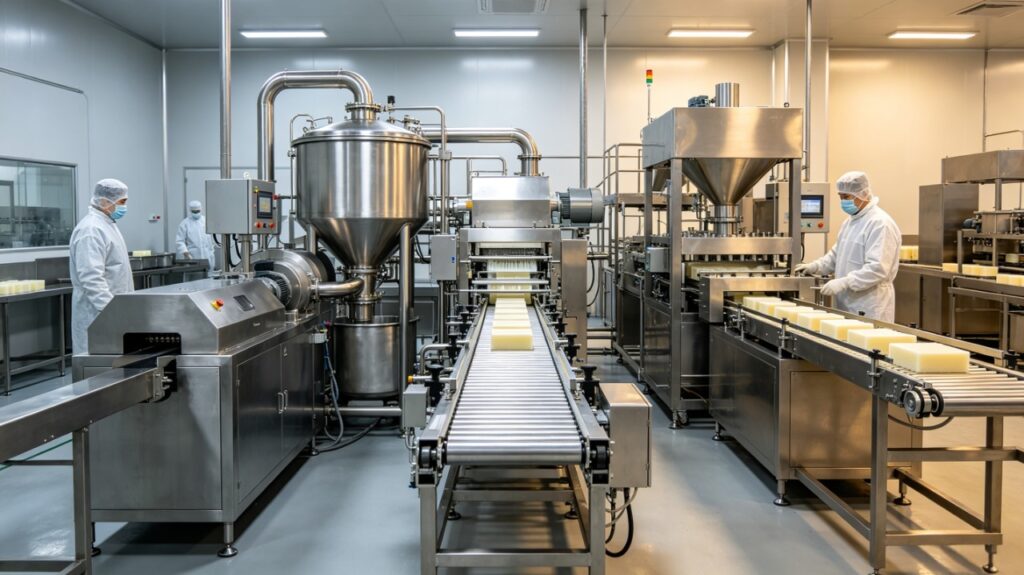
For soap manufacturers scaling production—from small boutique soap workshops to large industrial FMCG facilities—selecting reliable soap machine manufacturers is critical to production efficiency, product quality, and profit margins. The global soap machinery market is dominated by two major supplier groups: cost-effective Chinese soap machine manufacturers and premium European industrial machinery brands.
A common question crosses every buyer’s mind: Are high-priced European soap machines worth the investment? Or do Chinese soap machinery suppliers deliver a better cost-quality balance for modern commercial soap production? In this updated 2026 analysis, we compare hard pricing data, real quality gaps, operational pros and cons, and applicable scenarios to help you make a data-driven purchasing decision.
1. Market Overview: Two Competing Manufacturing Models
European soap machine manufacturers, mainly located in Germany, Italy and France, have long set global benchmarks for industrial soap machinery. They are widely recognized for high precision, robust durability, and stable automated operation, primarily serving large multinational FMCG brands with strict production compliance and high-volume output requirements.
Over the past 15 years, Chinese soap machine manufacturers have undergone massive industrial upgrading, evolving from low-cost imitation production to standardized, certified industrial manufacturing. Currently, Chinese suppliers occupy more than 78% of the global mid-range soap machinery market, supporting countless SMEs and fast-growing soap brands worldwide. Breaking the outdated stereotype of “cheap Chinese machinery”, top Chinese manufacturers provide CE, ISO 9001 and SGS-certified soap equipment, equipped with imported core components from Siemens and ABB, greatly narrowing the historical quality gap with European machines.
2. Direct Cost Comparison: Hard 2026 Pricing Data
Cost difference is the most intuitive distinction between Chinese and European soap production machines. To ensure a fair and industry-standard comparison, we adopt a mainstream 500kg/h fully automatic soap production line—the most widely used industrial model for commercial mass production—as our core benchmark:
| Specification | Chinese Manufacturers | European Manufacturers | Cost Difference |
| 500kg/h Full Automatic Line Price | $38,000 – $52,000 | $78,000+ | European models cost ~40% more |
| 300kg/h Mid-Size Line | $10,000 – $20,000 | $45,000+ | European models cost over 2x more |
| Lead Time | 45–60 days | 90–120 days | Chinese delivery 50% faster |
| Shipping & Import Cost | Lower, flexible logistics | Higher, premium freight & duty | Total landed cost gap widens further |
Data source: 2026 official quotations from mainstream industrial soap machinery suppliers, including Chinese top manufacturers (Ruisheng Machinery, Wellink Machinery) and professional European industrial equipment brands
Why Are Chinese Machines 40% Cheaper?
The significant price advantage of Chinese soap machines does not come from reduced quality standards, but from inherent structural manufacturing advantages. The key reasons for lower costs are as follows:
- Vertical supply chain integration: Leading Chinese soap machine factories independently produce over 70% of core parts including gearboxes, transmission shafts and PLC control cabinets, eliminating intermediate dealer markups and cutting overall production costs.
- Large-scale production economies: Top Chinese manufacturers achieve an annual output of over 30,000 sets of soap machinery, greatly reducing unit production costs through standardized mass production.
- Controlled operational overhead: Compared with high-cost European industrial zones, Chinese manufacturing bases enjoy balanced labor, factory site and R&D expenditure without sacrificing technical standards.
- Pure factory-direct sales model: Most qualified Chinese soap machinery exporters adopt direct B2B sales, avoiding multi-level distributor premiums and offering more transparent pricing.
3. Quality & Performance Analysis: Real Gap or Myth?
The biggest concern for global buyers remains consistent: Does the lower cost of Chinese soap machines mean compromised quality? To answer this question objectively, we analyze core quality indicators for soap production equipment, covering material durability, automation stability, production precision and overall service life.
3.1 Material & Build Quality
European soap machines feature ultra-heavy-duty industrial construction, with thickened stainless steel frames, customized high-power industrial motors and highly wear-resistant accessories. Designed for 24/7 non-stop continuous operation, these machines can serve stable industrial production for 15+ years, perfectly matching the ultra-high-intensity production needs of world-class FMCG brands.
In contrast, top-tier Chinese soap machines fully adopt food-grade 304/316 stainless steel for production contact parts and equip imported Siemens and ABB core electrical components, fully complying with international GMP, ISO and CE safety standards. The only minor gap lies in non-critical structural accessories: European brands use fully customized premium parts, while Chinese manufacturers adopt standardized cost-effective components. For 90% of commercial soap producers, this difference brings zero impact on final product quality and production stability.
3.2 Automation & Production Precision
European equipment takes the lead in ultra-high production precision. It achieves a strict weight tolerance of ±0.1g for each soap bar, stable emulsification performance for high-end cosmetic soap, and intelligent data tracking to ensure 100% formula replication consistency. This advantage is irreplaceable for luxury soap lines and premium FMCG production with zero-defect requirements.
Modern fully automatic Chinese soap production lines support one-stop full-process operation, including material mixing, fine milling, vacuum extrusion, bar stamping and final packaging, with a stable weight tolerance of ±0.3g. This precision fully meets all standard commercial production demands for laundry soap, daily bath soap and mid-range cosmetic soap, with unnoticeable quality differences in finished products.
3.3 Lifespan & Maintenance
European soap machinery delivers an ultra-long service life of 15 to 20 years with extremely low failure rates, ideal for fixed long-term industrial production lines. However, its shortcomings are obvious: original spare parts are extremely expensive, and professional European technical support is mandatory for equipment maintenance and repair, leading to high long-term operational costs.
Qualified Chinese soap machines offer a reliable service life of 10 to 12 years, which perfectly matches the average operation cycle of most SME soap enterprises. More importantly, Chinese equipment features ultra-low maintenance costs with universal, affordable and easily accessible spare parts. Most professional Chinese manufacturers provide 24/7 online after-sales consultation and fast overseas technical guidance, greatly reducing production downtime risks.
4. Core Pros & Cons: Chinese vs European Soap Machines
European Soap Machine Manufacturers
Strengths
- Industry-leading durability and ultra-stable performance for 24/7 uninterrupted industrial production
- Ultra-high production precision suitable for premium soap and high-standard finished product lines
- Full compliance with strict EU GMP, CE and international food safety regulations
- Proven stable performance for mass production of top global FMCG soap brands
Weaknesses
- Excessively high upfront investment, with overall costs 40%–100% higher than Chinese alternatives
- Long production and delivery lead time (3–4 months) with slow cross-border after-sales response
- High operational costs, including expensive original spare parts and professional maintenance services
- Poor production flexibility, not suitable for small-batch production, customized formulas or trial orders
Chinese Soap Machine Manufacturers
Strengths
- Excellent cost-performance ratio, delivering certified industrial-grade quality at a competitive price
- Fast production and delivery (45–60 days), accelerating market entry for new soap businesses
- Strong flexible customization, supporting personalized production lines for small, medium and large-scale factories
- Low daily operation and maintenance costs with accessible global after-sales support
- Complete turnkey solutions, covering machine design, production debugging and factory layout guidance
Weaknesses
- Uneven market quality standards, with low-end small factories cutting material and process costs
- Slight gaps in ultra-precision output and extreme long-term durability compared with top European machines
- Minor language and time zone barriers exist for cross-border after-sales communication
5. Which One Should You Choose? Scenario-Based Buying Guide
There is no absolute “best” soap machine supplier—only the most suitable one for your business. Your ideal choice depends on your production scale, product positioning, quality standards and budget constraints.
Choose European Soap Machines If:
- You are a large FMCG brand pursuing top-tier product quality and zero production defect rates
- You produce high-end luxury soap that requires strict weight precision and stable formula replication
- You need 24/7 non-stop industrial production and expect 15+ years of stable equipment operation without replacement
- Long-term production stability and ultra-low failure rates take priority over upfront cost savings
Choose Chinese Soap Machines If:
- You are a soap startup, SME or mid-sized manufacturer focusing on high cost performance
- You require flexible production lines to support frequent batch adjustments and product iterations
- You want to reduce upfront equipment investment and allocate more capital to brand operation and market expansion
- Your product portfolio mainly includes laundry soap, daily bath soap and mid-range cosmetic soap
- You prioritize fast delivery and responsive, cost-effective after-sales technical support
6. Final Verdict: 2026 Cost-Quality Balance
European soap machinery remains the industry gold standard for ultra-premium, zero-error and long-term stable industrial production. However, its extremely high price premium is only justified for top multinational FMCG brands with large-scale and fixed production demands. For 90% of global soap producers, the marginal quality improvement cannot offset its 40%+ higher procurement and operational costs.
In 2026, top Chinese soap machine manufacturers have achieved a nearly perfect cost-quality balance. With standardized international certifications, upgraded core configurations and mature one-stop turnkey services, Chinese equipment delivers reliable industrial-grade quality at a far lower cost. The minor quality gaps compared with European machines only apply to extreme high-precision luxury soap scenarios, which are irrelevant for most commercial soap production businesses.
To sum up: European soap machines dominate in ultimate production quality and stability; Chinese soap machines lead the market in practical cost-performance and commercial adaptability.
Key Takeaways
- Qualified Chinese soap machines cut equipment costs by around 40% while maintaining 95% of industrial quality for mainstream commercial soap production.
- European soap machines offer superior durability and precision but require double the investment and feature much longer delivery cycles.
- The biggest risk of sourcing Chinese soap machines is not inherent quality flaws, but uncertified low-end suppliers — always verify factory qualifications and certification documents.
- For most growing soap enterprises worldwide, Chinese turnkey soap production lines are the most profitable and practical choice in 2026.