
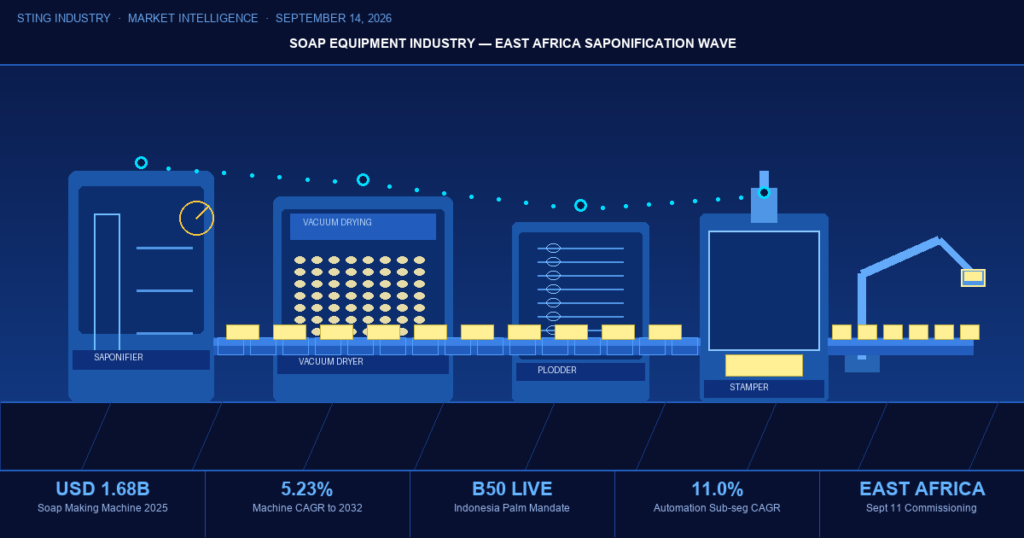
- Fresh commissioning news: Milindia confirmed the successful startup of a continuous saponification + vacuum drying plant in East Africa on Sept 11, 2026 — a wet-end project that mirrors August’s Weathering Tunnel + robotics pick-n-place first.
- Equipment market sizing converges: PW Consulting values the soap making machine market at USD 1.68B (2025) → USD 2.40B (2032) at 5.23% CAGR — fully automatic machines hold 60.9% share.
- Automation sub-segment compounds at 11% CAGR — nearly double the overall production-line baseline (5.6%–5.8%) — and digital twins are moving from pilot to OEM-standard.
- B50 is now live (July 1, 2026): Indonesia’s biodiesel mandate absorbs an estimated 8–10 million tonnes/year of palm oil, structurally tightening feedstock supply for soap-grade fatty acid distillers.
- PACK EXPO Las Vegas (Sept 29–Oct 1, 2026) opens in 15 days: 35,000+ attendees, 2,300+ exhibitors, 30th-anniversary edition — the decision venue for H1 2027 packaging capex.
- Sub-Saharan Africa CAGR remains the highest in the dataset at 14–16% — the East Africa commissioning is a leading indicator, not an outlier.
1. The Sept 11 East Africa Commissioning: What Was Installed
Milindia, the Noida-based soap-and-detergent plant engineering firm with a 1,000+ project installation footprint across 50+ countries, announced on September 11, 2026 that it had successfully commissioned a continuous saponification line linked directly to a continuous vacuum soap cooling and drying plant for a laundry-soap producer in East Africa. The configuration — saponifier in series with vacuum cooler/dryer, no intermediate noodle storage — produces pure, swing, and filled soap noodles from distilled fatty acids and/or neutral oils, with the vacuum dryer engineered for “consistent product quality, efficient vacuum cooling & drying, reliable continuous operation, and optimised process performance.”
Three weeks earlier, on August 19, the same OEM commissioned its “New Age” weathering tunnels at the same customer — equipped with a servo-driven bar-pushing mechanism and what Milindia describes as a first-in-industry robotics pick-n-place system for laundry-soap-bar handling. The sequencing is informative: the wet end (saponifier + vacuum dryer) is the strategic bottleneck, and it is being added first; the finishing-line automation (stamping, wrapping, palletising) is the next logical capex tranche.
Milindia’s commissioning cadence is itself a market signal. The company has now installed over 1,000 soap/detergent projects since 1968 — the most recent two being the East Africa pair, and a 10-TPH continuous saponification + vacuum drying plant in South-East Asia commissioned June 7, 2026. The geographic pattern (East Africa, South-East Asia, East Africa again) is consistent with the regional demand matrix below.
2. Market Sizing: Three Independent Scopes, One Direction
The equipment-market data published in Q3 2026 is unusually coherent across research houses. Three independent scopes converge on growth above 5% but with materially different end-product mixes:
| Scope | 2025/26 Value | Forecast | CAGR | Source |
|---|---|---|---|---|
| Soap making machine (narrow) | USD 1.68B (2025) | USD 2.40B (2032) | 5.23% | PW Consulting (2026) |
| Soap production line (broad) | USD 50.95B (2025) | USD 79.38B (2033) | 5.7% | Accio / Cognitive MR |
| Liquid soap equipment | USD 24.8B (2026) | USD 49.7B (2036) | 7.2% | Accio / Future Market Insights |
| Automation equipment sub-segment | n/a | n/a | 11.0% | Accio Business Insights |
| Global soap market (end product) | USD 26.91B (2026) | USD 33.93B (2031) | 4.75% | Mordor Intelligence |
The headline pattern: the equipment layer is compounding 1.0–2.3 pp faster than the end-product market it serves. That gap is the equipment-industry economics of 2026 in a single number — capex is being pulled forward by automation, regulatory compliance, and feedstock resilience, even where the underlying bar of soap is growing only 4–5% a year.
3. The B50 Feedstock Ripple: Why “Feedstock-Agile” Now Means Real Money
Indonesia’s B50 biodiesel mandate took effect on July 1, 2026, raising the palm-oil-based biodiesel blend in domestic diesel from 40% to 50%. The mechanism is straightforward and the magnitudes are large: an estimated 8–10 million tonnes per year of palm oil is being diverted to biodiesel at a permanent, structural rate. Crude palm oil (CPO) on Bursa Malaysia’s November 2026 contract closed at RM 4,859/tonne on August 28, and SD Guthrie’s guidance for Q1 2027 has been revised to RM 4,600–5,200/tonne.
| Implication | What It Means at the Reactor | Equipment Consequence |
|---|---|---|
| CPO tightness | 70–80% of soap OpEx is palm-derived (IMARC); a 10–20% price rise cuts gross margin by 7–14 pp on a fixed-formula line | Multi-fat dosing with ≤0.1% mass-flow accuracy; continuous swing between palm, palm kernel, tallow, soybean, distilled fatty acid |
| Asia noodle supply concentration | Indonesia + Malaysia + India control >70% of global soap-noodle export volume | Vertical integration: more plants are commissioning in-house saponification rather than buying noodles |
| RSPO certification demand | EU and NA importers increasingly mandate certified sustainable palm oil | PLC-level batch tracking + blockchain-ready traceability exports |
The Sept 11 Milindia commissioning reads differently against this backdrop. A continuous saponification plant commissioned in East Africa is a feedstock-security decision, not merely a capacity decision: it insulates the operator from import-noodle price spikes and from RSPO chain-of-custody paperwork gaps. The same logic is visible in Rafa Corporation’s 10-TPH Nigeria project (15 ha site, 5 MW solar hybrid, 95% closed-loop water) and in Unilever’s R1.4 billion (~USD 76 M) expansion of its Khanyisa Liquids Factory in Boksburg, South Africa.
4. Digital Twins Move From Pilot to OEM-Standard
The most consequential equipment-design shift documented in Q3 2026 is the move of digital-twin deployments from isolated pilot cells to OEM-standard offerings. The Q3 milestone: at least three major soap-line OEMs (Mazzoni LB, SAS, and Sela Engineering) are now offering pre-integrated digital-twin packages as standard options on new plodder and mixer lines — a meaningful reduction in the custom-integration cost that previously kept mid-tier buyers out of the segment.
| Layer | Typical Components | Cost Range (per line) | Function |
|---|---|---|---|
| Sensor | Vibration, temperature, pressure, flow, pH | USD 2,500–6,000 | Continuous condition monitoring |
| Edge compute | OPC-UA IPC + ML inference | USD 800–1,500 | Real-time anomaly detection (no cloud dependency) |
| Twin platform | 3D process model + historical data + SaaS | USD 15,000–40,000/yr | Scenario simulation, OEE, what-if |
The economics now clear the bar. Legacy soap plants average 15–25% unplanned downtime per year. Predictive-maintenance platforms promise 30–50% downtime reduction — USD 150–400K/year in recovered production on a 500 kg/h line. Industrial IoT sensor arrays have fallen from USD 80–150/node (2023) to USD 12–45/node (2026), and adoption among mid-to-large soap manufacturers (≥1 TPH) has risen from 8–12% in Q1 to 22–28% by Q3. The pilot era is over; the standardisation era has begun.
5. Regional Demand Matrix: Where Q4 2026 Capex Is Landing
| Region | Equipment CAGR | Demand Driver | Q3 2026 Signal |
|---|---|---|---|
| Asia-Pacific | 5.7%–8.6% | China liquid-soap equipment 8.6%; India 8.3%; Indonesia noodle exports >USD 485M (2024) | Milindia 10-TPH SEA commissioning (June 7); Chinese smart-equipment penetration 38%→60% |
| Sub-Saharan Africa | 14–16% | Low automation base (28%); per-capita soap use rising to 12.8 kg/yr post-pandemic | Milindia East Africa saponification (Sept 11); Rafa 10-TPH Nigeria (Q3); Unilever Boksburg R1.4 bn expansion |
| North America | 4.1% (mature replacement) | Healthcare/hospitality compliance; FDA OTC Drug Monograph updates | PACK EXPO Las Vegas (Sept 29–Oct 1) procurement venue |
| Europe | 3.8% (regulatory-driven) | Green Deal, CBAM, REACH, EU Digital Product Passport (Jan 2027 mandatory labelling) | 2D-barcode integration upgrades; SS316L wetted-parts replacement |
| Middle East & Africa (aggregate) | 6.98% (Fastest in dataset) | Urbanisation, institutional procurement, hospitality/healthcare | Rafa project adds ~80,000 t/yr noodle capacity to historically import-dependent region |
6. PACK EXPO Las Vegas in 15 Days: What to Watch
The 30th-anniversary edition of PACK EXPO Las Vegas (Sept 29–Oct 1, Las Vegas Convention Center) is the largest in the show’s history: more than one million net sq ft of floor, 2,300+ exhibitors, 35,000+ attendees from 40+ vertical markets. PMMI president and CEO Jim Pittas has named the four forces the 2026 edition is built around: automation, artificial intelligence, sustainability, and workforce development.
For soap-equipment buyers specifically, three exhibit-floor signals will be diagnostic:
- Sustainability Central (South Lower Hall) — Containers & Materials Pavilion will showcase the recyclable, reusable, and biobased substrates that paper-based flow wrappers, cold-seal retrofit kits, and mono-material wrappers will need to be qualified against.
- Processing Zone (North Hall) — front-of-line saponification and finishing-line innovations; expect at least one major OEM to launch a digital-twin-as-standard offering in line with the Q3 trend documented above.
- Healthcare Packaging Pavilion (North Hall) — directly relevant to soap-equipment buyers serving the healthcare/hospitality channels where North American 4.1% CAGR upgrades concentrate.
Two new guided show-floor tours debut in 2026: the PACK EXPO Discovery Tours for first-time buyers and senior decision-makers seeking automation solutions, and the PACK EXPO Sustainability Tour for CPG brand owners. Both will surface procurement patterns that will set the H1 2027 soap-equipment order book.
7. Compliance Convergence: Three Q3–Q4 Deadlines
Three regulatory milestones are converging on soap manufacturers in the September–December 2026 window:
| Deadline | Regulation | Equipment Implication |
|---|---|---|
| Q3 2026 | RSPO Principles & Criteria 2025–2026 review closes public consultation | Production-line data systems must capture lot-level RSPO chain-of-custody (origin, refinery cert ID, lot number) in audit-ready format |
| January 1, 2027 | EU Digital Product Passport mandatory labelling for cosmetics & personal-care products | Real-time 2D-barcode (QR/DataMatrix) encoding with variable data — batch code, expiry, RSPO cert ID, ingredient list — integrated with upstream batch systems |
| H2 2026 | Indonesia BPOM and India BIS tighten Certificate of Analysis (CoA) for imported soap machinery | OEMs must supply standardised digital CoA packages including digital-twin configuration data and sensor calibration records |
The capex implication converges across all three: manufacturers facing all three deadlines simultaneously should budget an additional 8–12% above base equipment cost for compliance-ready upgrades — data-capture systems, barcode-integrated packaging heads, and digital documentation packages.
Conclusion
The Sept 11 East Africa saponification commissioning is not an isolated project. It is the latest data point in a regional narrative — Sub-Saharan Africa compounding at 14–16% CAGR on a low automation base — and a feedstock-security response to a permanently tighter palm-oil market under Indonesia’s B50 mandate. It is also a leading indicator of the finishing-line automation tranche that will follow at the same site: servo-driven weathering tunnels, robotic pick-n-place, and — by the time the H1 2027 capex cycle peaks — digital twins as OEM standard.
For equipment buyers with capex in the September–December 2026 window, the implications are concrete: specify feedstock agility at the reactor, compliance-ready data capture at the finishing line, and digital-twin interfaces at the platform layer. The 15 days between now and PACK EXPO Las Vegas are the last clear procurement-research window before Q4 budgets close. The orders that follow will set the H1 2027 order book — and the regional pattern visible from Nairobi to Lagos to Boksburg will be the structural backdrop.
Data Sources: Accio Business Insights (April–September 2026); PW Consulting Worldwide Soap Making Machine Market 2026; Mordor Intelligence Soap Market (2026–2031); IMARC Group Soap Manufacturing Plant Report 2026; Business Research Insights (March 2026); Future Market Insights Liquid Soap Market; Cognitive Market Research; Kingpin Market Research innovation survey; Spherical Insights Top 30 soap production line companies (May 2026); Strategic Packaging Insights (March 2026); Milindia commissioning announcements (Aug 19, Jun 7, Sept 11, 2026); Verified Market Research; PMMI PACK EXPO Las Vegas 2026 exhibitor materials.
© 2026 STING Industry · Published as draft for editorial review · Industrial soap equipment insights for global manufacturers.