
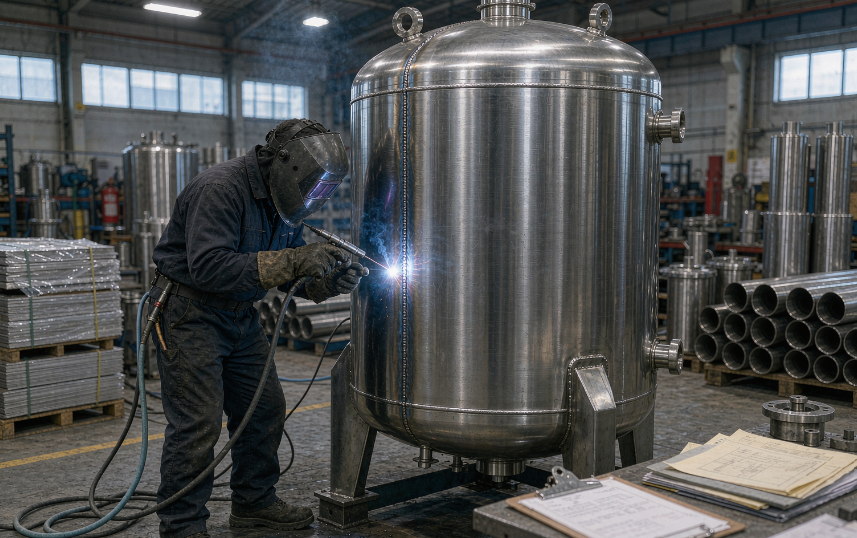
Two soap plant buyers can open machine quotes this December and find the same reactor, the same plodder and the same wrapper — and a spread of 15 to 25 percent between the totals. The difference is rarely the machine. It is the metallurgy line item: which stainless grade, how many tonnes of it, which surcharge mechanism the fabricator signed, and how much carbon cost is now riding on the steel itself. In the week of 3–7 November 2026, LME nickel moved more than US$1,000 per tonne in seven days, published 316L alloy surcharges in Europe are up 32.2% since January, and molybdenum — the element that separates soap-grade 316L from commodity 304 — is trading at its highest level since March 2023. For anyone specifying a saponification line, a vacuum dryer or a finishing train right now, the steel bill is a procurement decision as large as the vendor choice.
Key Takeaways
- LME nickel (3-month) jumped from US$15,220 to US$16,315/t (+7.2%) in the week of 3–7 November 2026, yet the rally is policy-driven — dollar weakness, Indonesian 2027 quota expectations and Morowali load cuts — against high refined stocks and an INSG forecast of a wider global surplus in 2027.
- The cost that matters most for soap equipment is the alloy surcharge: published November 2026 surcharges stand at EUR 5.21/kg for 316L versus EUR 3.94/kg in January (+32.2% YTD), and the 316L premium over 304 has widened +50% to EUR 2.33/kg — roughly EUR 15,600 extra on a 20-tonne 316L order since January.
- Molybdenum, not nickel, did more damage to 316L this year: molybdenum oxide rose from US$22.5/lb in January to US$34.4/lb in November, and European ferromolybdenum hit US$79.5/kg — the highest since March 2023.
- Grade selection remains a chemistry decision, not a price decision: hot concentrated caustic above roughly 80–120°C at >30% NaOH pushes austenitic 316L toward stress-corrosion territory, where duplex 2205 (PREN ≈35, yield ≥450 MPa) holds out to ~150°C and allows ~30% wall thinning — often netting out despite a 1.2–1.5× plate premium.
- CBAM’s definitive phase (from 1 January 2026) adds a second cost layer on the steel inside imported equipment: ≈€626/t for Indonesian-origin 304 cold-rolled, ≈€370/t for Chinese, ≈€185/t for Japanese at the Q2 certificate price of €75.28 — and the default-value uplift rises from 10% (2026) to 20% in 2027 and 30% from 2028.
- Procurement consequence for Q1 2027 contracts: negotiate the price mechanism, not the nickel forecast — fixed-price versus surcharge-linked, certificate requirements (ASTM A240 / EN 10088-2, EN 10204 3.1), passivation scope, and a CBAM data clause are now worth more than another round of supplier haggling.
1. What Actually Moved in November
The first week of November delivered one of the sharpest nickel moves of the year. Between 3 and 7 November 2026, the LME three-month price climbed from US$15,220 to US$16,315 per tonne — up US$1,095, or 7.2%, in five trading days. SHFE nickel followed from CNY 115,380 to CNY 122,740 per tonne, and the Shanghai stainless futures contract settled at CNY 14,190. Spot prices moved with it: 304 cold-rolled 2B out of Wuxi rose CNY 450 week-on-week to CNY 13,950 per tonne, and 300-series social inventory fell to 387,700 tonnes, down 2.06% and the lowest level of the year.
But the drivers matter more than the print, because they tell a buyer whether to wait or to contract. Only one of the three forces behind the rally is physical. Dollar weakness after the US midterm elections lifted dollar-denominated metals across the board. Expectations that Indonesia will tighten its 2027 RKAB mining quotas — and re-examine permits for semi-finished smelter projects — did the speculative work. Some Morowali RKEF lines cut load, linked to El Niño power constraints. Against that, Weda Bay has resumed shipments, refined nickel stocks remain elevated, Indonesian miners have applied to ship more than 500 million tonnes of nickel ore in 2027 — roughly double this year’s quota — and the International Nickel Study Group expects the global surplus to widen again next year. This is a policy-and-positioning rally, not a shortage.
| Indicator (early November 2026) | Level / change | Read-through for equipment buyers |
|---|---|---|
| LME nickel, 3-month | US$15,220 → 16,315/t (+7.2% in one week) | Surcharge-linked contracts will reprice within days |
| SHFE nickel | CNY 115,380 → 122,740/t | Chinese mill offers firm; delivery slots filling into January |
| 304 CR 2B, Wuxi (private mill) | CNY 13,950/t (+450 w/w) | Baseline for tanks, hoppers and non-wetted fabrications |
| 316L short-process hot-rolled cost, China | CNY 25,776/t (Mysteel, 9 Nov) | The real cost floor under wetted-part fabrication |
| 316L seamless tube, Wuxi | CNY 30,500/t | Coil-heated kettles and heat exchangers sit here |
| Ferromolybdenum, Europe | US$79.5/kg — highest since March 2023 | The 316L-over-304 premium keeps widening |
| Molybdenum oxide | US$33.63/lb Busan / US$34.40 Europe (from US$22.5/lb in Jan) | +53% YTD; moly did more work on 316L than nickel |
| 300-series social inventory, China | 387,700 t (−2.06%), lowest of the year | Little buffer if the rally persists into Q1 |
| November 300-series crude plan, China | 1.8893 Mt (+3.68% MoM) | Mills are leaning in, not cutting — supply intact |
Sources: Foshan Good Steel weekly pricing note (3–7 Nov 2026); Mysteel 316L cost survey (9 Nov 2026); SDRX Steel market report (4 Nov 2026).
2. The Surcharge Arithmetic Nobody Renegotiates
Ask a purchasing team what they pay for stainless and they will quote a base price. In most European and Asian contracts, that base is the smaller half of the invoice. The alloy surcharge — recalculated monthly or quarterly from nickel, chromium and molybdenum assessments — is where 2026 quietly repriced soap equipment. Published surcharges for cold-worked product tell the story:
| Alloy surcharge (cold-worked) | January 2026 | November 2026 | Change YTD |
|---|---|---|---|
| 304 | EUR 2.39/kg | EUR 2.88/kg | +20.5% |
| 316L | EUR 3.94/kg | EUR 5.21/kg | +32.2% |
| 316L premium over 304 | EUR 1.55/kg | EUR 2.33/kg | +50% |
Source: published European alloy surcharges, November 2026 (Foshan Good Steel).
On a 20-tonne 316L order — roughly one mid-size saponification and drying train of wetted steel — the grade premium alone has widened by about EUR 15,600 since January. That is more than most buyers saved by switching suppliers, and almost nobody renegotiates it, because it arrives as a surcharge line rather than a quoted price.
The weekly noise is smaller than it feels. One of the most dramatic nickel weeks of the year — the US$1,095 move — translates to roughly US$88/t of surcharge effect on 304 (about 8% nickel content), or EUR 0.076/kg: around 2.6% of the 304 surcharge. For 316L the arithmetic differs, because molybdenum has done more work than nickel. Oxide has risen from US$22.5/lb in January to US$34.5/lb — about US$26,455 per tonne of molybdenum — and 316L carries 2–3% of it. The lesson is directional, not week-to-week: the grade premium is structurally widening, and a buyer who locks grade content into the contract rather than leaving it to the surcharge mechanism is the one who keeps the saving.
3. Where a Soap Plant Actually Needs the Moly — and Where It Does Not
Cost pressure tempts downgrading, and this is where the chemistry has to speak first. Soap manufacturing exposes steel to three aggressive media at once: hot concentrated caustic (saponification at 80–105°C), brines and chloride-bearing process water (salt-loaded noodles and effluent), and fatty acids of varying purity. Each has a different failure mode, and the grade ladder is not linear in price or performance.
- Caustic service. At ambient temperature and concentrations below ~30%, 304 and 304L are sound. The danger is heat plus concentration: sodium hydroxide stress corrosion cracking becomes a live risk for austenitic grades as service climbs past roughly 80–120°C at above 30% NaOH — exactly the envelope of a saponification kettle or a soap-lye concentrator. Welds and cold-worked bends fail first; post-weld stress relief is not optional in hot caustic.
- Chloride service. Chloride stress corrosion cracking in austenitic stainless starts to bite above about 60°C under tensile stress. The critical temperatures rank cleanly: roughly 60°C for 304, ~100°C for 316L, ~150°C for duplex 2205. In pitting resistance, 2205 carries a PREN of about 35 against 316L’s ~25 — and it holds a yield strength of ≥450 MPa versus roughly 170 MPa for 316L, allowing ~30% wall thinning on pressure-bearing parts.
- The economics of duplex. 2205 plate lists at 1.2–1.5× the 316L price, but thinner walls, fewer corrosion failures and 2–3× component life in aggressive service often net the project out flat or better. It does, however, demand discipline in fabrication: ER2209 filler, low heat input (≤1.5 kJ/mm), interpass below 150°C to suppress sigma-phase embrittlement.
- Where downgrading is legitimate. Ambient tanks, dry storage, framing, guarding and non-wetted fabrications do not need molybdenum. Blanket-upgrading everything to 2205 wastes money exactly where 304 was always adequate. The correct move is a grade-by-service matrix in the specification, not a single “stainless” line item.
| Service in a soap plant | Sensible minimum grade | Why |
|---|---|---|
| Ambient oil and noodle storage, framing | 304 / 304L | No heat, no chlorides; 316L is wasted money |
| Saponification kettle, <80°C, caustic <30% | 316L, stress-relieved welds | Caustic SCC risk rises with temperature and stress |
| Hot lye concentrators, 80–120°C, >30% NaOH | Duplex 2205 (or 904L) | 316L caustic SCC risk is high; 2205 resists to ~150°C |
| Brine dosing, salt systems, effluent wetted parts | 316L minimum; 2205 where hot | Chloride pitting and SCC scale with temperature |
| Vacuum dryer shells, plodder barrels | 316L, certified plate | Product-contact hygiene plus hot caustic residue |
Grade thresholds compiled from published corrosion-engineering guidance (caustic and chloride SCC limits; PREN and yield data for 316L vs 2205). Confirm against the specific duty cycle and concentration before specification.
4. CBAM: The Second Layer Now Riding on the Steel
Since 1 January 2026, the EU’s Carbon Border Adjustment Mechanism has been in its definitive phase, and steel — the raw material of every soap machine exported to Europe — is covered. The carbon bill lands on the importer, but it gets priced into equipment quotations, and the spread by origin is large. At the Q2 2026 certificate price of €75.28 per tonne of CO₂e, a tonne of 304 cold-rolled of Indonesian origin carries roughly 8.32 certificates, or ≈€626; the same product from China carries ≈€370, from Japan ≈€185. Expressed per finished machine, that is a four-figure euro sum on a multi-tonne fabrication — before the alloy surcharge.
Three regulatory details matter for equipment buyers planning 2027–2028 capex:
- The default-value uplift runs ahead of the free-allocation phase-out. For steel, the default-value uplift factor rises from 10% in 2026 to 20% in 2027 and 30% from 2028 — meaning importers unable to evidence actual emissions will see their certificate count jump 22% by 2028 on high-default origins, more than half of the total 2026–2034 increase arriving in the first two years.
- Measured emissions are the only lever. Default values are punitive by design; verified actual emissions can rewrite the bill. Verification bodies register from 1 September 2026, first verification reports can issue from January 2027, certificates go on sale in February 2027, and the first annual surrender deadline is 30 September 2027. A fabricator who can document the mill’s actual emissions is already cheaper than one on defaults.
- Downstream machinery is next. A 2028 proposal would extend CBAM to roughly 180 steel- and aluminium-intensive downstream products — machinery among them. Equipment bought in 2027–2028 should assume carbon cost will follow the machine, not just the plate.
A quieter correction also matters: implementing regulation (EU) 2026/1740 amended default values for several stainless codes with retroactive effect to 1 January 2026, and raised fallback values for certain flat-rolled codes from 4.94 to 5.02 tCO₂e/t. For 2026 imports, checking the corrected commodity code against the origin is worth more than any forecast of certificate prices, which have already moved from €75.36 (Q1) to €75.28 (Q2) to €82.32 (Q3).
5. Q1 2027 Contracts: Negotiate the Mechanism, Not the Forecast
Nickel near US$16,000 with a structural surplus behind it, molybdenum at a 33-month high, and CBAM defaults rising in 2027 — the ingredients of a bad contracting window for anyone who signs a surcharge-linked contract at the wrong moment. The working answer is to structure the contract so that no single week of LME prints decides your capex:
- Fix the mechanism, not the metal. Decide explicitly between a fixed all-in price, a fixed base plus capped surcharge, or full surcharge pass-through — and price the difference. A fixed-price offer that costs 3% more today can be the cheaper contract the day after a +7% nickel week.
- Fix tonnage and grade content in the contract. List wetted-part tonnage by grade (304 / 316L / 2205) so the surcharge applies to a defined quantity — not to the fabricator’s discretion.
- Demand the certificates that back the grade. ASTM A240 or EN 10088-2 compliance, EN 10204 3.1 mill test certificates per heat, and third-party inspection before shipment are now routine asks; a vendor who hesitates is telling you where the substitution risk sits.
- Spec the passivation, not just the grade. ASTM A967 passivation on product-contact surfaces, weld-qualified procedures (ER2209 for duplex, low-carbon fillers for austenitics), and post-weld stress relief on hot caustic service belong in the technical schedule — corrosion failures at commissioning cost more than any surcharge.
- Put CBAM data in the offer. Require the fabricator to state the steel’s origin routes and whether verified actual emissions or defaults apply. The delta between €185 and €626 per tonne is a sourcing decision you can make in the tender stage, not at customs.
- Use the supply picture, don’t fear it. Mills are raising November output plans (300-series at +3.68% MoM) and inventories are thin but not tight; INSG expects a wider surplus in 2027. That is leverage for fixed-price negotiation, not a reason to delay Q1 awards into an uncertain Q2.
The metallurgy line was always on the invoice. In November 2026 it became large enough to have its own procurement strategy — and for soap plants contracting capacity ahead of 2027, writing that strategy into the tender is the cheapest capital improvement available.
Sources
- Foshan Good Steel, “Nickel’s $1,000 Week: How to Structure Stainless Steel Pricing for Q1 2027” — LME/SHFE moves 3–7 Nov 2026; published 304/316L alloy surcharges, molybdenum oxide and ferromolybdenum assessments. fsgoodsteel.com
- Mysteel, “316L Stainless Steel Cost & Profit Survey” (9 Nov 2026) — high nickel pig iron CNY 1,050/Ni, ferromolybdenum CNY 332,000/t, 316L short-process hot-rolled cost CNY 25,776/t. mysteel.com
- SDRX Steel, “Stainless Steel Plate Buyers Fix Q1 2027 Volumes as Nickel Rebound Stalls” (4 Nov 2026) — INSG surplus outlook, Indonesian 2027 ore applications >500 Mt, certificate and lead-time practice. sdrxsteel.com
- SMM (Shanghai Metals Market), CBAM stainless-steel calculator analysis — Q2 2026 certificate price €75.28, per-origin certificate counts (Indonesia ≈8.32 / China / Japan), default-value uplift schedule 10%→20%→30%. hq.smm.cn
- SMM, “Steel CBAM Calculator” release note — EU implementing regulations (EU) 2025/2621, (EU) 2025/2620 and correcting regulation (EU) 2026/1740; Q1–Q3 2026 certificate prices; first sales Feb 2027, first surrender 30 Sep 2027. news.smm.cn
- Corrosion-engineering guidance for caustic and chloride service: SCC critical temperatures for 304/316L/2205, PREN and yield-strength comparison, duplex welding practice (ER2209, heat input ≤1.5 kJ/mm, interpass <150°C). Multiple mill and distributor technical references.