
Key Takeaways
- October 2026 delivery logs from Chinese soap machinery makers show a clear clustering in the 500–2,000 kg/h band, aimed at Uganda and wider African markets.
- Global bar soap demand remains structurally solid: the soap market is forecast to grow from USD 26.91 billion in 2026 to USD 33.93 billion by 2031 (4.75% CAGR), with the Middle East & Africa the fastest-growing region.
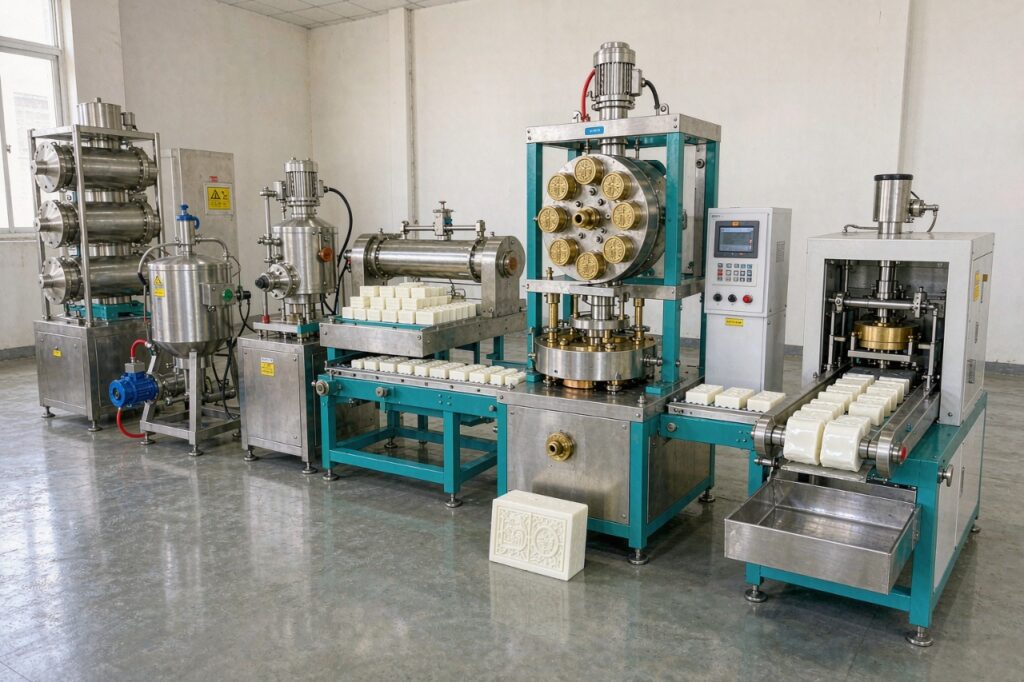
- Modular, servo-driven finishing lines now let first-time producers start below USD 50,000 in equipment capex and re-configure molds, cutters and wrappers for laundry, toilet and hotel soap SKUs on one line.
- Factory acceptance testing (FAT) and remote commissioning have become standard purchase criteria, shortening installation windows to 2–4 weeks after customs clearance.
1. A Delivery Wave in the Small-Format Band
The most recent machinery shipment records coming out of Henan and Tianjin tell a consistent story: the volume centre of gravity for new soap plant orders has shifted decisively toward compact lines. Zhengzhou Fanda Machinery alone logged a 500 kg/h saponification line delivered to Uganda in August, a 1,000 kg/h toilet soap finishing line shipped to Africa in mid-September, a 1,000 kg/h laundry soap line on 21 September, and a combined 2 t/h laundry-and-toilet-soap line dispatched on 9 October 2026. Tianjin Bright Machinery, meanwhile, announced an expansion of its international engineering fulfilment capacity specifically to serve “emerging entrepreneurs and medium-sized enterprises” across Southeast Asia, Africa, South America and the Middle East.
This is not a replacement for the megaproject cycle that has dominated headlines — 10 TPH national-scale plants in Nigeria, East Africa saponification complexes and the like. It is a parallel tier: hundreds of smaller entrants building 3–10 tonne-per-day operations around regional distribution networks, import-substitution policy and franchise-level brands.
| Delivery (2026) | Capacity | Configuration | Destination |
|---|---|---|---|
| 10 Aug | 500 kg/h | Saponification line | Uganda |
| 14 Sep | 1,000 kg/h | Toilet / hotel soap finishing line | Africa |
| 21 Sep | 1,000 kg/h | Laundry soap production line | Africa |
| 09 Oct | 2,000 kg/h | Combined laundry + toilet soap line | Africa |
Source: Zhengzhou Fanda Machinery shipment log, Aug–Oct 2026.
2. Why the Demand Floor Is Holding
Macro data supports the tier of small plants. Mordor Intelligence sizes the global soap market at USD 25.76 billion in 2025, rising to USD 26.91 billion in 2026 and USD 33.93 billion by 2031 — a 4.75% CAGR — with the Middle East and Africa flagged as the fastest-growing regional market and bar soap still representing roughly 97% of category revenue. Recent trade analysis puts 2025–2026 Middle East & Africa soap import growth at about 11.7% year-on-year, driven partly by water-scarce regions favouring low-foam, fast-rinse bar formats.
Two structural forces amplify small-line demand:
- Import substitution and tariffs. Regional trade frameworks and rising freight costs make local finishing from imported soap noodles increasingly competitive against finished-bar imports, especially where currency pressure raises landed consumer prices.
- Fragmented premium niches. Local brands can now defend 33% combined share in Africa and South Asia by adapting formulations to hard water and humid climates — something only feasible with in-house finishing capacity.
3. What the Equipment Actually Looks Like Now
The modern small-format line is a modular kit rather than a scaled-down factory. Current configurations share several design choices:
- Servo-driven electronic cutters that change bar length without gear swaps, letting one line cover 125 g laundry bars and 90 g hotel soap on the same shift.
- CNC-machined brass stamping dies with anti-stick ejection for logo embossing — a feature previously reserved for large OEM lines.
- Flexible saponification reactors rated for tallow, palm, coconut oil and direct fatty-acid routes, giving buyers raw-material optionality as palm prices fluctuate.
- Duplex vacuum plodders and triple-roll refiners in compact frames, bringing finished-bar texture quality within reach of first-time producers.
- Full FAT before shipment — lines are run on soap noodles at the factory and inspected live or via video, so commissioning after arrival takes weeks, not months.
4. The Investment Math for a 500–1,000 kg/h Plant
| Parameter | Typical Range (2026) |
|---|---|
| Line capacity | 500–2,000 kg/h (4–16 t/day) |
| Typical operator profile | First-time producer, regional brand, contract manufacturer |
| Core line | Mixer → refiner mill → vacuum plodder → servo cutter → stamper → wrapper |
| Raw material routes | Soap noodles (finishing) or full saponification from oils |
| Commissioning window | 2–4 weeks post-clearance with FAT pre-validated lines |
| Support model | Overseas engineer dispatch, video troubleshooting, remote diagnostics |
5. Outlook: Two-Tier Market, Two Playbooks
The equipment market is bifurcating. Multinationals continue to add 10 TPH+ national lines and automate dry ends ahead of digital product passport obligations, while the small-format tier expands on volume. For machinery suppliers, the strategic implications differ: large-line buyers buy compliance and throughput; small-line buyers buy flexibility, training and after-sales reach. Suppliers that pair compact hardware with multilingual documentation, spare-parts hubs and remote support — as both Tianjin Bright and the Henan cohort now advertise — are positioned to convert the emerging-market entry wave into long-term service annuities.
For prospective producers, the window favours action: with the fastest regional demand growth (MEA) running ahead of global CAGR and equipment lead times shortening, late-2026 and early-2027 slots determine who captures the next dry-season retail cycle.
Data Sources
- Mordor Intelligence, Soap Market Size & Share Analysis (2026–2031) — market size USD 25.76B (2025) / 26.91B (2026) / 33.93B (2031), CAGR 4.75%, MEA fastest-growing region.
- Zhengzhou Fanda Machinery, shipment news log, Aug–Oct 2026 — Uganda and Africa delivery records (500 kg/h, 2×1,000 kg/h, 2 t/h).
- Tianjin Bright Machinery, Soap Plant Machinery announcement — expanded international fulfilment, modular configurations, FAT protocol.
- Global laundry soap trade insights, 2026 — MEA import growth +11.7%; local/regional brand share gains in Africa & South Asia.