
Industry Analysis | June 2026
As consumer demand fragments across natural, specialty, and private-label soap categories, manufacturers face a structural inflection: invest in flexible production architecture or cede ground to more agile competitors. This analysis examines the equipment decision framework, ROI benchmarks, and regional procurement signals for H2 2026.
1. Market Context: Fragmentation Is the New Normal
The global soap production line market stands at USD 50.95 billion in 2025, projected to reach USD 79.38 billion by 2033 at a 5.7% CAGR (Cognitive Market Research). The equipment segment, narrower but faster-moving, is tracking 11–14.8% CAGR through 2033 — a divergence that reflects a structural replacement and upgrade cycle, not merely volume growth.
Behind these headline numbers is a more granular story: the product mix that manufacturers must serve is fragmenting rapidly. Average cosmetic and personal care brands now manage 40–60% more SKUs than five years ago (Kunbupack/Keypack 2026 industry analysis). Specialty categories — organic, vegan, herbal, medicated, hotel miniature, and private-label — are collectively growing faster than the commodity bar soap segment. Bar soap still commands ~60% of total volume, but premium and specialty formats are where margin lives.
This SKU proliferation is not a temporary trend. E-commerce-enabled direct-to-consumer distribution means that a facility producing 35 formulations with rapid launch cycles now competes with one that runs three standard formulas at maximum throughput. The equipment choices that determine who wins this competition are being made now.
2. The Flexibility Gap: What Legacy Lines Cannot Do
Traditional high-throughput soap production lines were engineered for a different competitive environment: run one or two standard formulations at maximum OEE, minimize downtime, and optimize cost per tonne. This architecture creates hidden costs that are invisible on a single-SKU P&L but devastating in a multi-SKU environment:
- Changeover time: Legacy plodder-based lines with fixed tooling require 2–4 hours per product transition — turning daily SKU switches into production-day losses.
- Formulation inflexibility: Lines optimized for palm-based hard bars struggle with high-glycerin, essential oil-rich, or syndet (synthetic detergent) formulations requiring different thermal profiles and viscosity handling.
- Minimum batch economics: Full-line setups impose minimum batch sizes of 500–1,000 kg, making small-batch specialty runs economically prohibitive without dedicated equipment.
- Integration debt: Older relay-based control systems lack recipe storage, HMI-driven parameter recall, and OPC-UA connectivity — preventing integration with MES/ERP systems that multi-SKU operations require.
The cost is quantifiable. A facility running 2–3 SKU changeovers per day on a 2-hour-each legacy line loses approximately 4–6 productive hours daily. At a fully-loaded line cost of $150–$300/hour (including depreciation, labor, energy, and overhead), this translates to $200,000–$450,000 in annual lost production for a mid-scale facility — before accounting for the revenue foregone by products that simply cannot be launched.
3. Equipment Architecture for Multi-SKU Flexibility
Achieving genuine production flexibility in soap manufacturing requires rethinking the line not as a fixed asset but as a configurable system. The four enabling elements are:
3.1 Modular Line Architecture
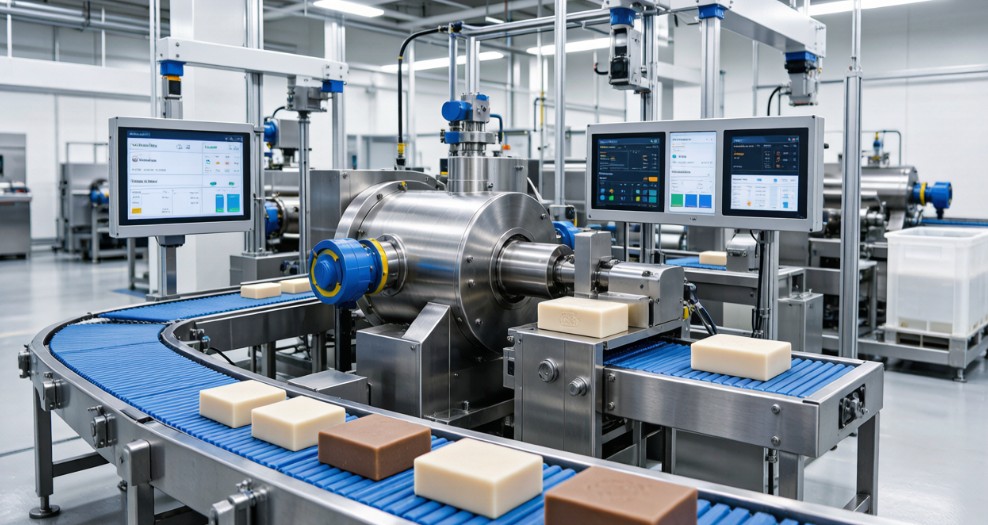
Modular systems allow incremental addition of production units — saponification reactor, vacuum crystallizer, plodder/extruder, refiner, cutter, stamping press, wrapper — without requiring a complete teardown-and-rebuild when production scope changes. The key procurement criterion is standardized inter-unit interfaces: mechanical coupling dimensions, electrical connectors, and control protocol compatibility (OPC-UA or equivalent). Modular systems from Chinese manufacturers are priced $38,000–$80,000 for semi-automatic configurations, while European engineered-to-spec systems run $100,000–$300,000+ for fully automatic lines.
3.2 PLC Recipe Management & Quick-Change Tooling
Modern PLC-based control systems with HMI touchscreen interfaces can store 50–100+ product recipes — encoding temperature profiles, mixing speeds, plodder pressure, cutter timing, and stamp force for each formulation. One-touch recipe recall, combined with quick-release tooling (color-coded, keyed components) on stamping dies and cutter blades, is the primary lever for compressing changeover time. Leading systems achieve 15–30 minute changeovers versus the 2–4 hour baseline of relay-controlled lines with fixed tooling — an 85%+ improvement documented in packaging industry case studies.
3.3 Capacity Segmentation Strategy
Not all SKUs require the same throughput. The operationally effective approach is a two-tier architecture:
- Flagship line (600–2,000+ kg/h): Fully automatic, optimized for the 3–5 highest-volume standard formulations. Run at maximum OEE with minimal changeover frequency.
- Flexible pilot line (100–500 kg/h): Semi-automatic, PLC-controlled, designed for rapid SKU rotation, new product trials, specialty/organic formulations, hotel amenity bars, and private-label orders. Unit economics are higher per tonne, but total batch economics are favorable given low minimum run sizes.
This architecture is more capital-efficient than attempting to engineer a single high-throughput line to be flexible — the physics of high-speed continuous extrusion are fundamentally incompatible with the frequent cleaning and die changes that small-batch specialty production requires.
3.4 CIP (Clean-in-Place) & Material Handling
Cross-contamination between formulations — especially between scented/colored specialty soaps and fragrance-free or medicated varieties — is a quality and regulatory liability. CIP systems, available on higher-end models, enable internal cleaning without disassembly, reducing changeover cleaning time from 45–90 minutes to 10–20 minutes. SS316 contact surfaces (versus the more common SS304) further reduce staining and absorption of essential oils and colorants, critical for premium positioning.
4. ROI Framework: The Economics of Flexibility Investment
The investment case for flexible production architecture is built on four value streams:
| Value Stream | Benchmark Impact | Mechanism |
|---|---|---|
| Changeover time reduction | 75–85% | Recipe recall + quick-change tooling |
| OEE improvement | 25–35% | Reduced changeover + predictive maintenance alerts |
| Waste reduction (changeover) | 50–60% | CIP + precise parameter control eliminates purge batches |
| New product velocity | 3× faster launch | Pilot-line trials → scale-up without dedicated equipment downtime |
| Labor cost | 30–40% reduction | Fewer operators for changeover; HMI-guided procedures |
| Payback period | 12–18 months | Typical for mid-scale operations with 15–25 SKUs, 2–3 changeovers/day |
For high-mix operations running 4+ daily changeovers, payback is often achieved in under 12 months. The key financial variable is not equipment cost but changeover frequency × revenue per production hour. A facility exporting premium soap to European retailers at $3.50–$5.50/bar finds the ROI calculus fundamentally different from one producing commodity household soap at $0.15/bar.
5. Segment Economics by Production Scale
| Scale | Capacity | CapEx Range | Best For |
|---|---|---|---|
| Artisanal / Startup | <100 kg/day | $5,000–$15,000 | Cold-process, custom blends, market testing |
| SME / Specialty | 100–500 kg/h | $20,000–$80,000 | Natural/organic lines, hotel amenity, private label |
| Mid-Scale Export | 500–1,200 kg/h | $80,000–$180,000 | Branded export, OEM contracts, multi-SKU portfolio |
| Industrial / Flagship | 1,200–2,000+ kg/h | $180,000–$300,000+ | Commodity volume, retail chain supply, emerging market entry |
The semi-automatic SME tier ($20,000–$80,000) is currently the fastest-growing purchase segment by unit count, driven by Asian and African manufacturers entering specialty export markets. Chinese supplier platforms report small-to-mid production line enquiries growing at double-digit rates through 2026, particularly from Southeast Asian contract manufacturers and Middle Eastern private-label producers seeking RSPO-certified palm oil capability.
6. Regional Demand Signals: Where Flexibility Investment Is Accelerating
| Region | Soap Market CAGR | Flexibility Driver |
|---|---|---|
| China | 8.6% | Liquid soap premiumization; domestic brand proliferation; OEM export diversification |
| India | 8.3% | Ayurvedic/herbal soap demand; PLI scheme CAPEX incentives; rural market tiering |
| North America | 7.8% | Clean beauty regulatory pressure; DTC brand scale-up; co-manufacturing contract demand |
| Southeast Asia | 7.1% | Palm oil certification compliance driving equipment upgrade cycle; halal soap segment growth |
| LATAM | 5.9% | Brazil/Mexico private-label market expansion; export-oriented SME equipment upgrades |
| Europe | 3.8% | Artisanal/natural soap premiumization; REACH compliance upgrades; sustainability certification |
The hospitality sector deserves specific mention: hotel soap production — miniature bars, branded shapes, custom fragrances — is a segment where flexibility equipment pays a disproportionate return. The hospitality soap line market is projected to hold the largest sub-segment share within soap stamping machines (Spherical Insights), driven by hotel chain sourcing that demands rapid changeover between branded specifications. A facility capable of switching between five hotel chain bar specifications in under 30 minutes captures fundamentally different contract economics than one requiring a full day’s retooling.
7. H2 2026 Procurement Decision Checklist
For procurement teams evaluating flexible production line investments in H2 2026, the following criteria separate operationally viable systems from technically impressive but inflexible ones:
- Recipe management capacity: Minimum 50 stored formulations with one-touch HMI recall. Verify that parameter sets include temperature, pressure, speed, and timing — not merely one or two variables.
- Changeover time guarantee: Request a contractual changeover time guarantee (target: ≤30 minutes) using your actual product portfolio. Insist on on-site demonstration before purchase.
- Material surface specification: SS316 for contact surfaces if running essential oil or colorant-intensive formulations. SS304 is adequate for standard palm/tallow bases.
- Control protocol openness: OPC-UA or MQTT connectivity for MES/ERP integration. Proprietary-only control systems create long-term integration debt.
- CIP capability: Available or retrofittable. Non-negotiable for operations switching between certified organic and conventional formulations in the same facility.
- Spare parts inventory: Confirm supplier stock of wear parts (dies, blades, seals) in-country or with ≤7-day delivery lead time. A 2-week parts lead time on a production-critical component is an operational liability.
- Certification scope: CE marking (EU market supply), ISO 9001 (quality system), and RSPO-compatible material handling where applicable. Verify — do not accept self-declaration without documentation.
8. Strategic Outlook: Flexibility as Competitive Moat
The underlying competitive dynamic in soap equipment procurement has shifted. Five years ago, the dominant value driver was scale efficiency — buying the highest-throughput continuous line that unit economics justified. Today, for all but the pure commodity volume segment, the primary value driver is product portfolio agility: the ability to launch new formulations faster, serve niche contracts that single-SKU lines cannot touch, and absorb raw material disruptions by switching formulations without production paralysis.
The equipment market is responding. Leading Chinese manufacturers — who supply the majority of the global semi-automatic and mid-scale segments — are incorporating PLC-based recipe management, quick-change tooling systems, and CIP capabilities as standard features at price points that previously commanded only basic relay-controlled equipment. This democratization of flexibility technology represents a genuine market inflection point: the ROI case that previously justified only for premium European or North American market suppliers now applies to emerging-market manufacturers serving regional specialty demand.
Manufacturers entering or expanding production capacity in H2 2026 face a clear strategic fork: a high-throughput single-SKU line optimized for commodity volume, or a modular flexible system that can evolve with the portfolio. The market data suggests the latter is increasingly the dominant choice — not as a premium option, but as the standard architecture for any facility with ambitions beyond a single core formulation.
Key Takeaways
- Soap equipment market CAGR (11–14.8%) is outpacing overall production line growth (5.7%) — driven by upgrade and flexibility investment, not volume growth alone.
- Multi-SKU manufacturers with legacy 2–4 hour changeover lines face $200,000–$450,000 in annual lost production; flexible systems with 15–30 minute changeovers recover this within 12–18 months.
- A two-tier architecture (high-volume flagship + flexible pilot line) delivers better capital efficiency than engineering a single line for both roles.
- Semi-automatic SME lines ($20,000–$80,000) are the fastest-growing purchase segment in 2026, reflecting emerging-market specialty export expansion.
- Hospitality and private-label OEM are the highest-ROI sub-segments for flexibility investment due to rapid specification switching and premium per-unit pricing.
- Technology floor has risen: PLC recipe management, quick-change tooling, and OPC-UA connectivity are now baseline expectations at mid-market price points.
Data sources: Cognitive Market Research (Soap Production Line Market 2025–2033); Accio Business Intelligence (June 2026); Alibaba SmartBuy Buying Guide (Nov 2025); Kunbupack/Keypack Industry Analysis (Jan 2026); Spherical Insights (Soap Stamping Machine Market 2026); LinkedIn MR Reports (Soap Making Machine CAGR Analysis 2026–2033). Market figures are directional and subject to revision; readers are advised to verify with primary sources for procurement decisions.
© 2026 STING Industry Intelligence | www.sting-industry.com