
Industry Analysis | June 2026
As e-commerce and subscription channels reshape soap distribution, manufacturers are investing in high-speed filling and packaging lines, flexible formulation systems, and raw-material intelligence to capture premium growth. This analysis examines the data signals and procurement implications for H2 2026.
1. Market Context: The Channel Shift Driving Equipment Demand
The global soap production line market stands at USD 50.95 billion in 2025 and is projected to reach USD 79.38 billion by 2033 at a 5.7% CAGR (Cognitive Market Research / Accio). The broader soap market, measured by Mordor Intelligence, is more conservative but directionally consistent: USD 25.76 billion in 2025 rising to USD 33.93 billion by 2031 at a 4.75% CAGR.
What distinguishes the 2026 cycle from prior years is not aggregate volume alone, but the channel mix. Online retail is now the fastest-growing distribution channel for soap products at a 5.89% CAGR through 2031 (Mordor Intelligence). Subscription boxes, direct-to-consumer (DTC) brands, and marketplace sellers are demanding smaller batch sizes, faster changeovers, and shelf-ready primary packaging that legacy bulk-lines were never designed to produce.
This channel shift is colliding with another structural force: premiumization. Natural and organic soap is the fastest-growing product sub-segment at a 5.86% CAGR (Mordor Intelligence). Bar soap still dominates with a 60.3% volume share (Verified Market Research), but liquid soap is expanding at 7.2% CAGR toward USD 49.7 billion by 2036 (Future Market Insights via Accio). The equipment implication is clear: a one-format, one-packaging, one-channel line is no longer a viable default.
2. The Google Trends Signal: Filling & Packaging Automation Peaks
In February 2026, Google search interest for the query “high-speed soap filling and packaging line” reached a normalized peak score of 100 — the highest reading on record (Accio / Google Trends). This is not a seasonal blip. The same period saw elevated search interest for automatic soap production lines, continuous soap manufacturing equipment, and high-speed filling and packaging systems.
The spike signals a concentrated procurement research phase. Buyers — including contract manufacturers, DTC brands, and emerging-market exporters — are actively evaluating the downstream end of the line: filling nozzles, capping stations, labeling systems, cartoners, and case packers. This is a meaningful shift from the earlier focus on upstream saponification and extrusion capacity. It suggests that the industry bottleneck in 2026 is not making soap, but packaging it profitably at the speed and variety the market demands.
- Packaging speed mismatch: Manual or semi-automatic filling lines that handle 30–60 bottles per minute cannot meet e-commerce fulfillment economics when DTC brands require 500–1,000+ units per run.
- Format complexity: Subscription and retail channels require multiple bottle sizes, refill pouches, sampler sets, and gift bundles — often on the same shift.
- Label compliance overhead: Markets such as the EU, Japan, and California require ingredient transparency, batch codes, and recycling labels that change with formulation and destination.
- Damage rates: E-commerce shipping exposes packaging to higher stress than retail shelf distribution. Leakers and cracked caps increase return rates and negative reviews.
3. Premiumization: The Natural/Organic and Specialty Formulation Surge
Consumer willingness to pay for ingredient transparency is translating directly into equipment requirements. Natural and organic soap growth at 5.86% CAGR (Mordor Intelligence) is outpacing the overall market, and the segment has distinct processing constraints: lower tolerance for synthetic stabilizers, higher sensitivity to temperature, and frequent formulation changes for seasonal or limited-edition SKUs.
Premium liquid soap also requires precise dosing and clean-fill environments. A single contaminated batch can destroy brand equity built on “clean” positioning. The result is demand for pharmaceutical-grade filling environments — SS316 contact surfaces, clean-in-place (CIP) systems, and inline particle detection — on equipment that historically operated at cosmetic-grade standards.
For bar soap, premiumization manifests in artisan embossing, custom molds, and natural colorants. The June 2026 product launches highlighted by Mordor Intelligence — including ayurvedic and cold-process formulations with 78% TFM and pH-balanced recipes — require equipment that preserves delicate botanical actives rather than maximizing throughput at any cost.
4. Regional Demand Matrix: Where Equipment Investment Is Accelerating
| Region | Key Metric | Equipment Driver |
|---|---|---|
| Asia-Pacific | 37.56% global revenue share | Capacity expansion in China, India, Indonesia; automation ROI rising with labor costs. |
| China | Liquid soap CAGR 8.6% | Domestic premium liquid soap demand; export-oriented packaging automation. |
| India | Liquid soap CAGR 8.3% | Ayurvedic/herbal specialty lines; PLI scheme localization; Middle East export demand. |
| North America | Liquid soap CAGR 7.8% | DTC/subscription brands; clean-label compliance; co-manufacturing contract growth. |
| Middle East & Africa | Fastest CAGR 5.26% | Localization, hotel amenity demand, and government hygiene initiatives. |
| Europe | Premiumization leader | REACH compliance, refill/reuse packaging, sustainable sourcing certifications. |
5. Raw-Material Intelligence: Why Formulation Flexibility Is Now a Risk Control Tool
Raw material volatility remains a primary risk for soap manufacturers. Lauric acid prices, derived from coconut and palm kernel oils, are expected to remain firm through H1 2026 before modest easing in H2 as Indonesian palm kernel oil output recovers (Oleochemicals Asia). Palm oil itself is up approximately 13.9% year-over-year (Trading Economics), reflecting ongoing supply constraints and biofuel demand competition.
This volatility changes the equipment specification. A manufacturer locked into a single high-throughput line optimized for a fixed palm-tallow base cannot economically respond to cost spikes in coconut oil or shifts in RSPO-certified supply availability. The procurement priority is therefore shifting toward:
- Recipe-driven formulation systems: PLC-controlled saponification and mixing that can switch between fat/oil bases without manual reconfiguration.
- Variable viscosity handling: Filling pumps and nozzles that accommodate both high-glycerin liquid soaps and thinner surfactant blends.
- Small-batch economics: Pilot lines that can test alternative raw-material inputs without tying up the flagship line.
- Certified-material segregation: RSPO, organic, and fair-trade inputs require dedicated batches and traceability records that integrated MES systems can enforce.
6. Packaging Automation: The New Competitive Bottleneck
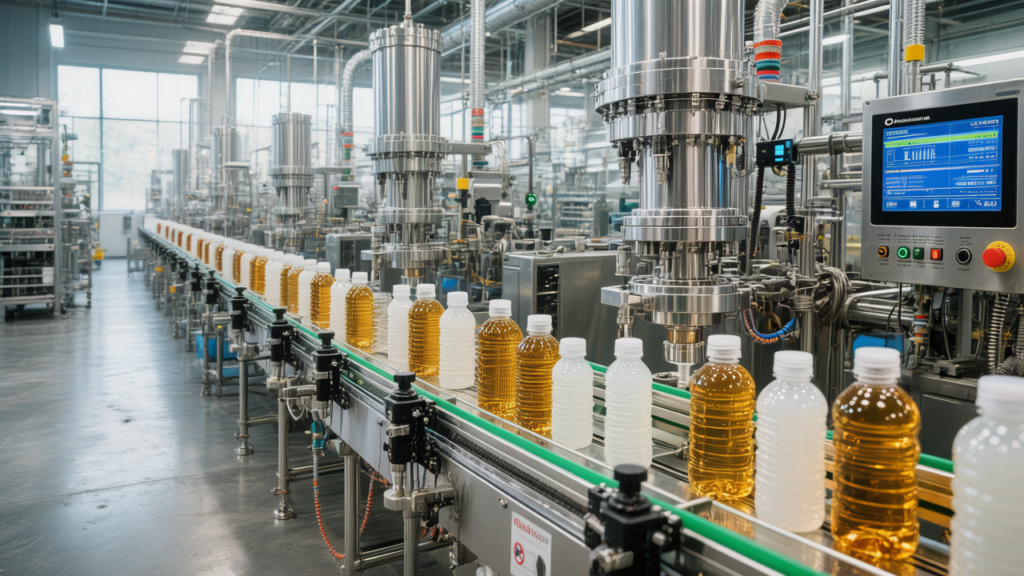
The filling-to-packaging segment is where the 2026 investment wave is most visible. A modern high-speed liquid soap line typically integrates:
| Station | Function | Why It Matters in 2026 |
|---|---|---|
| Bottle Depalletizer / Feeder | Supply containers | Accommodates PET, glass, aluminum, and refill formats without manual change parts. |
| Filling System | Dose liquid soap | Volumetric, gravimetric, or piston fillers with ±0.5% accuracy for premium positioning. |
| Capping / Pump Closure | Seal container | E-commerce durability is critical; torque consistency reduces damage rates. |
| Labeling | Apply labels | Supports multi-language, variable batch codes, and regional compliance labels. |
| Cartoning / Case Packing | Pack for shipment | Configures for retail cases, subscription boxes, and mixed-SKU variety packs. |
| Palletizing | Stack for dispatch | Pattern flexibility for mixed retail and e-commerce fulfillment. |
Entry-level semi-automatic filling and capping lines for SMEs are typically priced between USD 20,000 and USD 80,000, while fully automatic integrated lines for mid-scale export operations range from USD 80,000 to USD 300,000+. The payback period for packaging automation in high-mix DTC operations is commonly 12–18 months, driven by labor reduction, damage-rate improvement, and throughput increase.
7. H2 2026 Procurement Decision Checklist
For procurement teams evaluating soap filling and packaging investments in H2 2026, the following criteria separate operationally viable systems from technically impressive but inflexible ones:
- Format changeover speed: Target ≤15 minutes for bottle size and label changeovers; demand on-site demonstration with your actual SKUs.
- Fill accuracy: Specify ±0.5% gravimetric or volumetric accuracy at production speed; verify with repeatability data.
- Material compatibility: SS316 contact surfaces for natural/organic formulations; confirm compatibility with essential oils and plant extracts.
- E-commerce durability: Request shipping-test data for closures and seals; specify leakage-rate targets.
- Integration openness: OPC-UA or MQTT connectivity for ERP/MES and batch traceability; avoid proprietary-only controls.
- Scalability: Prefer modular stations that allow future addition of labeling, cartoning, or palletizing modules without line replacement.
- Certification documentation: CE marking, ISO 9001, and RSPO-compatible material handling documentation where relevant.
8. Strategic Outlook: Packaging as the New Moat
The H2 2026 investment cycle is defined by a simple reality: the soap itself is increasingly commoditized, while the packaging, format, and channel execution are where margin and market share are won. Manufacturers that can switch between a 500 mL retail bottle, a 250 mL subscription bottle, and a 1 L refill pouch on the same shift — without manual rework, contamination risk, or compliance errors — will capture the premiumization and e-commerce growth that the market data clearly points to.
The Google Trends peak in February 2026 was a leading indicator of this shift. The equipment vendors that respond with modular, recipe-driven filling and packaging lines — at price points accessible to mid-scale and emerging-market manufacturers — will shape the competitive landscape through 2030. The procurement window for buyers is now: lead times for automation equipment are extending, and the manufacturers that place orders in H2 2026 will secure capacity before the next wave of demand.
Key Takeaways
- Google search interest for “high-speed soap filling and packaging line” peaked at 100 in February 2026, signaling concentrated buyer research in packaging automation.
- E-commerce and online retail (5.89% CAGR) and natural/organic soap (5.86% CAGR) are the fastest-growing demand vectors, reshaping equipment requirements.
- Liquid soap is growing at 7.2% CAGR, with China (8.6%), India (8.3%), and North America (7.8%) leading regional expansion.
- Raw-material volatility — palm oil up ~13.9% YoY and firm lauric acid prices — makes formulation flexibility a risk-management priority, not just a cost issue.
- Packaging automation is now the primary bottleneck: mid-scale DTC and contract manufacturers commonly achieve 12–18 month payback on flexible filling and capping lines.
- H2 2026 procurement should prioritize format changeover speed, fill accuracy, e-commerce durability, and control-system openness.
Data sources: Cognitive Market Research (Soap Production Line Market 2025–2033); Accio Business Intelligence (Soap Production Line Trends 2026); Mordor Intelligence (Soap Market Report 2026–2031); Verified Market Research (Soap Production Line Market); Future Market Insights (Liquid Soap Market); Oleochemicals Asia (Lauric Acid Price Outlook 2026); Trading Economics (Palm Oil Price Data). Market figures are directional and subject to revision; readers are advised to verify with primary sources for procurement decisions.
© 2026 STING Industry Intelligence | www.sting-industry.com