
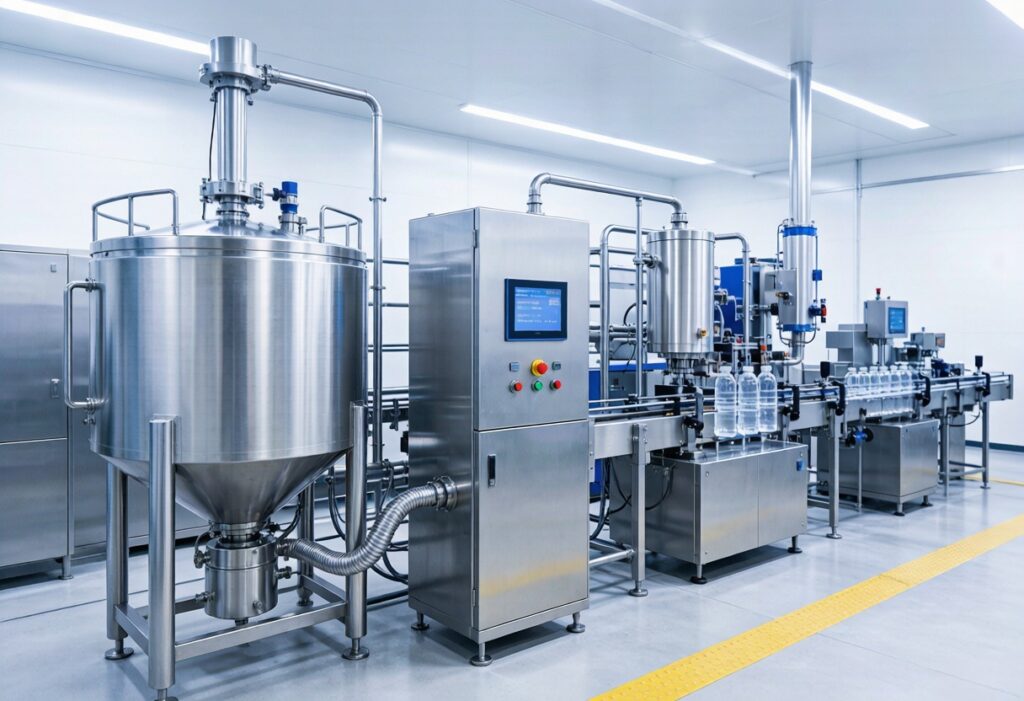
1. Three Landmark Liquid Soap Capex Announcements Define August 2026
Three projects announced across the Africa–Middle East corridor in 2026 confirm that liquid soap capex is no longer concentrated in East Asia or Europe. They reframe the regional procurement map for the second half of the year.
| Project | Location | Capacity | Significance |
|---|---|---|---|
| Unilever OMO Liquid Detergent Line | Saudi Arabia | Not disclosed; PE-recyclable bottle integration | First OMO liquid detergent line localized in Kingdom; circular packaging supply chain |
| Heshima Soap Manufacturing Facility (JITEGEMEE Trading) | Tambukareli, Dodoma, Tanzania | 216,000 L/month liquid soap; 7 SKUs (multipurpose, disinfectant, tile cleaner, handwash, bleach) | Largest single liquid soap line launch in East Africa in H1 2026; 50+ direct jobs |
| Rafa Corporation Continuous Saponification | Lagos, Nigeria | 10 TPH continuous saponification + 2×4-TPH toilet soap finishing lines | Largest single-line continuous saponification in West Africa (MIL India supplier; Starium Detergents FZE partner); positions Lagos as regional export hub |
The three projects span the full liquid-soap value chain: upstream saponification (Rafa), midstream liquid detergent mixing and emulsification (Unilever KSA), and downstream multi-SKU filling and packaging (Heshima Tanzania). Together they validate that procurement flows have shifted decisively away from a 2020-2024 pattern dominated by China- and India-headquartered buyers.
2. Market Structure: Liquid Soap Equipment at 7.2% CAGR — The Capex Disconnect
Independent market data from Accio Business Insights and Verified Market Research confirms liquid soap equipment is structurally outpacing the broader soap machinery market:
| Segment | 2025 | 2036 Forecast | CAGR | Source |
|---|---|---|---|---|
| Global soap production line market | USD 50.95 B | USD 79.38 B (2033) | 5.7% | Accio / Cognitive MR |
| Liquid soap equipment sub-segment | USD 23.3 B | USD 49.7 B | 7.2% | Future Market Insights / Accio |
| Global liquid hand sanitizer market | USD 4.26 B | USD 5.72 B (2032) | 6.2% | PMarketResearch |
| Global hand sanitizer market (all formats) | USD 48 B | USD 78 B (2030) | ~9.3% (2026-Q1 run-rate) | GEP Research |
The capex disconnect matters for procurement teams: while the broader soap machinery market grows at 5.7%, liquid soap equipment grows at 7.2% — a ~150 bps annual premium that compounds to a near-doubling of the addressable liquid-equipment market between 2025 and 2036. For finance directors modeling equipment amortization over a 10-year asset life, this means liquid-format capacity carries structurally faster payback than bar-soap capacity in the same period.
3. Liquid Soap Production Line Architecture: The Five-Station Value Chain
Unlike a bar soap line — where the bottleneck has historically been the mixing room or the finishing line — a liquid soap line is structured around five sequential but interdependent stations. Each station has its own technology decision points and capex profile:
| Station | Function | 2026 Standard Specs | Critical Decision |
|---|---|---|---|
| 1. Water treatment | RO + softening; removes Ca²⁺/Mg²⁺ that destabilize surfactants | ≤10 ppm TDS; SS304/316; ≤0.5 L water per kg product (closed-loop) | Closed-loop vs once-through — sustainability gate |
| 2. Mixing & emulsification | Dissolve AES/AESA/LSA; homogenize oils, fragrances, actives | Tank 50–20,000 L; top stirrer 0–65 rpm; bottom homogenizer 0–3500/4200 rpm; SS316L contact parts; vacuum deaeration optional | Batch kettle vs continuous loop; vacuum deaeration for premium SKUs |
| 3. Storage & transfer | Buffer tank; hold finished product before filling | SS316L or HDPE; 50–5,000 L; slow agitation to prevent separation | Material segregation for RSPO/organic batches |
| 4. Filling | Volumetric / gravimetric / piston fill; ±0.5% accuracy | 8/12/18/24/32/40/50/60/72 valve rotaries; 2,000–25,000 BPH (500 ml); PET/glass/aluminium; ≤15-min changeover | Viscosity-adaptive nozzles for gel vs thin formats |
| 5. Capping, labeling, & cartoning | Screw cap / pump closure; multi-language labels; case pack & palletize | Torque consistency for e-commerce leakage; OPC-UA / MQTT integration | E-commerce durability testing now a procurement gate |
The bottleneck has shifted. Where 2020-2023 line designs placed the bottleneck at the mixing/homogenization stage (large-batch cycle times of 60-90 minutes), 2026 procurement patterns push the constraint downstream to the filling-and-packaging stage. The reason: high-speed rotary fillers (8,000-25,000 BPH) and integrated capping-labeling-cartoning lines now represent the single largest capex line item in new liquid soap plant projects, particularly for producers serving both retail bottles and refill-format SKUs.
4. Equipment Vendor & Spec Landscape: Mid-August 2026 Cross-Section
The mid-August 2026 vendor landscape for liquid soap equipment is dominated by Chinese and Indian manufacturers across the SME and mid-tier segments, with European and U.S. vendors retaining the premium and institutional segments. The table below consolidates verified specifications from active Made-in-China and vendor catalogue entries as of August 2026:
| Vendor | Country | Model / Range | Capacity | Drive / Material | Indicative Price |
|---|---|---|---|---|---|
| Yangzhou ZhiTong | Jiangsu, China | ZT-series homogenizing mixer | 200 L – 5,000 L | Top stirrer 0–65 rpm; homogenizer 0–4200 rpm; SS304/316; CE/ISO | USD 3,200+ per unit |
| Guangzhou Yuxiang | Guangdong, China | YX-JBJ mixing plant | 100 L – 10,000 L | SS316 contact / SS304 platform; Siemens motor; hydraulic lift; CE/ISO/GMP | USD 8,000–18,000 |
| SC Mixer (SCM) | China | SLM-series homogenizer | 200 L – 5,000 L | Top agitator 0–53 rpm; homogenizer 0–3,000 rpm; SUS316L / SUS304; CE; 2-yr warranty | Quote on request |
| Yalian Cosmetic Machinery | Guangzhou, China | YMC-series homogenizer vessel | 50 L – 5,000 L | Top stirrer 0–65 rpm; bottom homogenizer 0–3,500 rpm; Siemens/ABB; jacket heating | USD 1,568–3,568 |
| Guangzhou Lianhe | Guangzhou, China | Vacuum emulsifying mixer + filling line | Up to 5,000 L batch | ISO 9001/GMP; turnkey liquid soap line supplier (1996 established) | Turnkey quote |
| COSMATI | Guangzhou, China | CM-SGB-B filling + capping | 2,000–3,000 BPH; 5–250 ml | Servo piston; Panasonic motor; ±0.5% accuracy; SS316 contact | USD 10,000–20,000 |
| Newlink Machinery | Zhangjiagang, China | CGF rotary monoblock (wash-fill-cap) | 2,000–25,000 BPH (500 ml); 8–72 valves | PLC + touchscreen; SUS304/316; CE/SGS; ≤30-min changeover | USD 9,500–98,000 |
| Geoenix | Mumbai, India | Turnkey liquid soap plant | Custom | Fully automated; SS hygienic construction; exported from India | Turnkey quote |
The price band from USD 1,568 (Yalian entry-level homogenizer) to USD 98,000 (Newlink high-speed rotary monoblock filler) defines the accessible capex range for liquid soap lines in 2026 — an order-of-magnitude wider than the band for bar soap finishing lines. This breadth is precisely what is enabling SME market entry across Sub-Saharan Africa and Southeast Asia: a Nigerian or Vietnamese entrepreneur can launch a credible 200 L batch handwash line for under USD 5,000, while a multinational like Unilever commissions a fully integrated PE-bottle OMO line at two orders of magnitude higher.
5. Regional Demand Matrix: Where Liquid Soap Capex Is Concentrating
The August 2026 regional pattern confirms three structural demand centers: Asia-Pacific as the volume anchor, Middle East & Africa as the highest-growth frontier, and Latin America as a mid-tier growth corridor:
| Region | Liquid Soap Equipment CAGR (2026–2036) | 2026 Investment Driver | Capex Tier in Focus |
|---|---|---|---|
| China | 8.6% | Urbanisation + premiumisation + domestic brand expansion | Mid-to-high-tier integrated lines (USD 50K–500K) |
| India | 8.3% | Rising middle class + hygiene habit formation + PLI scheme | Domestic Geoenix-tier + Chinese mid-tier (USD 8K–80K) |
| North America | ~7.8% | Healthcare compliance + refillable format adoption + DTC brands | Premium integrated + Pharma-grade CIP (USD 80K–500K+) |
| Middle East & Africa | 5.26% headline / 11.4% liquid-hand-sanitizer sub-segment | Unilever OMO KSA, Heshima Tanzania, Rafa Nigeria — three simultaneous H1 2026 project announcements | SME semi-auto (USD 2K–20K) + mid-range turnkey (USD 30K–300K) |
| Latin America | Above-average | Brazil & Mexico urban market expansion; natural-soap premium | Cost-efficient automated lines (USD 30K–150K) |
| Europe | Steady | REACH compliance + refill/reuse packaging + ISO 22716 GMP | Sustainability-led premium lines |
| Southeast Asia | 8%+ | Tourism rebound +14.6% portable-format export (2025); Indonesia private-label expansion | Mid-tier Chinese + Indian turnkey |
The standout signal in this matrix is the Middle East & Africa region: its headline soap-equipment CAGR of 5.26% obscures a much faster sub-segment in liquid-hand-sanitizer equipment, where GEP Research data shows a regional sales growth rate of 11.4% — more than double the regional average. The combination of Unilever’s Saudi OMO line, Heshima’s Tanzanian 216,000 L/month facility, and Rafa’s Nigerian 10-TPH saponification backbone means the entire Africa-Middle East corridor is now absorbing both upstream saponification equipment and downstream filling-and-packaging equipment simultaneously — a pattern previously seen only in China during 2018-2020.
6. Liquid Hand Sanitizer Sub-Segment: The 6.2% CAGR Parallel Market
Within the liquid soap equipment universe, hand sanitizer manufacturing has crystallized as a distinct sub-segment with its own demand drivers, formulation chemistry (60-95% ethanol or isopropanol), and equipment specification (explosion-proof motors, volatile-solvent handling, sealed transfer). Mid-2026 market data:
| Metric | Value (2025) | Forecast | Source |
|---|---|---|---|
| Global liquid hand sanitizer market | USD 4.26 B | USD 5.72 B by 2032 (6.2% CAGR) | PMarketResearch |
| Global hand sanitizer (all formats) | USD 48 B | USD 78 B by 2030 | GEP Research |
| North America 2025 share | USD 1,375.86 M | Largest regional value | PMarketResearch |
| Asia-Pacific share (forecast) | 37%+ global | Fastest-growing region | GEP Research |
| China 2025 consumption | USD 2.81 B (32.1% global) | Share rising to 27% of hand sanitizer by 2030 | GEP Research |
| Middle East & Africa sales growth | — | +11.4% in 2026 | GEP Research |
| Southeast Asia export growth | +14.6% in 2025 | Tourism rebound-driven | GEP Research |
For equipment manufacturers, the hand sanitizer sub-segment requires specification differentiation: explosion-proof motors (ATEX/IECEx certified for ethanol vapour atmospheres), stainless-steel piping compatible with 60-95% alcohol, sealed transfer pumps, and CIP/SIP capability for healthcare-grade output. Chinese vendor COSMATI’s CM-SGB-B (USD 10,000-20,000, ±0.5% servo-piston accuracy, Panasonic drive) sits squarely in this segment, while ATEX-certified European equipment typically prices 3-5× higher for equivalent throughput.
7. CapEx Matrix: Four Tiers Define the 2026 Procurement Window
The August 2026 capex landscape for liquid soap production lines splits into four identifiable tiers. Each tier has its own ROI profile, target buyer profile, and dominant vendor set:
| Tier | CapEx Band | Typical Output | Target Buyer | Indicative Payback |
|---|---|---|---|---|
| T1 — Entry | USD 2,000–20,000 | 200–500 L/day; semi-automatic batch; manual fill & cap | African / Southeast Asian SME startups; private-label launches | 6–12 months |
| T2 — SME Integrated | USD 20,000–80,000 | 500–2,000 L/day; semi-auto mix + 2,000–3,000 BPH filler | Mid-scale producers in Nigeria, Kenya, Indonesia, Vietnam | 12–24 months |
| T3 — Mid-Range Automated | USD 80,000–300,000 | 2,000–10,000 L/day; 8,000–18,000 BPH integrated line; PLC + IoT | Export-oriented manufacturers in India, Egypt, Türkiye, Brazil | 18–36 months |
| T4 — Institutional Turnkey | USD 300,000–5,000,000+ | 10,000+ L/day; 18,000–25,000 BPH; full IoT/MES + CIP/SIP | Unilever, P&G, Reckitt, Johnson & Johnson; regional FMCG leaders (Rafa, Heshima) | 24–60 months (volume-dependent) |
Tier 1 and Tier 2 are where the volume of order flow is concentrated in August 2026 — driven by African and Southeast Asian SME entry. Tier 3 is the most competitive vendor battleground, with Chinese (ZhiTong, Yuxiang, Newlink, COSMATI) and Indian (Geoenix) vendors aggressively contesting mid-tier contracts. Tier 4 remains dominated by European and U.S. institutional-equipment vendors, though Chinese turnkey suppliers are increasingly credible at the lower end of the Tier 4 band.
8. H2 2026 Procurement Checklist: Seven Non-Negotiable Specifications
For procurement teams evaluating liquid soap production lines in the second half of 2026, the following specifications separate operationally viable systems from technically impressive but inflexible ones. Each criterion maps to a measurable procurement requirement:
| # | Specification | 2026 Requirement | Why It Matters Now |
|---|---|---|---|
| 1 | SS316L contact surfaces | Tank, agitator, homogenizer, all product-contact parts verified SS316L (not SS304) | Essential oils, plant extracts, and preservatives in natural/organic formulations corrode SS304 over time |
| 2 | Viscosity-adaptive filling | Servo-piston or mass-flow meter; ±0.5% accuracy across 100 cP – 10,000 cP range | Premium SKUs (gel, lotion, cream formats) and thin surfactants on the same line |
| 3 | Quick-changeover (QCO) | ≤15 minutes for bottle-size, label, and cap changeover; on-site demonstration with buyer SKUs | SKU proliferation across natural, antibacterial, refill-format SKUs |
| 4 | PLC + IoT connectivity | PLC/SCADA with OPC-UA or MQTT; remote OEE dashboard; ≤35% downtime reduction | Now baseline — not premium — for buyers in Egypt, Nigeria, Indonesia, Vietnam |
| 5 | Closed-loop water | <0.5 L water per kg soap produced; CIP recovery integrated | EU wastewater directives + tightening Southeast Asian regulations |
| 6 | E-commerce closure testing | Torque consistency; ISTA 3A shipping test data; leakage-rate target | DTC and subscription sales now a structural channel — leakage returns destroy unit economics |
| 7 | RSPO traceability & MES integration | MES that segregates RSPO Mass Balance / Segregated / Identity Preserved batches; lot-level traceability | EU Deforestation Regulation (EUDR) compliance + ISO 22716 GMP for healthcare buyers |
9. Conclusion: The Liquid Soap Capex Window Is Open — But Closing
The convergence of three structural forces — a 7.2% equipment CAGR (vs 5.7% for the broader market), three simultaneous landmark project announcements across Africa and the Middle East in H1 2026, and a four-tier capex matrix that runs from USD 2,000 SME entry to USD 5M+ institutional turnkey — defines the August 2026 procurement window.
For equipment buyers, the strategically significant shift is that liquid soap capex is no longer a China- or India-only decision. The August 2026 order book includes a Saudi OMO line, a Tanzanian 216,000-litre-per-month multi-SKU facility, and a Nigerian 10-TPH continuous saponification backbone — each representing a distinct buyer profile and tier. Vendors able to deliver SS316L contact parts, viscosity-adaptive filling, ≤15-minute QCO, and IoT-enabled MES integration at the T2-T3 band (USD 20,000-300,000) will absorb the bulk of new orders through H1 2027.
For STING and comparable mid-tier soap equipment suppliers, the actionable implication is that the liquid soap sub-segment warrants explicit overweight in the second-half 2026 product roadmap. The bar soap finishing line market — covered in prior weeks — remains structurally slower (5.7% CAGR) and increasingly commoditized. The 7.2% CAGR liquid soap window is open today; the question is how quickly a vendor can credibly occupy the T2-T3 band with verifiable QCO, SS316L, and IoT specifications.
Data sources: Accio Business Insights (April 2026); Future Market Insights / Accio (Liquid soap equipment USD 23.3 B → 49.7 B, 7.2% CAGR through 2036); Verified Market Research (March 2026 update); PMarketResearch (Liquid Hand Sanitizer Market 2026); GEP Research (Global hand sanitizer market USD 48 B / 78 B by 2030; MEA +11.4% 2026; SEA +14.6% 2025; China USD 2.81 B 32.1% share); Data Insights Reports (CAGR 6.2% 2026-2034); Archive Market Research (Liquid Hand Sanitizer 660.55 M / 7.7% CAGR); Packaging MEA (Unilever OMO liquid detergent line Saudi Arabia 2026); JITEGEMEE Trading Co. Ltd / jtcl.co.tz (Heshima Soap Tambukareli Dodoma facility 216,000 L/month January 2026); StreamlineFeed / Nairametrics (Rafa Corporation 10-TPH continuous saponification Lagos, MIL India, Starium Detergents FZE, July 28 2026); Made-in-China vendor catalogues (Yangzhou ZhiTong ZT-series, Guangzhou Yuxiang YX-JBJ, SC Mixer SLM-series, Guangzhou Yalian YMC-series, Guangzhou Lianhe, COSMATI CM-SGB-B, Zhangjiagang Newlink CGF-series, Geoenix Mumbai); Accio / Sting Industry Insights (5-station architecture, 4-tier capex matrix, regional CAGRs); Shree Balaji Detch Em (Bar vs Liquid Soap comparison). All market size figures in USD. CAGR projections sourced from third-party research institutions and provided for informational purposes.
© 2026 STING Industry Insights · www.sting-industry.com · Published August 17, 2026