
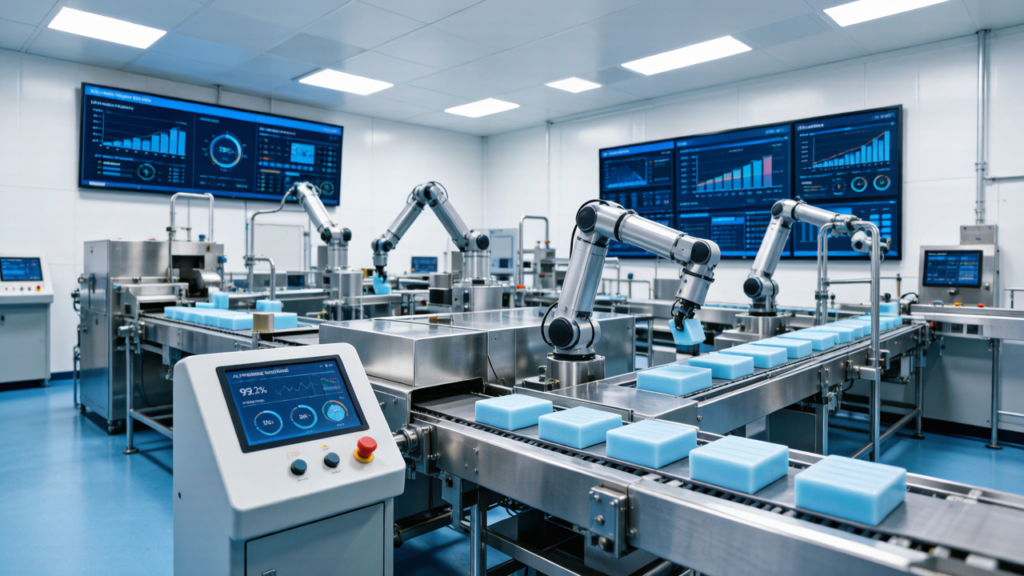
As H2 2026begins, the soap equipment sector is showing three clear signals: market-sizing forecasts are converging around a multi-billion-dollar growth trajectory, AI-based monitoring is moving from pilot to production-line standard, and Indonesia’s B50 biodiesel mandate is forcing a raw-material rethink. This analysis connects the data points and maps what they mean for buyers specifying new lines in Q3.
In This Analysis
- Market Data Convergence: The Numbers Align
- AI and Smart Monitoring: The 19% Defect-Detection Advantage
- B50 Biodiesel Is Live: Palm-Oil Supply Realignment
- Equipment Mix: Saponification, Extrusion, and Finishing
- Regional Demand Matrix
- H2 2026 Procurement Signals
1. Market Data Convergence: The Numbers Align
A cross-check of recent forecasts from Mordor Intelligence, IMARC, Future Market Insights, and Kingpin Market Research shows a coherent picture: the end-product market is growing at a mid-single-digit pace, while the equipment and production-line layers are expanding faster, driven by automation and sustainability upgrades.
| Source | Scope | 2026 Value | Forecast Year | CAGR |
|---|---|---|---|---|
| Mordor Intelligence | Global soap market | $26.91B | 2031 | 4.75% |
| IMARC | Bath soap market | $25.48B | 2034 | 3.60% |
| IMARC | Hand soap market | $23.30B | 2034 | 5.20% |
| Future Market Insights | Liquid soap market | $24.8B | 2036 | 7.20% |
| Mordor Intelligence | Bath & shower products | $53.01B | 2031 | 4.39% |
| Kingpin Market Research | Soap production line | $888.39M | 2035 | 4.10% |
| PW Consulting | Soap making machine | $1.68B | 2032 | 4.80% |
| Cognitive / Accio | Soap production line | $50.95B | 2033 | 5.70% |
Key signal: The liquid soap segment (7.2% CAGR) and the dedicated soap-making machine market (4.8% CAGR) are both outpacing the broader bath-soap end-product market (3.6% CAGR). This confirms that capital spending is shifting toward equipment that supports format diversification, automation, and higher throughput rather than simple capacity expansion.
2. AI and Smart Monitoring: The 19% Defect-Detection Advantage
According to Kingpin Market Research’s recent survey of equipment innovation in the soap production line sector, 38% of manufacturers are integrating AI-based monitoring systems, with users reporting a 19% improvement in defect detection. The technology is no longer experimental; it is becoming a line-specification requirement for mid-to-large producers.
The most deployed AI applications in soap production lines today include:
- Vision-based defect detection: Cameras coupled with edge ML models identify cracks, air pockets, and dimensional deviations in stamped bars in real time.
- Inline viscosity and caustic dosing control: Near-infrared (NIR) sensors and AI-driven mass-balance adjustment reduce batch variability and active-ingredient waste.
- Predictive maintenance: Vibration and temperature analytics on mixers, plodders, and extruders flag bearing wear and seal degradation before unplanned downtime occurs.
- Digital control panels: 26% of recent innovations emphasize operator-facing HMI systems that improve operational accuracy by 20%.
| Innovation Focus | Share of Recent Product Development | Reported Performance Gain |
|---|---|---|
| Eco-friendly / energy-efficient machinery | 54% | Energy consumption down 22% |
| Modular designs | 49% | Faster SKU changeover |
| Smart / connected technologies | 45% | Remote monitoring & diagnostics |
| Production capacity expansion | 41% | Higher throughput per line |
| AI-based monitoring | 38% | Defect detection up 19% |
| Compact machinery | 36% | Space usage down 17% |
| Multi-functional equipment | 34% | 3–4 processes in one unit |
| Reduced maintenance frequency | 32% | Maintenance down 21% |
| High-speed extrusion | 30% | Output up 25% |
| Digital control panels | 26% | Operational accuracy up 20% |
Procurement implication: AI monitoring is becoming a baseline expectation rather than a premium add-on. Buyers specifying new lines in Q3 should require documented API or OPC-UA interfaces for vision and sensor data, so the line can integrate with existing plant analytics platforms rather than creating isolated data silos.
3. B50 Biodiesel Is Live: Palm-Oil Supply Realignment
Indonesia’s B50 biodiesel mandate took effect on July 1, 2026, raising the palm-oil-based biodiesel blend in domestic diesel from 40% to 50%. The policy is not just an energy transition; it is a structural demand shock for the global palm-oil balance. Official figures show the program is expected to absorb around 17.6 million kiloliters of biodiesel in 2026, supported by 26 biodiesel producers, 32 fuel companies, and 85 distribution points.
B50 policy snapshot: The mandate is projected to create Rp 24.68 trillion in added value, support more than 2.2 million jobs, and reduce CO2 emissions by 46.72 million tons. Foreign-exchange savings are estimated at Rp 157.28 trillion as domestic palm oil displaces diesel imports. By April 13, 2026, biodiesel distribution had reached 3.9 million kL, or 24.9% of the full-year allocation.
For soap manufacturers, the immediate equipment implications are threefold:
- Feedstock cost pressure: Redirecting palm oil into fuel blending tightens supply for oleochemical and soap uses. Equipment that reduces raw-material waste — precision dosing, gravimetric batching, and inline recovery — becomes a direct cost hedge.
- Formulation agility: Producers are accelerating blends of coconut, shea, sunflower, and other oils to reduce palm dependence. This requires multi-fat blending systems, quick-clean plodders, and modular mixer vessels capable of rapid changeover.
- Traceability requirements: With RSPO and national sustainability frameworks tightening, batch-level chain-of-custody data is becoming a prerequisite for certified-sustainable soap exports.
Regional ripple: India — the world’s largest soap market by volume and highly import-dependent on palm oil — is facing a 14-month low in palm-oil imports. This pressure is pushing Indian manufacturers toward multi-oil formulations and locally sourced alternatives, which in turn changes equipment specifications for mixing and refining.
4. Equipment Mix: Saponification, Extrusion, and Finishing
PW Consulting’s 2026 worldwide soap-making machine analysis breaks the market by process function. Saponification and vacuum drying remain the largest segment, followed by plodding/extrusion and cutting/stamping. This reflects the capital-intensive nature of the front-end chemical conversion and drying steps.
| Process Function | 2025 Market Value | Global Share | Equipment Implication |
|---|---|---|---|
| Saponification & vacuum drying | $588.76M | 35.0% | High thermal efficiency, continuous reactor control |
| Plodding & extrusion | $452.16M | 26.9% | Precision screw geometry, quick-clean designs |
| Cutting & stamping | $340.37M | 20.2% | Servo accuracy, fast die changeover |
| Other functions | $300.53M | 17.9% | Packaging, wrapping, material handling |
By machine type, fully automatic systems dominated 2025 revenue with a 60.9% share ($1.02B), while semi-automatic systems held 29.2% and manual/artisanal machines retained 9.9%. The steady shift toward fully automatic lines reflects labor-cost pressures and the need for repeatable quality across long runs and multiple SKUs.
5. Regional Demand Matrix
PW Consulting’s 2025 regional breakdown confirms Asia-Pacific as the dominant demand center, with Europe and North America combining for another 41% of global machine revenue. Latin America and the Middle East & Africa are smaller but growing as localization policies and consumer demand expand.
| Region | 2025 Market Value | Share | H2 2026 Demand Driver |
|---|---|---|---|
| Asia-Pacific | $720.31M | 42.8% | Scale expansion, China/India automation, B50 adaptation |
| Europe | $387.24M | 23.0% | DPP compliance, sustainability, premium bar formats |
| North America | $305.78M | 18.2% | Private-label expansion, automation upgrades, dispenser compatibility |
| Latin America | $151.29M | 8.99% | Domestic capacity building, cost-efficient scale |
| Middle East & Africa | $117.40M | 6.98% | Localization, halal certification, hospitality supply |
India watch: IMARC estimates India’s soap market at $4.13B in 2025, growing to $5.48B by 2034 (3.2% CAGR). With high palm-oil import dependence and a large base of small and mid-sized manufacturers, India is emerging as a key market for flexible, semi-automatic to fully automatic line upgrades that balance throughput with capital discipline.
6. H2 2026 Procurement Signals
Based on the convergence of market data, AI adoption, and raw-material realignment, the following specifications are becoming baseline requirements for buyers entering the H2 2026 procurement window:
- AI-ready vision and sensor architecture: Specify cameras, NIR sensors, and vibration probes with documented OPC-UA or MQTT interfaces, so data can feed plant analytics rather than vendor-locked dashboards.
- Multi-fat blending capability: Ensure mixers and plodders support at least 3–4 oil sources with ≤30-minute changeover and CIP-friendly design to hedge against palm-oil volatility.
- Energy efficiency: With 54% of new equipment development focused on eco-friendly designs and 22% energy reduction achievable, demand documented kWh/kg benchmarks and heat-recovery options.
- Modular layout: Specify skid-mounted or modular units that allow capacity expansion without full line replacement — a direct response to SKU fragmentation.
- Traceability data capture: Built-in batch logging for oil origin, certification IDs, and lot numbers, exportable in formats compatible with RSPO and emerging DPP requirements.
- Compact footprint: With 36% of recent innovations emphasizing space reduction, evaluate vertical or compact layouts where floor space is constrained.
- Regional service and spare-part support: Asia-Pacific’s 42.8% share means uptime depends on local technical coverage and spare-parts availability.
Budget Guidance
A complete, AI-ready, multi-fat-capable soap line in the 500–1,000 kg/h range is currently quoted in the $150,000–$280,000 band, depending on automation level and finishing configuration. The premium for AI monitoring, energy-efficient drying, and traceability systems typically adds 8–15% to the base line cost but is increasingly offset by reduced waste, lower downtime, and compliance risk reduction.
Conclusion: The H2 2026 Window Favors Smart, Flexible Capital
The data for mid-July 2026 points to a single strategic conclusion: the soap equipment market is entering a cycle where smart, flexible capital outperforms simple capacity. Market-size forecasts are converging on a multi-billion-dollar growth path, AI-based monitoring is becoming a line-standard rather than a pilot project, and the B50 biodiesel mandate is forcing a permanent realignment of palm-oil supply chains.
Buyers who specify multi-fat blending, AI-ready sensors, energy-efficient drying, and traceability systems in Q3 2026 will be positioned to absorb both the raw-material volatility and the regulatory tightening expected in 2027. Those who defer these capabilities risk paying 2–3× more for retrofits once the EU Digital Product Passport, ASEAN 2D-barcode, and RSPO traceability deadlines become mandatory.
The competitive line of the next five years is not defined by maximum throughput alone. It is defined by adaptability: the ability to switch formulations, detect defects in real time, prove provenance, and operate with lower energy per kilogram. For manufacturers evaluating capex in the second half of 2026, the question is no longer whether to invest in smart equipment — it is whether to specify it before the compliance window narrows further.
Data Sources
- Mordor Intelligence — Soap Market Size & Share (2026–2031, CAGR 4.75%)
- Mordor Intelligence — Bath & Shower Products Market (2026–2031, CAGR 4.39%)
- IMARC Group — Bath Soap Manufacturing Plant Project Report 2026
- IMARC Group — Hand Soap (Liquid or Bars) Manufacturing Plant Project Report 2026
- IMARC Group — Soap Manufacturing Plant Project Report 2026 (India soap market CAGR 3.2%)
- Future Market Insights — Liquid Soap Market (2026–2036, CAGR 7.2%)
- Kingpin Market Research — Soap Production Line Market (2026–2035, CAGR 4.1%)
- PW Consulting — Worldwide Soap Making Machine Market 2026
- Cognitive Market Research / Accio — Soap Production Line Trends (2026–2033, CAGR 5.7%)
- Vortech Global — B50 Biodiesel Policy and Palm Oil Processing Equipment
- China National Finance — Indonesia B50 Biodiesel Policy Implementation (July 2026)
- Business Research Insights / Made-in-China — Soap Equipment Industry Analysis
© 2026 STING Industry | Published as draft for editorial review | Industrial soap equipment insights for global manufacturers