
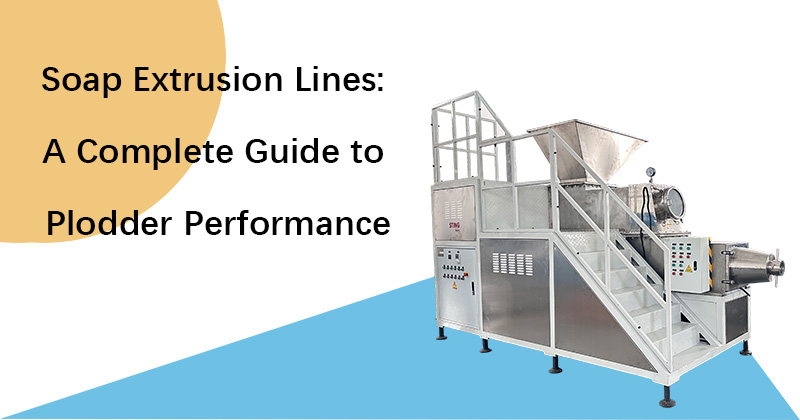
Soap extrusion is the process that transforms a rough, crumbly soap mass into the smooth, uniform bars your customers actually hold. Yet it’s one of the most misunderstood stages of the production line — operators often treat the plodder as a “pass-through” rather than a precision machine.
Get the extrusion stage right and you lock in consistent bar weight, surface finish, and fragrance retention. Get it wrong and you’ll be chasing rejects all day while your packaging line idles.
This guide covers how soap extrusion lines work, the critical performance parameters to evaluate, and how to size the right plodder configuration for your output targets.
How a Soap Plodder Actually Works
A soap plodder is an extruder purpose-built for soap base (sodium or potassium stearate blends). Unlike plastic extruders, plodders operate at near-ambient temperatures to preserve fragrance, colorants, and active ingredients.
Core mechanism:
- Feed hopper — accepts chips, noodles, or milled soap base
- Single or double worm screws — advance and compress the soap column
- Compression cone — builds pressure and homogenises the mass
- Die plate — shapes the extrudate into the desired cross-section
- Cutting unit — slices the continuous rope into bar blanks
Most modern plodders use a duplex (double-worm) configuration: the first stage re-mills and homogenises; the second stage builds final pressure and extrudes through the die. Simplex plodders handle lower-viscosity bases or are used downstream of a dedicated refiner.
Key operating parameters:
| Parameter | Simplex Plodder | Duplex Plodder |
|—|—|—|
| Output range | 100–500 kg/hr | 300–3,000 kg/hr |
| Screw diameter | 50–100 mm | 80–150 mm (each worm) |
| Operating temperature | 30–45 °C | 30–50 °C |
| Drive power | 5–22 kW | 15–75 kW |
| Vacuum option | Rarely | Standard on most models |
| Typical bar finish | Good | Excellent |
Why vacuum matters: Vacuum applied between the two stages removes entrapped air, which causes pitting on bar surfaces and accelerates oxidative rancidity. Reputable suppliers include vacuum as standard on duplex lines; skip it only for economy-grade bars.
Extrusion Line Layout: From Chips to Cut Bars
A complete extrusion line for finished bar soap typically includes the following stages, each of which affects the final product:
1. Refiner / amalgamator
Blends soap base with additives (dyes, perfumes, TiO₂, active ingredients). This is where batch-to-batch consistency is built — not at the die.
2. First-stage plodder worm (milling stage)
Further refines the blend. Screw speed and flight geometry determine shear intensity; too much shear generates heat that volatilises fragrance.
3. Vacuum chamber
Removes air at 0.5–1.5 kPa absolute pressure. A sight glass lets operators confirm foam is collapsing. Some designs include a moisture control loop here.
4. Second-stage worm (extrusion stage)
Builds pressure against the die. Output rate is set here. Pressure at the die face typically runs 30–80 bar depending on soap hardness.
5. Die plate and nozzle
Interchangeable dies provide different cross-sections (oval, rectangular, round, specialty). Die material is typically hardened tool steel; non-stick coatings are available for heavily perfumed or TiO₂-loaded bars.
6. Cutting unit
Wire or blade cutters slice the rope at programmed intervals. Servo-driven cutters maintain ±0.5 g weight tolerance at full speed; mechanical cam cutters tolerate ±1.5–2.0 g.
7. Bar conveyor and transfer
Feeds cut bars to the stamping press. Correct conveyor speed is critical — bars that reach the press too warm deform under the stamp force.
Technical Specifications: What to Compare When Sourcing
When evaluating plodder suppliers, these are the parameters that separate capable machines from those that will limit your line later:
| Specification | Entry-Level | Mid-Range | Industrial |
|—|—|—|—|
| Throughput (kg/hr) | 100–400 | 400–1,200 | 1,200–3,000+ |
| Bar weight tolerance | ±2.0 g | ±1.0 g | ±0.5 g |
| Screw material | Carbon steel | 316 SS or Ni-alloy | Hardened Ni-alloy |
| Drive type | Fixed-speed motor | Inverter-controlled | Servo + inverter |
| Vacuum depth | None / optional | 1–2 kPa | 0.5 kPa (adjustable) |
| HMI / controls | Manual dials | Basic PLC + touchscreen | Full SCADA integration |
| CIP / washdown | Hose-down | Partial CIP | Full CIP + tool-free disassembly |
| Footprint (L × W) | 1.5 × 0.8 m | 2.5 × 1.2 m | 4.0 × 1.5 m |
| Typical lead time | 6–10 weeks | 10–16 weeks | 16–24 weeks |
Screw design is frequently underspecified in supplier quotations. Ask for the helix angle, compression ratio, and clearance between screw and barrel. These determine how much shear the soap sees — critical for heat-sensitive fragrance formulas.
If your product range includes transparent or glycerine-based bars, confirm the supplier has run the same soap base through their demo machine. Transparent soap behaves very differently under compression compared with standard laundry or toilet soap.
Our bar soap production machines are engineered around these parameters, with modular die sets and servo-cutting as standard on mid-range and above. For upstream saponification capacity planning, see our saponification equipment page.
Matching Plodder Capacity to Your Downstream Line
One of the most common and costly mistakes in line design is sizing the plodder independently from the stamping press, packaging line, and palletizer.
The golden rule: your bottleneck should always be the stamping press, never the plodder. A plodder running at 70–80% of its rated capacity produces more consistent bars than one pushed to 100%.
Capacity matching example:
| Line Component | Rated Speed | Design Target (80%) | Recommendation |
|—|—|—|—|
| Duplex plodder | 600 kg/hr | 480 kg/hr | Set as baseline |
| Stamping press | 120 bars/min | 96 bars/min | Confirmed match at avg 80 g bar |
| Wrapper | 100 bars/min | 80 bars/min | Slight bottleneck — add buffer conveyor |
| Case packer | 15 cases/min | 12 cases/min | Check case count per SKU |
| Palletizer | 8 pallets/hr | 6.4 pallets/hr | Confirm at peak shift |
Running this calculation before purchase reveals whether you need a single-lane or dual-lane packaging line — a decision that can change your capital cost by 40–60%.
For guidance on downstream packaging configurations, our soap packaging line page covers wrapper types, throughput tables, and integration points.
ROI Analysis: Upgrading Your Extrusion Stage
Whether you’re replacing a simplex plodder or upgrading from a manual refiner-extrusion setup, the ROI case is straightforward if you measure the right things.
Quantifiable gains from a modern duplex plodder:
- Reduced soap loss: Tighter weight tolerance (±0.5 g vs ±2.0 g) saves approximately 1.5–2.5% of total soap mass per run. On a 400 kg/hr line running two shifts, that compounds quickly.
- Lower reject rate: Vacuum extrusion typically reduces surface-defect rejects from 3–5% to under 0.5%.
- Higher fragrance retention: Lower shear and temperature reduce fragrance evaporation by an estimated 8–15%, allowing formulators to reduce dosage without sacrificing scent strength.
- Faster changeover: Tool-free die changes and CIP cut per-SKU changeover from 45–60 minutes to 15–20 minutes.
Sample ROI model (mid-range duplex plodder, 600 kg/hr):
| Cost / Saving Item | Annual Value (USD) |
|—|—|
| Soap mass saving (2% of 600 kg/hr × 2 shifts × 250 days × $1.20/kg) | ~$72,000 |
| Reject reduction (from 4% to 0.5%, same basis) | ~$24,300 |
| Fragrance saving (10% reduction, $8/kg dosage basis) | ~$8,600 |
| Changeover time saving (30 min × 3 SKU changes/day × 250 days × $45/hr) | ~$5,600 |
| Total annual saving | ~$110,500 |
| Equipment investment (duplex plodder, installed) | ~$180,000–240,000 |
| Estimated payback | ~20–26 months |
Note: figures assume a mid-scale toilet soap operation. Actual savings vary with soap base cost, reject costs, and shift patterns. Contact us for a site-specific analysis.
For facilities that also handle palletized outbound shipments, pairing the extrusion upgrade with an automated end-of-line solution delivers compound savings — see our packing and palletizing systems.
Industry context: According to Statista’s global soap market data, bar soap output continues to grow in emerging markets at 4–6% CAGR, reinforcing the investment case for scalable extrusion capacity. Equipment standards are governed by ISO TC 91 (Surface Active Agents), which sets testing protocols relevant to bar soap consistency. For raw material fatty acid specifications that directly impact plodder performance, the AOCS Official Methods are the global benchmark.