
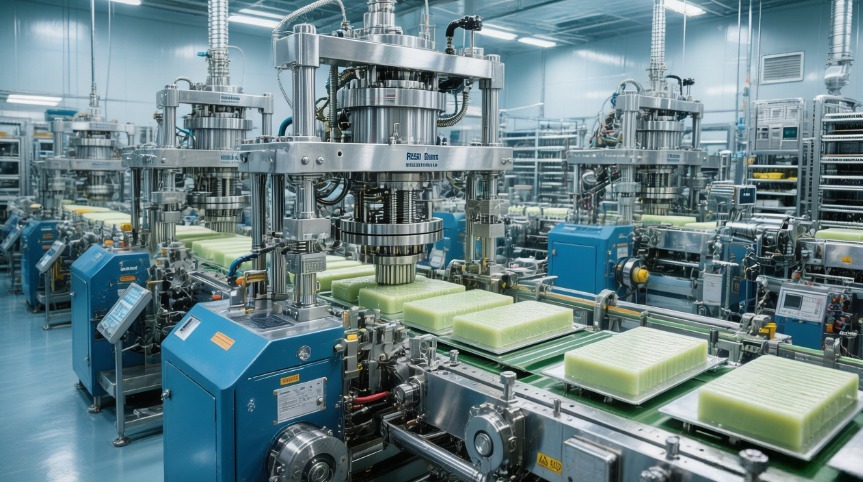
Executive Summary: The global soap stamping machine market is on a CAGR trajectory of 6.7% (USD 229.6 M in 2026 → USD 338.8 M by 2033), while the broader soap production line sector tracks at 5.7% CAGR toward USD 79.4 B by 2033. Three structural forces are shaping capital allocation in 2026: the rapid adoption of servo-electric stamping technology, tightening sustainability and energy-efficiency compliance mandates, and the accelerating shift toward modular, quick-changeover production architectures. Manufacturers who act on these forces now will build a durable competitive moat; those who defer face compounding retrofit costs.
1. Market Sizing: Where the Numbers Stand in Mid-2026
Cross-referencing data from Coherent Market Insights, MarkWide Research, and Accio Business Insights yields a consistent picture: the soap stamping machine segment is growing faster than the overall soap production equipment market, driven by premiumisation trends and regulatory-driven equipment refreshes.
| Segment | 2026 Value | Target Year | Projected Value | CAGR |
|---|---|---|---|---|
| Soap Stamping Machine (Coherent MI) | USD 229.6 M | 2033 | USD 338.8 M | 6.7% |
| Soap Stamping Machine (MarkWide Research) | USD 187.4 M | 2035 | USD 285.8 M | 4.80% |
| Soap Stamping Machine (Accio — high estimate) | — | 2033 | — | 11.7% |
| Soap Production Line (Overall) | USD 50.95 B | 2033 | USD 79.38 B | 5.7% |
| Liquid Soap Equipment | — | 2036 | — | 7.2% |
| Automation-Grade Equipment | — | — | — | 11% |
* CAGR variance across research providers reflects differing scope definitions (machine-only vs. integrated line) and base-year methodologies. Coherent Market Insights and MarkWide Research bracket the conservative-to-moderate range; Accio’s 11.7% captures high-growth automation sub-segments.
2. The Servo-Electric Inflection Point
The most decisive technology shift occurring in Q2 2026 is the accelerating replacement of hydraulic and pneumatic stamping systems by servo-electric drive architectures. The catalyst is not simply performance — it is a convergence of regulatory pressure, operational economics, and brand differentiation.
Hydraulic Systems
Dominant in installed base for heavy-duty applications. High force capacity, but hydraulic oil contamination risk disqualifies them from premium cosmetic and pharmaceutical-grade production environments. Incumbent in European precision machinery (Mazzoni LB, Binacchi).
Pneumatic Systems
Market-share leader at 53.4% in 2026 (Coherent MI). Favored in emerging markets for low capital cost, simple maintenance, and zero oil contamination. Indian manufacturers (Adhisakthi, Kailash Engineering) are primary proponents.
Servo-Electric Systems ▲
Fastest-growing in new orders. Pressure curve accuracy ≤0.5%. Annual replacement rate of 15–20% in Japan/France luxury segments. Japan’s METI energy-efficiency guidelines are accelerating legacy pneumatic-to-servo transitions.
Why Precision Matters: The Embossing Quality Equation
Servo motors allow programmable pressure profiles across the stamp cycle — a capability that is non-negotiable for shea butter, glycerin, and specialty botanical formulations where hardness varies by batch. Traditional systems apply fixed peak pressure, producing rejects when formulation density deviates from the designed norm. Servo systems dynamically adjust within the same cycle, driving scrap rates down 20–35% in documented deployments.
3. Regional Market Dynamics: Where Investment is Flowing
| Region | 2026 Share | Growth Driver | Key Buyers |
|---|---|---|---|
| Asia Pacific | 39.4% | FMCG capacity expansion; labor cost escalation driving automation ROI | Maharashtra & Gujarat contract manufacturers; China liquid soap lines |
| North America | 26.3% ▲ Fastest | Artisan & premium soap brands; EaaS (Equipment-as-a-Service) adoption | Colorado, Vermont, Oregon specialty brands (2,000–10,000 bars/day) |
| Europe | — | REACH Annex XVII compliance; luxury cosmetic contract manufacturing | Milan–Bologna precision equipment cluster; German industrial automation |
| Japan | — | METI energy guidelines; luxury hotel/skincare brand requirements | Hotel amenity manufacturers; premium skincare OEMs |
| India | Liquid Soap CAGR 8.3% | PLI scheme localisation mandate; Middle East export market demand | Adhisakthi, Kailash Engineering, Amarnath Engineering |
| China | Liquid Soap CAGR 8.6% | Domestic liquid soap consumption surge; export-oriented production ramp | Fluko Machinery, Guangzhou Ailusi Machinery, Nantong Tongji |
4. Compliance as a Capex Catalyst: REACH, METI, and PLI Effects
Three regulatory frameworks are functioning as involuntary capex catalysts in 2026, forcing equipment refreshes that might otherwise have been deferred 3–5 years.
REACH Annex XVII — EU Nickel Release Limits
Direct surface-contact components on soap stamping dies must comply with nickel migration limits under REACH Annex XVII. Legacy chrome-plated dies manufactured before 2022 face non-compliance risk. PVD (Physical Vapour Deposition) and ceramic-coated replacement dies are now a prerequisite for any European-market contract manufacturer. Multi-jurisdiction validation — simultaneous FDA GMP documentation and CE technical files — extends sales cycles by 6–12 months but creates a durable barrier against lower-compliance competitors.
Japan METI Energy-Efficiency Guidelines
Japan’s Ministry of Economy, Trade and Industry updated energy performance benchmarks for industrial process equipment in 2025. Older pneumatic stamping presses fall outside the new thresholds in the hotel amenity and precision skincare segments. Annual replacement rates of 15–20% for legacy pneumatic units in Japan and France are already being observed, representing a meaningful, recurring equipment replacement cycle.
India PLI Scheme — Production-Linked Incentive
India’s Production-Linked Incentive scheme is creating domestic procurement pull for soap equipment manufactured in India. Maharashtra and Gujarat clusters — already serving the Middle East export market — are absorbing demand that previously went to European suppliers. This regionalisation of supply chains is compressing delivery lead times and shifting price-discovery dynamics in the USD 500K–USD 2M capital equipment range.
5. Modular Architecture and the EaaS Business Model
The structural fragmentation of the bar soap market — across moisturizing, antibacterial, hypoallergenic, artisan, and pharmaceutical-grade sub-categories — has made fixed single-formula production lines a liability rather than an asset. Equipment vendors who recognised this early have repositioned around two interrelated innovations: modular line architecture and Equipment-as-a-Service (EaaS) subscription models.
- 01
Quick-Changeover Die Systems: Semi-automatic machines with <15-minute changeover times are capturing the 800–2,500 bars/hour production tier. This segment is growing fastest in North America’s artisan soap market.
- 02
EaaS Subscription Penetration: Monthly-fee models covering maintenance, die storage, and software updates are gaining traction in the 2,000–10,000 bars/day capacity band in the US and UK. EaaS converts capital equipment spend into an operating expense, lowering the adoption barrier for growing brands.
- 03
Precision Dosing Integration: Modern modular lines integrate gravimetric dosing systems capable of handling vitamins, essential oils, and pharmaceutical actives — enabling a single production platform to serve both commodity and premium formulations without retooling.
- 04
Electro-Pneumatic Hybrid Architecture: A new equipment category combining servo-motor precision with pneumatic cost structures is emerging, opening a previously absent price-performance tier between full-hydraulic industrial presses and entry-level pneumatic units.
6. Smart Manufacturing Integration: IoT, AI, and Predictive Maintenance
Google Trends data recorded a search-volume peak (index 94) for “high-speed soap printing machine” in January 2026, consistent with the announcement cycles of major industry trade shows. The demand signal is unambiguous: buyers are actively seeking information on high-throughput, intelligence-enabled stamping solutions. The technology response is converging around three capabilities:
Predictive Maintenance
IoT-connected stamping presses transmit vibration, temperature, and pressure telemetry to cloud or edge computing nodes. ML models trained on historical failure patterns generate maintenance windows before breakdowns occur, reducing unplanned downtime.
Adaptive Production Parameters
Real-time formulation density feedback from inline sensors allows PLC systems to adjust stamp force, dwell time, and ejection speed mid-run. This adaptive loop eliminates the separate “calibration batches” that previously consumed 3–8% of production time during formula transitions.
Blockchain Traceability
RSPO-certified palm oil sourcing and pharmaceutical-grade quality programs increasingly require batch-level provenance records. Stamping machines with integrated MES connectivity can write immutable production records to distributed ledgers, satisfying both regulatory and brand assurance requirements.
7. Strategic Outlook: Five Decisions That Define the Next Three Years
For soap equipment procurement managers, plant engineers, and supply chain directors reviewing capital budgets, the market data points to five decisions that will separate well-positioned manufacturers from those facing costly mid-cycle corrections:
| # | Decision | Implication of Deferral |
|---|---|---|
| 1 | Servo-electric vs. hydraulic/pneumatic system selection | 15–20% annual replacement cost in regulated markets; lost access to REACH/METI-compliant segments |
| 2 | Modular vs. fixed-format line architecture | High retrofit costs when SKU proliferation accelerates; inability to participate in premium formulation segments |
| 3 | IoT integration scope at time of purchase | Post-installation IoT retrofit costs run 40–60% higher than at-purchase integration; extended downtime during installation |
| 4 | Regional supplier qualification (CE+FDA vs. domestic-only) | 6–12 month validation cycle penalty; inability to supply cross-Atlantic contract manufacturing customers |
| 5 | EaaS model evaluation for mid-scale operations | Higher upfront capex exposure; slower capacity-scaling response to demand surges |
Conclusion
The soap stamping machine market in mid-2026 is not simply growing — it is undergoing structural reconfiguration. The servo-electric transition, the modular architecture imperative, and the compliance-driven replacement cycle are compressing the window for low-risk technology decisions. The 6.7% CAGR baseline is a floor, not a ceiling: manufacturers who delay automation and compliance alignment will face steeper catch-up costs, while those who act proactively will access premium segments, reduce per-unit costs, and satisfy increasingly stringent buyer qualification criteria.
Data sources: Coherent Market Insights (Soap Stamping Machine Market 2026–2033); MarkWide Research (Soap Stamping Machine Market 2026–2036); Accio Business Insights (Soap Production Line Trends 2026); soapmakingmachine.com Industry Analysis (May 2026); Future Market Insights; Business Research Insights.