
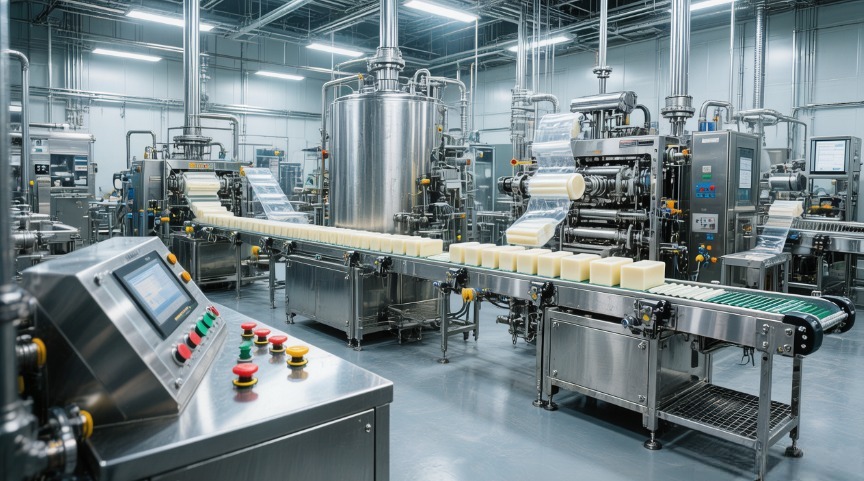
1. Market at a Glance: Mid-2026 Snapshot
The soap production line market has entered a consolidation phase within a sustained growth trajectory. Three independent data sources converge on a 5.7%–5.8% growth range, with the absolute market size now exceeding $53 billion.
| Metric | Value | Source |
|---|---|---|
| Global Production Line Market (2026) | $53.52 Billion | VMR / Accio |
| Production Line CAGR (2026–2033) | 5.7% — 5.8% | VMR, LinkedIn MR, Accio |
| Liquid Soap Equipment CAGR (2026–2036) | 7.2% | Accio / Business Research Insights |
| Bar Soap Market Share (2026) | 60.3% of total revenue | VMR |
| Personal Care Application Share | 62.5% | VMR |
| Projected 2033 Market Value | $79.38 Billion | Accio |
The divergence between bar soap (stable, 3.6% CAGR through 2034) and liquid soap (7.2% CAGR through 2036) continues to shape equipment investment. Liquid soap’s higher growth reflects its dominance in institutional channels — healthcare, hospitality, and commercial washrooms — where automatic dispensing systems drive volume requirements. Hand soaps alone are projected to capture 39% of the liquid soap market in 2026.
2. Energy Efficiency Benchmarks: The Scale Dividend
Industrial energy consumption data from manufacturing equipment catalogs on Made-in-China reveals a stark efficiency curve that makes a compelling case for capacity consolidation.
| Line Capacity (kg/h) | Installed Power (kW) | Unit Energy (kWh/kg) | Efficiency vs. 300 kg/h |
|---|---|---|---|
| 300 | 32 | 0.107 | Baseline |
| 500 | 50 | 0.100 | —6.5% |
| 1,000 | 75 | 0.075 | —29.9% |
| 2,000 | 85 | 0.043 | —60.3% |
The non-linear relationship between throughput and power draw — where a 6.7× increase in output (300 → 2,000 kg/h) requires only a 2.7× increase in installed power — is primarily driven by shared infrastructure overhead: motor base loads, heating system residency, and cooling water circulation loops that scale sub-linearly with throughput. For operators running sub-500 kg/h lines, this translates to a structural energy cost disadvantage of $18,000–$35,000 per year at typical industrial electricity rates (assuming 6,000 operating hours/annum).
The EU Green Deal and revised EPA manufacturing efficiency standards are amplifying this effect. Equipment buyers in regulated jurisdictions now face energy performance benchmarks as a condition of operational permits, making sub-scale lines increasingly difficult to justify — not merely on economics, but on compliance grounds.
3. Modular Architecture: Mid-Tier Producers Close the Gap
The most significant equipment design trend in H1 2026 is the emergence of genuinely modular production platforms. Historically, the market offered two unsatisfactory options: fully dedicated high-speed lines (capex $2M–$10M+) that lock producers into single-SKU formats, or manually intensive semi-automated systems that cap throughput and quality consistency. Modular architectures — with plug-and-play modules for mixing, extrusion, stamping, wrapping, and cartoning — are changing this equation.
Key features driving adoption:
- SKU agility: Switch between bar soap and liquid soap formats within the same production shift without full line reconfiguration. Critical for producers serving both mass-market retail (pallets) and specialty orders (boutique hotel amenities).
- Incremental capex: Start with core modules at $150K–$500K, add capacity as demand materializes. This flips the traditional “bet the farm” investment model to a phased deployment that mid-tier Southeast Asian and African producers can self-fund.
- IoT-native instrumentation: Each module ships with embedded sensors, OPC-UA communication, and edge analytics dashboards. Predictive maintenance algorithms train on module-level vibration, temperature, and torque data — a significant improvement over whole-line monitoring that generates noise-heavy signal.
Industry data confirms the shift: Accio’s trend analysis shows “modular soap production line” as one of the fastest-rising procurement search terms in Q1–Q2 2026, and Made-in-China category pages for soap equipment now feature modular configurations prominently, with price ranges from $9,000 (entry-level single module) to $49,000 (full automated line with mixing-through-packaging integration).
4. Regional Dynamics: Three Markets, Three Growth Profiles
| Region | CAGR | Key Driver | Equipment Preference |
|---|---|---|---|
| China | 8.6% | Liquid soap capacity expansion; FMCG export | High-speed automated lines (>1,000 kg/h) |
| India | 8.3% | Government hygiene campaigns; Ayurvedic/herbal soap boom | Modular mid-range (500–1,000 kg/h) |
| United States | 7.8% | Healthcare & food service compliance; reshoring | Fully integrated, IoT-enabled lines |
| Germany | 6.0% | EU Green Deal; energy efficiency mandates | Low-energy, certified sustainable lines |
| Japan | 5.4% | Aging workforce → automation imperative | Servo-electric precision lines |
| APAC (overall) | 6.2% | Urbanization, rising disposable income | Mix of automated & modular |
Asia-Pacific holds over 44% of global market share and is also the fastest-growing region at 6.2% CAGR. The demand profile, however, is not uniform. Chinese and Indian buyers prioritize different configurations — high-volume automated lines in China vs. modular, multi-SKU lines in India — reflecting fundamentally different downstream market structures. Equipment suppliers offering a single architecture for both markets will leave value on the table in at least one.
A structural shift worth noting: February 2026 saw Google Trends record a sharp spike (index value 100) for “high-speed soap filling and packaging line” searches — a concentrated signal that procurement intent for automation is not merely rising linearly, but clustering around specific decision windows. Sellers who align marketing and quoting capacity with these windows capture disproportionate share.
5. Sustainability: From Compliance Burden to Cost Lever
Sustainability mandates — REACH amendments, EU Corporate Sustainability Reporting Directive (CSRD), India’s 2026 Solid Waste Management Rules — were initially treated by equipment buyers as compliance overhead. The data now suggests a different reality: energy-efficient equipment generates operational savings that offset compliance costs within 18–36 months.
Key developments:
- Water recycling modules: Closed-loop cooling systems now recover 85–92% of process water. With industrial water costs rising in water-stressed manufacturing regions (India, North Africa, parts of China), payback periods have compressed to under 12 months.
- Biodegradable packaging integration: Equipment lines with built-in paper-wrapper and compostable-film handling are displacing plastic-only packaging modules. Sidel’s 2025 partnership with a biodegradable-packaging startup signals the upstream supply chain is maturing.
- Plant-based feedstock compatibility: The organic soap segment (CAGR 7.96%) demands equipment that handles plant oils, shea butter, and essential oils without cross-contamination or degradation. Stainless-steel, CIP (clean-in-place) capable lines command a 15–25% premium but are becoming baseline requirements for export-oriented producers targeting EU and North American buyers.
6. Competitive Landscape: Consolidation & New Entrants
The equipment supply side is showing early signs of consolidation alongside geographic diversification. Italian incumbent Mazzoni LB continues to hold the premium segment, while Chinese manufacturers — Fluko Machinery, Guangzhou Ailusi, Yuxiang — are gaining mid-market share through competitive pricing ($9,000–$49,000 full lines) and improving after-sales infrastructure in target export markets. South Africa’s Zhauns has carved a niche in the African continent, leveraging proximity-based service advantage.
The downstream brand landscape shapes equipment demand patterns:
- Global FMCG leaders (Unilever, P&G, Colgate-Palmolive) drive demand for high-throughput, single-SKU dedicated lines, often with proprietary specifications and multi-year supply agreements.
- Regional champions in India, Southeast Asia, and Africa increasingly demand modular, multi-format lines that can pivot between mass-market and premium sub-brands.
- D2C and private-label brands (growing at 9.5% CAGR via online channels) favor small-batch, quick-changeover equipment that can produce runs as short as 500–2,000 units per SKU.
This three-tier demand structure creates a natural segmentation opportunity for equipment suppliers — one unlikely to be captured effectively by a single-architecture vendor.
7. Outlook: H2 2026 Equipment Procurement Signals
Based on the data convergence across five research sources, three procurement signals merit attention for the second half of 2026:
- Energy audit as pre-purchase requirement. With the demonstrated 60% unit-energy differential between small and large lines, and tightening regulatory standards in EU and North American markets, energy performance specifications will transition from a “nice-to-have” line item to a binding contract term in equipment RFQs. Buyers who request kWh/kg guarantees now secure first-mover advantage in supplier negotiations.
- Modular-first procurement strategy. The capex logic for modular platforms — phased investment, format flexibility, multi-SKU capability — is winning against the traditional dedicated-line approach not only for mid-tier producers but increasingly for large incumbents seeking supply chain optionality. Expect modular line share to grow from an estimated 18–22% of new installations in 2025 to 30–35% by end-2027.
- Liquid soap capacity expansion. At 7.2% CAGR, liquid soap equipment demand will outpace bar soap equipment by 2:1 through 2036. Producers still operating bar-only lines should model the cost of retrofitting vs. the opportunity cost of ceding the liquid segment to competitors.
Data Sources: Verified Market Research (Soap Production Line Market Report #374019, March 2026), Accio Business Insights (Soap Production Line Trends, March–May 2026), Business Research Insights (Liquid Soap Equipment Forecast, Q1 2026), Made-in-China (Soaptech Energy Consumption Benchmarks, May 2026), LinkedIn Market Research (Soap Production Line 2026–2033 Forecast, May 2026).
Disclaimer: This analysis is prepared for industry professionals and equipment buyers. Market data represents third-party research estimates and should be verified against local conditions before procurement decisions.