
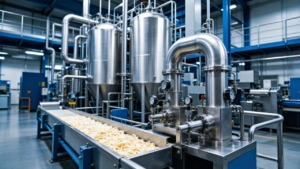
Raw material handling is the least glamorous part of soap manufacturing—and the most underrated. Factories routinely invest six figures in saponification reactors and packaging lines, then feed them with hand-scooped oil drums and open lye buckets. The result? Inconsistent batches, contamination risks, and downtime that eats 20–30% of available production time.
This guide breaks down the storage, conveying, and dosing systems that keep a soap line running at full capacity. Whether you are building a greenfield plant or upgrading an existing one, getting material handling right pays back faster than any other capital investment.
1. Raw Material Storage: Silos, Tanks, and Containment
Every soap factory handles four core material categories: solid fats (tallow, palm stearin), liquid oils (palm oil, coconut oil, olive oil), caustic solution (NaOH or KOH), and dry additives (soap noodles, fragrance, colorant, salt). Each requires a dedicated storage strategy.
Storage Requirements by Material Type
| Material | Storage Method | Capacity Range | Key Considerations |
|———-|—————|—————-|——————-|
| Solid fats (tallow, stearin) | Heated jacketed tanks | 5–50 tons | Maintain 55–65°C; prevent solidification |
| Liquid oils (palm, coconut) | Insulated stainless steel tanks | 10–100 tons | Nitrogen blanketing for oxidation prevention |
| Caustic solution (NaOH/KOH) | HDPE or FRP tanks | 2–20 tons | Secondary containment; temperature monitoring 20–40°C |
| Soap noodles | Stainless steel silos | 5–30 tons | Desiccant air drying; FIFO discharge |
| Fragrance & colorants | Sealed drums / IBC totes | 200–1,000 L | Temperature-controlled room (18–25°C); UV protection |
Design Principles
- Redundancy: Every storage vessel should have a backup or bypass. A single tank failure should not halt the entire line.
- Material compatibility: Caustic solution corrodes mild steel. Use 316L stainless steel or FRP for NaOH/KOH contact surfaces.
- Climate adaptation: In tropical climates (Indonesia, Nigeria, India), oil storage tanks need larger heating capacity to counter ambient heat loss during rain cycles. In cold climates, trace heating on all piping is mandatory.
- Inventory visibility: Install load cells or radar level sensors on every tank. Manual dip-stick measurement introduces 5–8% inventory error, which cascades into dosing inaccuracy.
STING Industry’s saponification equipment integrates directly with upstream storage systems, ensuring consistent feed rates and temperature control across the entire reaction process.
2. Conveying Systems: Moving Materials Without Contamination
Once materials are stored, the challenge is moving them to the process line without exposure, degradation, or loss. Soap factories use four primary conveying methods, each suited to different material types and distances.
Conveying Method Comparison
| Method | Best For | Distance Range | Throughput | Capital Cost | Contamination Risk |
|——–|———-|—————|————|————-|——————-|
| Pneumatic (dense phase) | Soap noodles, dry additives | 10–100 m | 500–5,000 kg/h | $15K–$60K | Very low (closed pipe) |
| Pneumatic (dilute phase) | Light powders, fragrance | 5–50 m | 100–1,000 kg/h | $8K–$30K | Low |
| Mechanical (screw/auger) | Semi-solid fats, soap chips | 2–20 m | 200–3,000 kg/h | $5K–$25K | Medium (open transfer) |
| Pumped (gear/lobe pump) | Liquid oils, caustic solution | 5–200 m | 500–10,000 kg/h | $3K–$20K | Very low (sealed) |
Selection Criteria
- Soap noodles: Dense-phase pneumatic conveying is the industry standard. It moves pellets gently through closed pipes at 2–5 m/s, minimizing breakage and dust generation. Dilute-phase systems run faster (15–20 m/s) but create more fines— unacceptable if you need uniform pellet size for extrusion.
- Liquid oils and caustic: Sanitary lobe pumps with magnetic couplings eliminate shaft seals, which are the #1 failure point in caustic service. For long-distance runs (>50 m), consider a booster pump midway to maintain pressure.
- Fragrance: Short, dedicated pneumatic lines from the drum room to the mixer. Never share piping with other materials—cross-contamination ruins entire batches. Use PTFE-lined pipes for fragrance compatibility.
- Solid fats: Heated jacketed screw conveyors maintain 60°C along the entire transfer path. Any cold spot solidifies the fat and blocks the line within minutes.
Common Pitfalls
- Pipe radius too tight: Pneumatic bends should have a radius of at least 6× the pipe diameter. Tighter turns cause noodle breakage and pipe wear.
- No cleanout ports: Every conveying line needs accessible cleanout ports at bends and low points. Without them, material buildup goes undetected until a blockage occurs.
- Shared lines: Running multiple materials through the same pipe without a validated CIP (clean-in-place) system is a contamination risk. Dedicate lines by material category.
3. Dosing and Metering: Precision That Determines Quality
Dosing accuracy directly determines soap quality. A ±2% error in caustic dosing shifts pH by 0.5–1.0 units. A ±5% error in fragrance dosing creates noticeable scent variation between batches. Modern soap lines demand dosing precision of ±0.5% or better.
Dosing Technologies Compared
| Technology | Material Type | Accuracy | Flow Range | Cost | Maintenance |
|———–|————–|———-|————|——|————-|
| Coriolis mass flow meter | Liquids (oil, caustic) | ±0.1% | 0.5–50,000 kg/h | $8K–$25K | Low (no moving parts) |
| Magnetic flow meter | Conductive liquids (lye) | ±0.2% | 1–10,000 kg/h | $3K–$10K | Low |
| Loss-in-weight feeder | Dry additives, noodles | ±0.25% | 10–5,000 kg/h | $12K–$40K | Medium (load cell drift) |
| Volumetric screw feeder | Powders, salt | ±2–5% | 50–2,000 kg/h | $2K–$8K | Medium |
| Peristaltic pump | Fragrance, colorant | ±1% | 0.1–500 L/h | $1K–$5K | High (tube replacement) |
Best Practices
- Mass over volume: Always prefer mass-based dosing (Coriolis, loss-in-weight) over volumetric. Volume changes with temperature—oil expands 0.7% per 10°C, which introduces significant error in tropical climates.
- Redundant verification: Install a secondary check valve or flow indicator downstream of the primary dosing point. If the primary meter drifts, the secondary check catches it before material reaches the reactor.
- Calibration cadence: Coriolis meters need calibration every 6 months. Loss-in-weight feeders need monthly calibration checks. Peristaltic pump tubes need replacement every 500–1,000 operating hours.
- Batch vs. continuous: For lines under 500 kg/h, batch dosing into a weigh tank is simpler and more accurate. For lines above 500 kg/h, continuous in-line dosing with closed-loop feedback control is more efficient.
Accurate dosing feeds directly into the bar soap production line, where consistent pellet and additive ratios determine extrusion quality and bar weight uniformity.
4. Integration with Saponification and Downstream Operations
Material handling does not exist in isolation. The storage and conveying system must integrate seamlessly with both upstream saponification and downstream finishing operations.
Integration Checklist
| Integration Point | Requirement | Common Failure Mode |
|——————-|————-|———————|
| Storage → Saponification reactor | Automated feed with temperature control | Manual transfer causes temperature drop and inconsistent reaction |
| Caustic dosing → Reactor | Closed-loop pH feedback | Open-loop dosing causes pH drift between batches |
| Oil blending → Saponification | Multi-stream proportional mixing | Sequential addition creates concentration gradients |
| Soap base → Plodder/extruder | Continuous feed with buffer hopper | Batch transfer causes plodder starvation and extrusion gaps |
| Fragrance dosing → Mixer | Post-crutching, pre-extrusion timing | Early addition volatilizes fragrance; late addition causes uneven distribution |
Buffer Capacity
Every transfer point needs a buffer vessel between 1.5× and 3× the batch size. This buffer absorbs timing mismatches between upstream and downstream equipment—for example, when saponification takes 45 minutes per batch but the plodder runs continuously.
- Undersized buffer: The plodder starves between batches, producing short bars or air pockets.
- Oversized buffer: Material ages in the hopper, causing surface hardening and moisture loss that affects extrusion quality.
5. ROI Analysis: What Material Handling Upgrades Actually Return
Material handling investments are easy to justify because the payback comes from three measurable sources: reduced downtime, lower material waste, and improved batch consistency.
ROI Model: 800 kg/h Soap Production Line Upgrade
| Investment Item | Capital Cost | Annual Savings | Payback Period |
|—————-|————-|—————-|—————-|
| Heated oil storage tanks (2× 20 ton) | $35,000 | $8,500 (reduced spoilage + energy) | 4.1 months |
| Dense-phase pneumatic noodle conveyor | $28,000 | $12,000 (reduced waste + labor) | 2.8 months |
| Coriolis mass flow meters (×3) | $22,000 | $18,000 (reduced batch rejection) | 1.5 months |
| Loss-in-weight additive feeder | $18,000 | $9,500 (consistent dosing) | 2.3 months |
| Automated CIP system | $15,000 | $6,000 (reduced changeover time) | 2.5 months |
| Total Package | $118,000 | $54,000 | 2.6 months |
Key Assumptions
- Baseline downtime: 25% of available production time lost to material handling issues (manual transfer, tank cleaning, blockage clearing).
- Post-upgrade downtime: 8% — a 68% reduction in downtime-related losses.
- Batch rejection rate: Drops from 4.2% to 0.8% due to precise dosing and contamination control.
- Labor savings: 2 full-time operators reassigned from material handling to quality control.
- Production line: 800 kg/h, 2 shifts, 300 operating days per year.
Scaling the Model
| Plant Scale | Total Investment | Annual Savings | Payback |
|————-|—————–|—————-|———|
| 200 kg/h (entry) | $45,000 | $22,000 | 2.0 months |
| 500 kg/h (mid) | $80,000 | $38,000 | 2.5 months |
| 800 kg/h (standard) | $118,000 | $54,000 | 2.6 months |
| 1,500 kg/h (industrial) | $185,000 | $82,000 | 2.7 months |
According to Statista’s cleaning products market outlook, global demand for bar soap will continue growing at 4–5% CAGR through 2028, meaning every hour of recovered downtime translates directly into incremental revenue.
The global soap market data from Statista reinforces this trend, showing that manufacturers who invest in automated material handling capture market share faster than those relying on manual processes.
Conclusion: Start With the Pipes, Not the Reactor
Most soap factory expansion plans start with a bigger reactor or a faster packaging line. That is the wrong sequence. Material handling infrastructure—storage, conveying, and dosing—is the foundation that determines how fast and how consistently every downstream machine can run.
The ROI numbers are clear: a comprehensive material handling upgrade pays for itself in under 3 months at almost any plant scale. The improvement in batch consistency alone justifies the investment, and the labor and downtime savings are pure bonus.
Next Steps
- Audit your current system: Map every material transfer point and measure the time each one takes. Manual transfers taking more than 15 minutes are prime automation candidates.
- Prioritize dosing accuracy: If budget is limited, start with Coriolis mass flow meters on your oil and caustic lines. This single upgrade typically pays back in under 2 months.
- Plan for integration: Ensure any new storage or conveying equipment communicates with your existing soap packaging line and finishing equipment via standard PLC interfaces.
Ready to upgrade your material handling system? STING Industry designs and manufactures integrated storage, conveying, and dosing systems tailored to your plant scale and product range. Contact our engineering team at frank@stingholdings.com or visit our packing and palletizing solutions page to learn how we can help you cut downtime and boost output.
STING Industry — Saponification Equipment | Bar Soap Machines | Soap Packaging | Packing & Palletizing