
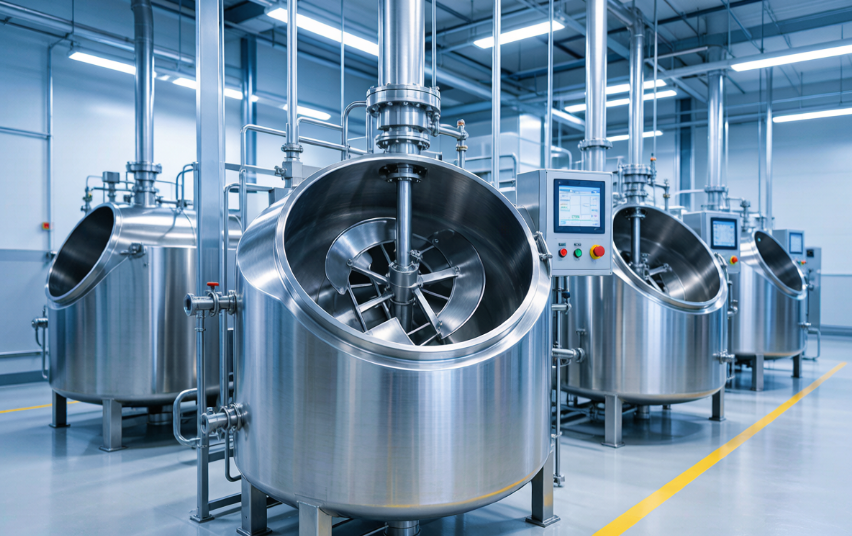
Recent market data and equipment announcements show the soap mixing stage moving from a support function to a strategic constraint. The global soap mixing machine market is valued at USD 520.0 million in 2025 and is projected to reach USD 771.6 million by 2032. Three forces are tightening the mix room: private-label capacity doubling, higher-viscosity natural formulations, and the shift from stand-alone batch handling to smart, automated process control.
In This Analysis
- The $520M Mixing Segment: A Niche That Controls the Whole Line
- Recent Signals: Capacity Doubling, Viscous Formulations, and Smart Retrofits
- Machine Mix: Batch, Continuous, and Vacuum
- Application Split: Bar, Liquid, and Specialty
- Why Viscosity and Formulation Agility Are the Real Drivers
- H2 2026 Procurement Checklist for Mixing Equipment
1. The $520M Mixing Segment: A Niche That Controls the Whole Line
The global soap production line market is measured in tens of billions, but the dedicated mixing machine segment is where many capacity and quality problems originate. A cross-check of recent forecasts shows the mixing layer expanding slightly faster than the broader machine market, a sign that producers are upgrading this stage first.
| Market Segment | 2025 Value | Forecast Value | CAGR | Source |
|---|---|---|---|---|
| Soap production line | $50.90B | $88.05B (2035) | 5.60% | Spherical Insights |
| Soap making machine | $1.68B | $2.40B (2032) | 5.23% | PW Consulting |
| Soap mixing machines | $520.0M | $771.6M (2032) | 5.80% | PW Consulting |
Key signal: The mixing machine segment is growing at 5.8% CAGR, faster than the broader soap making machine market (5.23%). This is not a coincidence. When producers add liquid formats, natural oils, or private-label SKUs, the mixer is the first asset to hit its limit. The front-end reactor and packaging line may still have headroom, but uneven dispersion, air entrapment, or batch-to-batch viscosity drift can shut down the entire downstream process.
2. Recent Signals: Capacity Doubling, Viscous Formulations, and Smart Retrofits
The past six months have produced a series of concrete developments that place the mixing stage at the center of the H2 2026 capex conversation. These are not speculative trends; they are announced capacity expansions, delivered equipment, and product updates from active suppliers.
| Date | Company / Source | Development | Equipment Implication |
|---|---|---|---|
| March 2026 | MidSolid Press & Pour | Doubled manufacturing capacity for private-label melt-and-pour soap | More compatible and reliable upstream mixing equipment needed |
| December 2025 | Charles Ross & Son | Completed largest Double Planetary Mixer (DPM-750) for highly viscous soap and personal care formulations | Mixers must sustain uniform dispersion as viscosity climbs |
| October 2025 | LIENM | Updated liquid soap mixing machines with smart automation for small-to-large-scale production | Competitive focus shifts from batch handling to repeatable process control |
The common thread is clear: the industry is moving beyond simple blending toward repeatable, scalable, and viscosity-capable mixing. The MidSolid expansion highlights private-label demand; the Ross DPM-750 highlights formulation complexity; the LIENM update highlights automation and repeatability. Together, they define the 2026 mixing procurement brief.
3. Machine Mix: Batch, Continuous, and Vacuum
PW Consulting’s 2026 soap mixing machine segmentation shows batch systems still dominating revenue, but continuous and vacuum systems each serve distinct strategic roles. The right choice depends on whether the plant prioritizes flexibility, throughput, or quality.
| Machine Type | 2025 Value | Share | Best Fit |
|---|---|---|---|
| Batch soap mixing machines | $313.63M | 60.31% | Multi-SKU, specialty, and private-label operations |
| Continuous soap mixing machines | $133.77M | 25.73% | High-volume bar and liquid soap lines |
| Vacuum soap mixing machines | $72.60M | 13.96% | Premium bars, sensitive formulations, reduced air entrapment |
Procurement implication: Batch machines retain the largest share because they match the industry’s growing SKU fragmentation. However, plants that can standardize on fewer high-volume formulations may capture lower unit costs with continuous systems. Vacuum mixing is the quality play: it is smaller in revenue but critical for premium, transparent, or low-density products where air pockets are unacceptable.
4. Application Split: Bar, Liquid, and Specialty
Mixing demand is not evenly distributed across soap formats. Bar soap production absorbs roughly two-thirds of mixing machine revenue, reflecting its high-volume, standardized inputs. Liquid and specialty soaps are smaller but more demanding on process control.
| Application | 2025 Value | Share | Mixing Requirement |
|---|---|---|---|
| Bar soap production | $340.62M | 65.50% | High-throughput, repeatable dispersion of soap noodles and fats |
| Liquid soap production | $137.59M | 26.46% | Viscosity stability, emulsification, and consistent rheology |
| Specialty soap production | $41.79M | 8.04% | Flexible batch tuning, heat-sensitive additives, quick changeover |
Strategic note: Liquid soap production is the fastest-growing format overall, with liquid soap manufacturing equipment growing at 7.2% CAGR through 2036. This places disproportionate pressure on liquid mixing systems, because viscosity and emulsion stability are harder to guarantee at scale than bar soap blending. Buyers expanding liquid capacity should size the mixer not for today’s recipe but for the next generation of thicker, more concentrated, or sulfate-free formulations.
5. Why Viscosity and Formulation Agility Are the Real Drivers
The mixing market is not expanding because of population growth alone. The more immediate driver is input volatility and recipe complexity. In 2026, palm oil and lauric fatty acid prices have remained volatile, with lauric acid quoted around USD 1,480 per metric tonne FOB Indonesia. Manufacturers are responding by diversifying oil sources, increasing additive loadings, and raising the share of plant-based ingredients that behave differently from conventional tallow or palm-based feedstocks.
Each of these shifts raises the importance of the mixer:
- Multi-fat blending: Coconut, shea, sunflower, and sunflower-derived alternatives have different melting profiles and fatty-acid distributions. Uniform saponification requires controlled heat input and precise agitation geometry.
- Thicker, more concentrated liquids: Concentrated and refill-friendly liquid soaps reduce packaging but increase viscosity. Mixers designed for low-viscosity formulations lose efficiency and uniformity as viscosity rises.
- Heat-sensitive additives: Vitamins, essential oils, and probiotic actives degrade under excessive shear or temperature. Jacketed vessels with temperature control and low-shear agitation options protect ingredient efficacy.
- Yield protection: With caustic soda and oil prices volatile, batch losses in the mixer have a direct margin impact. Repeatable dosing and dispersion reduce giveaway and rework.
Raw-material reality: The 2026 operating environment rewards equipment that protects yield and handles variability. A mixer that can process both conventional palm-based recipes and high-viscosity natural-oil blends without mechanical changeover pays for itself in raw-material savings long before its energy or labor savings are realized.
6. H2 2026 Procurement Checklist for Mixing Equipment
Based on the market sizing, recent supplier moves, and raw-material trends, the following specifications are becoming baseline for buyers specifying mixers in the second half of 2026:
- Viscosity range: Confirm the mixer can handle the maximum expected viscosity of future formulations, including concentrated liquids and high-fat blends, not just current recipes.
- Heat transfer: Specify jacketed vessels with precise temperature control to protect heat-sensitive additives and manage fat/oil melting profiles.
- Shear control: Demand variable-speed agitation and interchangeable impeller options to switch between high-shear dispersion and low-shear blending.
- Batch logging: Built-in data capture for oil origin, lot numbers, temperatures, and mixing times supports RSPO, EU Digital Product Passport, and customer CoA requirements.
- Automation interface: OPC-UA or MQTT connectivity allows the mixer to feed plant-level analytics rather than operating as an isolated batch station.
- Quick clean and changeover: CIP-compatible designs and quick-release tooling reduce downtime between SKUs, a direct response to private-label and multi-fat trends.
- Spare-parts and regional support: Asia-Pacific’s 42.8% share of the soap making machine market means uptime depends on local technical coverage and spare-parts availability.
Budget Guidance
A mid-capacity, automation-ready soap mixing system with jacketed vessel, variable-speed agitation, and batch logging typically falls in the $45,000–$110,000 range, depending on capacity, materials of construction, and control-system integration. The premium for vacuum capability, smart automation, and multi-fat compatibility can add 15–25%, but is often recovered through reduced raw-material waste and fewer rejected batches within the first 18–24 months.
Conclusion: The Mix Room Is the H2 2026 Control Point
The 2026 data frame shows a clear inflection: the soap mixing machine market is growing faster than the broader machine market, supplier activity is intensifying, and raw-material volatility is forcing formulation changes that start in the mix room. Plants that treat mixing as a low-cost support function risk creating a bottleneck that no amount of downstream automation can fix.
Buyers entering the H2 2026 procurement window should evaluate mixers on viscosity range, heat transfer, shear control, data connectivity, and changeover speed — not just on batch size and motor power. The mixing decision is no longer a secondary engineering choice; it is the strategic choice that determines whether a new line can handle the next five years of product and feedstock evolution.
For manufacturers looking to lock in capacity before year-end, the message is direct: specify the mixer for the formulation portfolio you will have in 2028, not the one you are running today.
Data Sources
- PW Consulting — Soap Mixing Machines Market (2025 $520.0M, 2032 $771.62M, CAGR 5.8%)
- PW Consulting — Worldwide Soap Making Machine Market (2025 $1.68B, 2032 $2.40B, CAGR 5.23%)
- Spherical Insights — Global Soap Production Line Market (2025 $50.90B, 2035 $88.05B, CAGR 5.6%)
- Kingpin Market Research — Soap Production Line Innovation Survey (2026–2035)
- Future Market Insights — Liquid Soap Manufacturing Equipment (CAGR 7.2% through 2036)
- MidSolid Press & Pour — Company announcement, March 2026
- Charles Ross & Son — DPM-750 Double Planetary Mixer press release, December 2025
- LIENM — Liquid soap mixing machine smart automation update, October 2025
- soapmakingmachine.com / STING — Soap Production Equipment in 2026: Automation, Sustainability, and Smart Manufacturing
- Industry pricing reports — Caustic soda and lauric fatty acid FOB Indonesia, Q4 2025–H1 2026
© 2026 STING Industry | Published as draft for editorial review | Industrial soap equipment insights for global manufacturers