
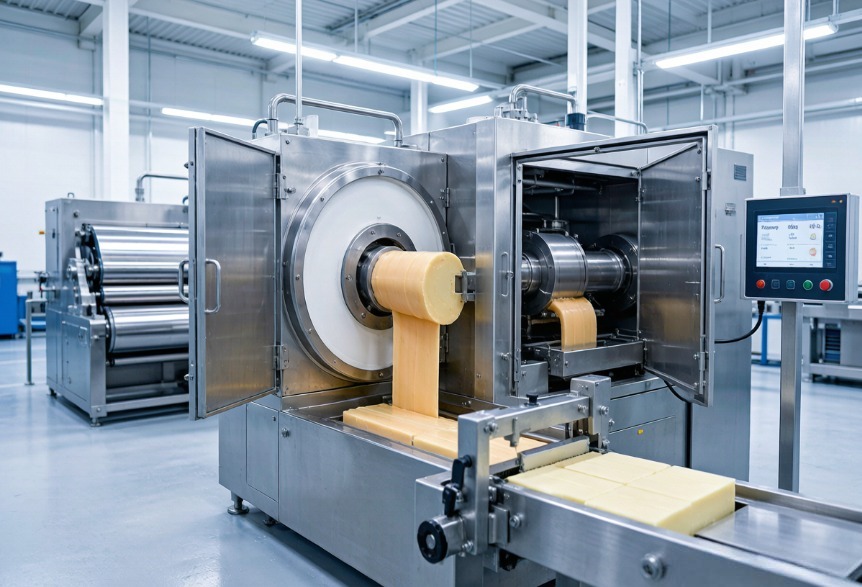
This article breaks down the four-stage finishing line architecture, the technology shifts redefining each stage, and the procurement specifications that separate a compliant line from a yield-optimized one.
1. The Finishing Line Now Represents 46% of Global Soap Equipment Spend
PW Consulting’s 2026 market breakdown of the global soap making machine market — valued at USD 1.68 billion in 2025 — quantifies the structural weight of the finishing line:
| Process Function | 2025 Value (USD M) | Share | Stage |
|---|---|---|---|
| Saponification & Vacuum Drying | 588.76 | 35.0% | Wet phase (upstream) |
| Plodding & Extrusion | 452.16 | 26.9% | Finishing line |
| Cutting & Stamping | 340.37 | 20.2% | Finishing line |
| Packaging & Wrapping | 300.73 | 17.9% | Downstream |
| Total Market | 1,682.02 | 100.0% | — |
Adding plodding/extrusion (26.9%) and cutting/stamping (20.2%) gives the finishing line a 47.1% share — USD 792.53 million in 2025. Including the inline roll mill and amalgamator sub-stages that precede the plodder, the practical finishing line spend exceeds USD 1.18 billion, making it the single largest capex cluster in a modern soap plant.
2. The Four-Stage Finishing Line Architecture
A modern finishing line transforms dried soap noodles (12–15% moisture) into wrapped bars through four tightly-coupled stages. Each stage has a distinct technology choice that determines final bar quality.
| Stage | Function | 2026 Technology Standard | Critical Output Metric |
|---|---|---|---|
| 1. Amalgamator | Add fragrance, color, additives; coat noodles | Sigma-blade mixer with gravimetric dosing | Additive uniformity ±0.3% |
| 2. Roll Mill (Refiner) | Homogenize, plasticize, break dry specks | 3-roll mill, 3.5 L/D ratio, 50 HRC martensitic rolls | Flake thickness 0.2–0.4 mm |
| 3. Duplex Vacuum Plodder | Refine, de-air, extrude continuous billet | Twin-worm duplex, vacuum <0.05 bar, L/D 4 | Bar density 1.20–1.28 g/cm³ |
| 4. Cutter + Stamper | Cut to length, imprint brand/logo | Servo-electric cutter, pneumatic/hydraulic stamper | Weight tolerance ±0.5 g |
The sequential logic is unforgiving: a defect introduced upstream cannot be corrected downstream. A poorly-milled soap mass entering the plodder will produce streaked billets; a poorly-extruded billet cannot be saved by even the most precise stamper. This is why 2026 procurement specs are now written stage-by-stage rather than line-by-line.
3. Vacuum Plodder Technology Shift: From Simplex to Twin-Worm Duplex
The plodder is the heart of the finishing line, and the technology standard has shifted decisively in 18 months. Three configurations now coexist in the market:
| Configuration | Vacuum Stage | Typical Capacity | 2026 Use Case |
|---|---|---|---|
| Simplex Plodder | None (single screw) | 100–300 kg/hr | Small-scale, rural, entry-level detergent bars |
| Duplex Vacuum Plodder | Single vacuum chamber between two screws | 300–800 kg/hr | Mid-scale toilet soap, contract manufacturing |
| Twin-Worm Duplex Vacuum Plodder | Twin tangential worms + vacuum chamber | 500–1,500 kg/hr | Premium toilet soap, export-grade lines |
The shift is driven by three converging pressures:
- Air removal requirement. A duplex vacuum plodder operating at <0.05 bar reduces entrapped air to under 0.5% by volume. Single-stage plodders leave 2–3% residual air, producing visible bubbles in transparent soaps and surface cracks in toilet bars after stamping.
- Density consistency. Twin-worm designs achieve bar density in the 1.20–1.28 g/cm³ range with ±0.02 g/cm³ variance. This consistency is what allows downstream cutters to hit ±0.5 g weight tolerance — a non-negotiable for retail-grade toilet soap.
- Multi-fat formulation handling. As plants transition from uniform animal tallows to variable vegetable oil blends (palm kernel, shea, coconut), the higher shear capacity of twin-worm designs prevents cavitation in the mixing shaft — a documented failure mode in 2026 plant audits.
4. Roll Mill Refining: The 3.5 L/D Dividend
The roll mill sits between the amalgamator and the plodder, and its specification is the most under-appreciated variable in finishing line capex. The 2026 standard has shifted from the traditional 2.5 L/D ratio to 3.5 L/D, with three measurable benefits:
| Specification | 2.5 L/D (Legacy) | 3.5 L/D (2026 Standard) | Operational Impact |
|---|---|---|---|
| Heat transfer surface | Baseline | +40% | Lower soap temperature rise; less fragrance loss |
| Roll surface hardness | 45 HRC | 50 HRC martensitic stainless | Roll life +30%; fewer regrinds |
| Surface roughness | 0.8 Ra | 0.4 Ra | Smoother flakes; fewer visual defects in finished bar |
| Core construction | Hollow roll | Solid carbon steel shaft + shrunk cylinder + cooling channels | Deflection under load cut by 50%; gap consistency improves |
For premium toilet soap producers, the 3.5 L/D roll mill is now a hard requirement — fragrance loss during milling drops 15–20% versus legacy 2.5 L/D designs, a direct margin gain given that fragrance is typically 4–7% of total soap cost.
5. Cutting & Stamping: Where Yield Is Won or Lost
The final stage — cutting the continuous extruded billet into individual bars and stamping the brand imprint — represents USD 340.37 million in 2025 equipment spend, but its real impact is on yield, not capex. A poorly-specified cutter/stamper combination can erase 4–8% of upstream yield in seconds.
Three 2026 procurement requirements define the modern standard:
- Servo-electric cutter drive. Replaces pneumatic cutters with ±1.5 g weight variance. Servo drives achieve ±0.5 g at 60–120 cuts/min, the prerequisite for retail-ready toilet soap.
- Heated stamping die. Maintained at 35–45°C to prevent soap sticking during imprint. Cold dies cause surface tearing; overheated dies cause smearing. Servo-electric stampers now achieve ≤0.5% pressure accuracy.
- Inline vision QC. Camera-based inspection at 100% sampling, flagging weight, surface, and imprint defects in real time. Defect detection improvement of 19% has been documented in 2026 line audits versus legacy offline sampling.
6. Finishing Line CapEx Matrix by Production Scale
The capex required for a compliant, yield-optimized finishing line scales non-linearly with target throughput. The matrix below summarizes H2 2026 market pricing across four production tiers:
| Tier | Capacity (kg/hr) | Plodder Type | Finishing Line CapEx (USD) | Typical Buyer |
|---|---|---|---|---|
| Entry | 100–300 | Simplex | 25,000 – 60,000 | Rural detergent bar, artisan scale-up |
| Mid-scale | 500–800 | Duplex vacuum | 120,000 – 280,000 | Contract manufacturer, regional brand |
| Industrial | 1,000–1,500 | Twin-worm duplex vacuum | 320,000 – 650,000 | National brand, export-oriented producer |
| Flagship | 2,000+ | Twin-worm duplex + inline NIR + vision QC | 850,000 – 1,800,000 | Multinational FMCG, premium private label |
Pricing reflects H2 2026 quotes from Chinese, Indian, and Italian equipment suppliers. The jump from mid-scale to industrial tier — roughly 2.3× capex for 1.8× capacity — is driven primarily by the move from single-worm to twin-worm duplex vacuum plodders and the addition of inline vision QC systems.
7. Regional Demand Signals for Finishing Line Equipment
Regional allocation of finishing line capex is shifting. The Asia-Pacific region continues to lead in absolute spend, but the technology profile differs sharply by region:
| Region | 2025 Soap Machine Share | Dominant Finishing Line Spec | H2 2026 Demand Driver |
|---|---|---|---|
| Asia-Pacific | 42.82% (USD 720.3M) | Duplex vacuum, 500–1,000 kg/hr | China 8.6% / India 8.3% liquid soap CAGR; private-label capacity |
| Europe | 23.02% (USD 387.2M) | Twin-worm duplex + inline NIR, 1,000+ kg/hr | EU DPP / 2D-barcode compliance; RSPO traceability |
| North America | 18.18% (USD 305.8M) | Servo-electric stamper, vision QC standard | Premiumization; antibacterial/sensitive-skin SKUs |
| Latin America | 8.99% (USD 151.3M) | Duplex vacuum, mid-scale | Argentina/Chile eco-bar and boutique segment |
| Middle East & Africa | 6.98% (USD 117.4M) | Simplex & duplex mix, halal-certified lines | Halal soap capacity; rural hygiene expansion |
A separate dynamic is the stainless steel input cost: Chinese SS304 traded at approximately 3,103 CNY/tonne in early April 2026 (Trading Economics), sustaining pressure on plodder and roll mill pricing. Suppliers that lock in material costs in Q3 contracts are likely to offer 5–7% better capex terms than spot-priced competitors.
8. H2 2026 Finishing Line Procurement Checklist
For procurement teams evaluating finishing line upgrades or greenfield projects in H2 2026, the following seven specifications represent the non-negotiable baseline for a yield-optimized, compliance-ready line:
| # | Specification | 2026 Baseline | Why It Matters |
|---|---|---|---|
| 1 | Plodder configuration | Duplex vacuum (twin-worm for 1,000+ kg/hr) | Bar density 1.20–1.28 g/cm³; air content <0.5% |
| 2 | Vacuum chamber pressure | <0.05 bar, continuous monitoring | Prevents surface cracks and bubble defects |
| 3 | Roll mill L/D ratio | 3.5 L/D, 50 HRC martensitic rolls | +40% heat transfer; 15–20% less fragrance loss |
| 4 | Cutter drive type | Servo-electric (not pneumatic) | Weight tolerance ±0.5 g at 60–120 cuts/min |
| 5 | Stamping die temperature control | 35–45°C, ±1°C accuracy | Clean imprint, no smearing or surface tear |
| 6 | Inline vision QC | 100% sampling, weight + surface + imprint | +19% defect detection vs offline sampling |
| 7 | Wetted-part metallurgy | AISI 304 (minimum) / 316L for saponification | Caustic corrosion resistance; ISO 22716 GMP compliance |
Conclusion: The Yield Imperative
The H2 2026 finishing line is no longer a downstream afterthought to the saponification plant. At USD 1.18 billion in 2025 equipment value — 46% of total soap machine spend — it is the largest single capex cluster in a modern soap plant, and the stage where 4–8% of yield is won or lost.
The technology standard has decisively shifted to duplex vacuum plodders, 3.5 L/D roll mills, servo-electric cutters, and inline vision QC. Plants still operating simplex plodders and pneumatic cutters are not just behind on technology — they are operating at a structural yield disadvantage that compounds with every formulation change and every SKU added.
For H2 2026 procurement decisions, the seven specifications above represent the baseline. The marginal cost of moving from baseline to optimized is typically 12–18% of finishing line capex; the yield gain is 3–6 percentage points. Few investments in a soap plant offer that return profile.