
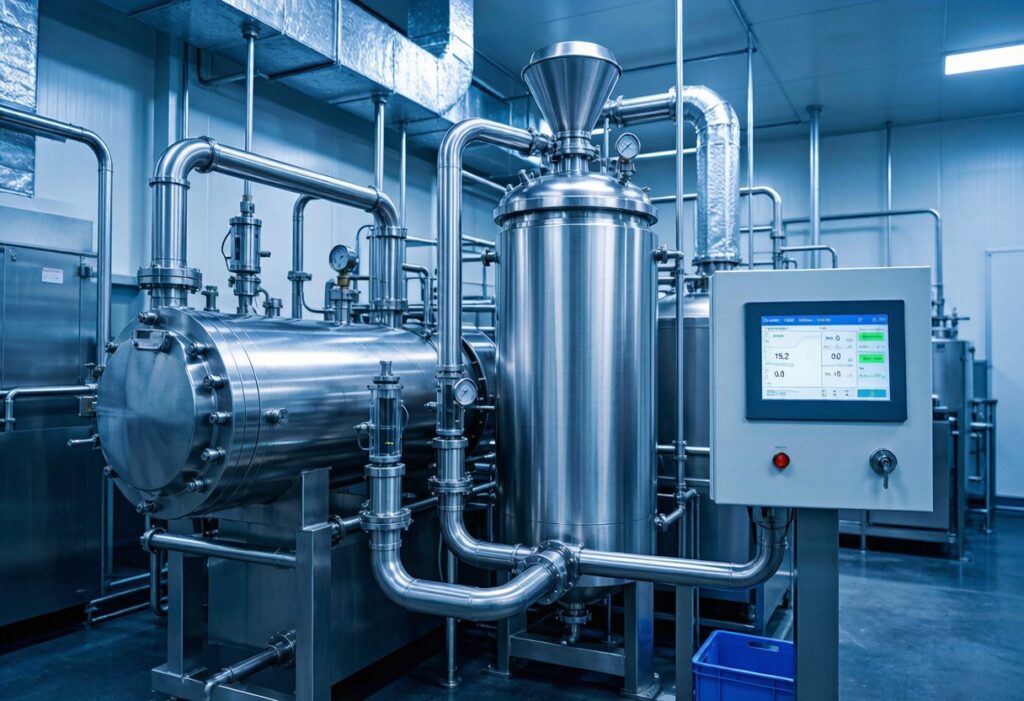
Cover image: Continuous saponification loop integrated with vacuum spray drying chamber — the wet-phase backbone of modern soap noodle production. Representative industrial configuration.
Mid-August 2026 marks a structural inflection in the wet phase of soap manufacturing. On July 28, Rafa Corporation signed contracts for Nigeria’s largest single-line continuous saponification plant — a 10-tonnes-per-hour (TPH) integrated system paired with continuous vacuum cooling and drying, plus two 4-TPH toilet soap finishing lines. The deal, inked with MIL India Private Limited and operated through Starium Detergents FZE, places Africa on the map as a serious buyer of upstream oleochemical processing infrastructure — not just downstream finishing lines.
This development arrives at a moment when saponification and vacuum drying — long the most under-discussed segment of the soap equipment value chain — has been confirmed as the single largest process-function category globally, representing 35.0% of the soap making machine market with USD 588.76 million in 2025 revenue (PW Consulting, 2026). For procurement directors evaluating H2 2026 capital allocation, the message is clear: the chemical reactor is no longer a back-office utility — it is the strategic core.
1. The Rafa Corporation Landmark: A 10-TPH Signal from Nigeria
The Rafa investment — announced at the Starium Head Office in Victoria Island, Lagos — is the most significant single-line continuous saponification commitment ever recorded in West Africa. Key parameters:
| Parameter | Specification | Strategic Implication |
|---|---|---|
| Saponification reactor | Continuous loop, 10 TPH | Largest single-line in Nigeria |
| Vacuum cooling & drying | Integrated continuous unit | Eliminates batch-to-dryer transfer losses |
| Finishing lines (toilet soap) | 2 × 4 TPH | 8 TPH aggregate downstream capacity |
| Product portfolio | Multipurpose bars + premium noodles | B2C + B2B dual-channel flexibility |
| Existing footprint | 80,000 t/yr powder detergent (Epe, Lagos) | Scaling to 200,000 t/yr by year-end |
| Equipment supplier | MIL India Private Limited | India-Africa south-south technology corridor |
The procurement logic is unmistakable: by integrating saponification, vacuum drying, and finishing under a single continuous architecture, Rafa eliminates the neat-soap handling losses (typically 2–4% in batch kettles) and locks in product consistency across an 8-TPH downstream train. The 10:8 reactor-to-finishing capacity ratio leaves headroom for soap noodle merchant sales — a deliberate hedge against bar soap demand cyclicality.
2. Saponification & Vacuum Drying: The 35% Market Segment
Independent market analysis now places saponification and vacuum drying as the dominant process-function category in the global soap making machine market. The category outpaces plodding/extrusion (26.9%), cutting/stamping (20.2%), and packaging/wrapping (17.9%) by a clear margin.
| Process Function | 2025 Revenue (USD M) | Global Share | Role in Production Chain |
|---|---|---|---|
| Saponification & Vacuum Drying | 588.76 | 35.0% | Wet phase: oil → neat soap → noodles |
| Plodding & Extrusion | 452.16 | 26.9% | Refining/extrusion of noodles into billets |
| Cutting & Stamping | 340.37 | 20.2% | Final forming, embossing, branding |
| Packaging & Wrapping | 300.73 | 17.9% | Retail-ready secondary packaging |
Source: PW Consulting / pmarketresearch.com, Worldwide Soap Making Machine Market 2026
The dominance is not accidental. Saponification is the chemical gateway — every kilogram of finished soap must pass through the reactor — and vacuum drying is the moisture-stability gatekeeper that determines whether downstream plodding yields a clean, air-free billet or a cracked, streaked reject. Buyers who under-spec this segment pay the cost downstream in elevated scrap rates and stamping defects.
3. Batch Kettle vs Continuous Saponification: The Architectural Choice
The wet phase offers two fundamentally different reactor architectures. The decision between a batch kettle (crutcher) and a continuous saponification loop is no longer just a capacity question — it is a strategic commitment that defines feedstock flexibility, glycerin recovery yield, and per-tonne operating cost for the 15–20-year life of the asset.
| Dimension | Batch Kettle (Crutcher) | Continuous Saponification Loop |
|---|---|---|
| Capacity range | 0.5–3 TPH typical | 1 TPH minimum, scalable to 10+ TPH |
| Cycle time | 4–8 hours per batch | Continuous, residence ~20–40 min |
| Reaction heat | External steam heating | Exothermic, self-sustaining to 135°C |
| Dosing precision | Manual / semi-auto | Mass flow meters, 0.1% accuracy |
| Free alkali control | Variable, lab-titrated | Inline, instrument-driven, constant |
| Steam / water / power | Baseline | Lower on all three utilities |
| Operator dependence | High (skill-critical) | Low (instrument-driven) |
| CapEx band | $60K – $400K | $500K – $3.5M+ |
| Payback advantage | Lower entry cost | Faster payback via utility savings + yield |
The Mectech continuous loop design — used widely in India, Indonesia, and increasingly in Africa — illustrates the new baseline. Fat and aqueous phases are preheated to 95°C, mixed in a high-shear homogenizer where exothermic reaction heat raises neat soap to 135°C without external steam, then matured in a loop reactor before feeding the vacuum spray drier. Mass flow meters operate at 0.1% accuracy — an order of magnitude tighter than batch dosing — which translates directly into tighter free-alkali control and predictable TFM (Total Fatty Matter) output.
4. Vacuum Spray Dryer Specifications: The 0.5–10 TPH Spectrum
Once saponified, neat soap at ~30% moisture must be flash-dried under vacuum into soap noodles at 11–15% moisture. The vacuum spray dryer is the physical-chemical bridge that locks in product consistency. The 2026 vendor landscape shows a clean four-tier capacity spectrum:
| Model Class | Chamber Ø (mm) | Capacity (TPH) | Motor (kW) | Typical Application |
|---|---|---|---|---|
| 500ES-VSD-1000 | 1,000 | 0.5–0.8 | 3.0 | Pilot / small enterprise |
| 1000ES-VSD-1000 | 1,000 | 1.0–1.5 | 4.0 | Mid-size national brand |
| 3000ES-VSD-1500 | 1,500 | 2.0–5.0 | 5.5 | Established regional producer |
| 8000ES-VSD-1700 | 1,700 | 6.0–10.0 | 7.5 | Export-scale mega-plant |
Source: LIMAC Machinery, Jinan Zhonghui, Yusou Heavy Industry — 2026 supplier specifications
Critical metallurgical note: all wetted parts — chamber walls, spray nozzles, scrapers, and the main shaft — must be specified in SS304 minimum, with SS316L mandatory when free fatty acid blends exceed 5% or when chlorides are present in the brine wash. The cost premium for 316L over 304 is currently 18–25% in China (stainless steel trading at approximately CNY 3,103/tonne in early April 2026, Trading Economics), but the corrosion-driven service life extension exceeds 40% — a non-negotiable trade-off for any plant operating beyond a 10-year horizon.
5. AI Process Control: NIR In-Line Sensing Arrives in the Reactor Loop
The most consequential 2026 development in saponification is not mechanical — it is sensorial. By late 2026, leading facilities are integrating inline Near Infrared (NIR) spectrometers directly into the saponification loop, replacing the legacy 4-hour lab titration cycle with real-time feedback on free alkali, moisture, and glycerin content. The implications are quantifiable:
| Control Variable | Legacy (Lab Titration) | NIR In-Line + Edge Computing | Improvement |
|---|---|---|---|
| Free alkali feedback | 2–4 hr lag | Sub-60-second | ~150× |
| Off-spec batch rate | 3.0–5.5% | 0.4–0.8% | ~85% reduction |
| Glycerin recovery yield | 88–92% | 95–97% | +3–7 pp |
| Caustic dosing variance | ±2.5% | ±0.3% | ~8× tighter |
| Operator intervention | Hourly | Exception-only | ~70% reduction |
The economic case is straightforward. On a 5-TPH line producing 35,000 tonnes annually, a 3-percentage-point gain in glycerin recovery at current refined glycerin prices translates to roughly USD 280,000–420,000 per year in incremental co-product revenue — paying back the NIR installation within 12–18 months. This is why AI-driven viscosity mapping and dynamic caustic dosing have moved from pilot facilities to line-standard procurement specifications in the second half of 2026.
6. Glycerin Recovery Economics: The Co-Product Multiplier
Glycerin is no longer a marginal byproduct. With global vegetable glycerin demand at USD 1.58 billion in 2026, forecast to reach USD 2.65 billion by 2036 (CAGR 5.3%, Future Market Insights), and palm-oil-derived glycerin alone reaching USD 3.94 billion in 2026 (PW Consulting Chemical & Energy Research Center), the recovery loop now materially influences reactor design specifications.
| Glycerin Grade | 2026 Price (USD/MT) | Demand Driver | Recovery Equipment Implication |
|---|---|---|---|
| Crude (80% purity) | 200–440 | Animal feed, industrial | Basic salt-wash + settling |
| Refined technical (99.5%) | 620–680 (CIF India) | Detergent, textile, polymer | Vacuum distillation column |
| Refined USP/IP grade | 700–1,100 | Pharma, food, cosmetics | Pharmacopoeia-certified refining skid |
| China-sourced technical | ~640 (Q3 benchmark) | Oversupply-driven deflation | Strategic sourcing leverage window |
Sources: Future Market Insights, OleochemicalsAsia, Palm-Chemicals.com, PW Consulting — 2026 data
The structural backdrop: Indonesia’s B40 biodiesel mandate (15.646 million kiloliters of allocation in 2026) generates approximately 100 kg of crude glycerin per metric ton of biodiesel produced — adding a predictable 1.5+ million tonnes of biodiesel-derived crude glycerin to global supply. China’s parallel refining overcapacity is applying downward price pressure on technical grades, creating a buyer’s market through Q3 2026. For soap manufacturers, this means glycerin recovery is no longer purely a margin play — it is a supply-chain hedge against the same palm-oil feedstock volatility that drives the B50 mandate ripple effect.
7. Regional Demand Matrix: Where Saponification CapEx Is Flowing
Demand for new saponification capacity is highly concentrated. The regional split — drawn from PW Consulting’s 2025 market share data and cross-referenced with announced 2026 capex projects — shows Asia Pacific absorbing nearly half of all installations, with Africa emerging as the fastest-growing secondary market on the back of the Rafa investment and similar projects in Egypt, Ethiopia, and Kenya.
| Region | 2025 Share | 2026 Value (USD M) | Demand Bias |
|---|---|---|---|
| Asia Pacific | 42.82% | 252.18 | India, Indonesia, China — capacity expansion |
| Europe | 23.02% | 135.51 | RSPO compliance retrofit, energy efficiency upgrades |
| North America | 18.18% | 107.03 | Replacement cycles, USP-grade glycerin integration |
| Latin America | 8.99% | 52.95 | Brazil biodiesel co-product integration |
| Middle East & Africa | 6.98% | 41.09 | Nigeria Rafa 10-TPH; Egypt, Kenya, GCC greenfield |
Source: PW Consulting, Worldwide Soap Making Machine Market 2026; Sting Industry analysis
The 6.98% MEA share, while modest in absolute terms, is growing at the fastest rate in the dataset — the Rafa project alone adds roughly 80,000 tonnes of annual soap noodle capacity to a region historically dominated by imported finished soap. India, with its USD 4.13 billion (2025) → USD 5.48 billion (2034) soap market at 3.2% CAGR (IMARC), remains the single largest country-level saponification capex destination.
8. CapEx Bands and Payback: The Investment Spectrum
Saponification plant investments span more than two orders of magnitude, from small-batch artisanal systems to integrated continuous plants rivaling the Rafa scale. Independent project economics modelling (KAMRIT 2026, IMARC Soap Manufacturing Plant Report) converges on a four-tier framework:
| Tier | Capacity (TPH) | CapEx (USD) | Payback (yrs) | Architecture |
|---|---|---|---|---|
| Entry / Artisanal | 0.1–0.5 | $60K – $250K | 1.5–2.5 | Batch kettle + manual finish |
| Mid-market | 0.5–2.0 | $250K – $1.2M | 2.5–4.0 | Semi-continuous or batch + vacuum dryer |
| Industrial | 2.0–5.0 | $1.2M – $4.5M | 3.5–5.0 | Continuous loop + 316L wetted parts |
| Mega-plant | 5.0–10.0+ | $4.5M – $15M+ | 4.0–5.6 | Fully integrated continuous + NIR + glycerin refinery |
A useful benchmark: a representative 79,200 tonnes/year soap noodle plant in North Sumatra (designed 2026) carries a fixed capital requirement of USD 23.98 million with working capital of USD 12.35 million, achieving a pre-tax ROI of 33.74% and a payback period of 2.29 years (UGM repository study). These figures establish the upper end of credibility for greenfield feasibility analysis.
9. H2 2026 Procurement Checklist: 7 Non-Negotiables for the Wet Phase
For procurement teams finalizing saponification capex in the August–December 2026 window, the following specifications represent the current baseline — anything below this tier locks the buyer into obsolescent chemistry and unfavorable per-tonne economics.
| # | Specification | Minimum Acceptable | Why It Matters in 2026 |
|---|---|---|---|
| 1 | Reactor architecture | Continuous loop with homogenizer + maturation reactor | Exothermic heat recovery, 3–5× lower steam use |
| 2 | Mass flow metering accuracy | ≤0.1% for fat and caustic dosing | Tight free-alkali control, predictable TFM |
| 3 | Wetted metallurgy | SS316L for reactor, nozzles, shaft, scraper | 15+ year service life, chloride resistance |
| 4 | Vacuum dryer moisture range | 11–28% controllable, ±0.5% stability | Downstream plodder yield protection |
| 5 | In-line NIR spectroscopy | Free alkali + moisture + glycerin real-time | 85% off-spec reduction, 3–7 pp glycerin yield gain |
| 6 | Glycerin recovery integration | Salt wash + vacuum distillation to technical grade | Co-product revenue, feedstock cost hedge |
| 7 | RSPO traceability & EU DPP readiness | Batch-level data logging, mass-balance accounting | EU Digital Product Passport, EUDR compliance |
Conclusion: The Reactor Is the Strategy
For two decades, the soap equipment industry’s procurement conversation has been anchored at the finishing line — plodders, cutters, stampers, wrappers. Mid-August 2026 marks the point at which the upstream chemical reactor reclaims its strategic centrality. The Rafa Corporation 10-TPH commitment is one data point; the 35% process-function market share is the structural backdrop; the NIR-driven 85% off-spec reduction is the operational lever. Together, these signals redefine where capital, sensors, and metallurgical specification must converge.
For STING and other equipment suppliers serving export markets, the implication is direct: the buyer’s question in H2 2026 is no longer “what finishing line do you offer?” — it is “what continuous saponification architecture, what NIR integration, and what glycerin recovery economics can you deliver?” The answer to that compound question will determine market share for the next decade.
Data sources: PW Consulting / pmarketresearch.com (Worldwide Soap Making Machine Market 2026), BusinessPost Nigeria (Rafa Corporation investment announcement, July 28, 2026), Punch Nigeria, Mectech Process Engineers (continuous saponification plant specifications), LIMAC Machinery Works Corporation (vacuum dryer specifications), Jinan Zhonghui Machinery (XSD series), Industry Index 2026 Buyer’s Guide, Future Market Insights (Vegetable Glycerin Market 2026), OleochemicalsAsia (China glycerine oversupply analysis, Q3 2026), Palm-Chemicals.com (crude glycerine supply chain 2026), PW Consulting Chemical & Energy Research Center (Palm Oil Glycerin Market 2026), IMARC Group (India soap market 2026), KAMRIT (Soap Noodles Plant Project Report 2026), Universitas Gadjah Mada repository (North Sumatra 79,200 t/yr plant design study), Trading Economics (stainless steel pricing, April 2026), Sting Industry market analysis.
Tags: soap saponification equipment, continuous saponification plant, vacuum spray dryer, soap noodle production, Nigeria soap manufacturing, Rafa Corporation, MIL India, glycerin recovery, NIR in-line spectroscopy, SS316L reactor, H2 2026 procurement, soap equipment market 2026, palm oil feedstock, RSPO traceability.