
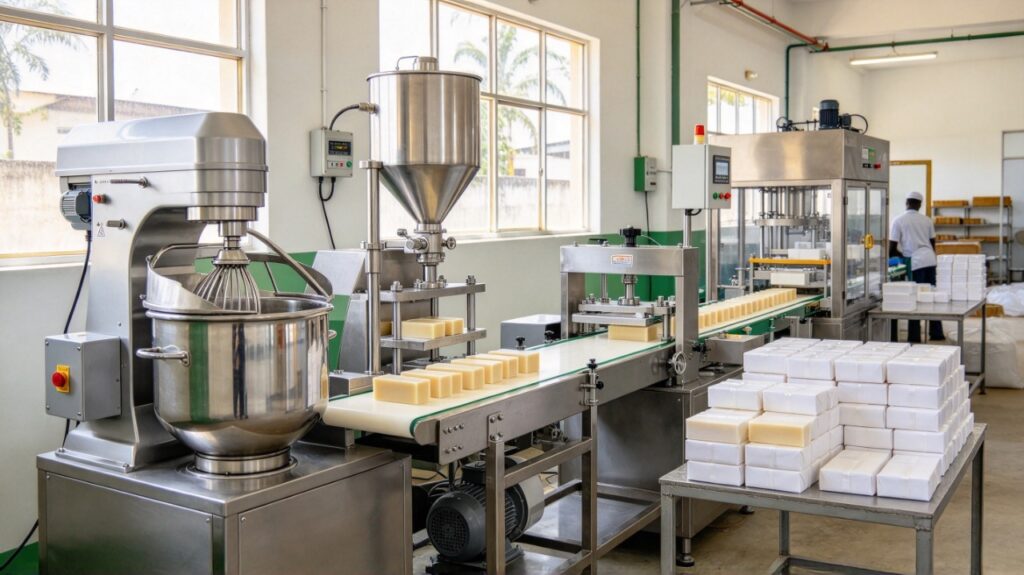
Planning to build a soap factory in Ghana? Check suitable soap production line options, budget tips and shipping considerations for Ghana soap entrepreneurs.
Ghana’s fast-growing population, rising urban incomes and strong demand for affordable personal care products are drawing a new wave of soap entrepreneurs. From small-scale liquid soap and bar soap startups in Accra and Kumasi to medium factories supplying regional distributors, more business owners than ever are asking the same two questions: which soap production line should I buy, and how do I get it shipped to Ghana without surprises? This guide walks through the current market, recommended machine capacities, import logistics and the questions we hear most often from Ghanaian buyers.
Current Soap Market Demand in Ghana
The Ghanaian soap market is large, fragmented and still expanding. A few structural facts explain why setting up a local soap factory remains an attractive opportunity:
- Steady demand growth. Ghana’s bath and shower category continues to grow on rising hygiene awareness, urbanization and a young population. Industry reports estimate the bath products market growing at roughly double-digit annual rates, driven by affordable mass-market bar soap and growing interest in natural, shea- and shea-butter-based formulations.
- Imports are falling as local production rises. In 2012–2015 Ghana imported on average about 76,000 tonnes of manufactured soap per year; that figure has since settled around 50,000–55,000 tonnes annually. The gap is being filled by domestic producers — a clear sign that locally made soap is gaining ground on imports.
- Both branded and informal segments are active. Multinational players such as Unilever Ghana still lead the branded bar soap segment, but there are over 10 major domestic producers plus a long tail of small and micro manufacturers serving neighborhood markets, sachet and family-pack distribution, and specialty natural/organic soap lines.
- Regional export opportunity. Ghana already exports bar soap to neighboring ECOWAS markets such as Benin, Togo and Burkina Faso. A factory that reaches consistent quality and cost can sell beyond Accra and Kumasi into the wider West African trade corridor.
- Local raw material advantages. Ghana is part of the shea belt, and locally produced cocoa pod ash, palm oil, palm kernel oil and shea butter support the traditional African black soap (alata samina) segment. This gives local formulators a sourcing edge that importers cannot easily match.
In short: demand is broad, price-sensitive and favors producers who can deliver stable quality at a competitive cost. For a new entrant, the winning position is usually a focused product range — for example, laundry bar soap for household and institutional buyers, or affordable bathing/toilet soap for retail — rather than trying to compete head-on with the multinationals from day one.
Recommended Soap Production Line Capacity for Ghana New Factories
Most first-time Ghanaian soap factory buyers fall into two realistic tiers. Choosing the right capacity up front matters: a line that is too large ties up capital in machines and inventory, while a line that is too small cannot cover fixed costs as volume grows.
Small entry line: 100–200 kg/hour
This is the most common starting point for new entrepreneurs. A small bar soap line typically includes a sigma mixer or soap noodle mixer, a duplex/plodder (vacuum plodder for a smoother bar), a cutter and a stamper/press, plus an optional semi-automatic wrapping machine. It can run from purchased soap noodles — the standard starting approach for new factories — and turn out laundry or bathing bars in a range of weights.
- Best for: First-time factory owners, district-level brands, producers starting with 1–2 products.
- Power requirement: Usually 380 V / 50 Hz, 3-phase. Total installed power is modest (roughly 15–30 kW), which matters in Ghana where grid supply can be unreliable and a generator backup is often budgeted.
- Footprint: Fits in a workshop of roughly 80–150 m².
- Why it fits Ghana: Lower capital outlay, easy to operate with 2–4 workers, and flexible enough to switch between laundry soap and toilet soap formulas.
Medium growth line: 300–500 kg/hour
Once a brand has secured distributor relationships or institutional orders (schools, hospitals, hotels, CHPS compounds, retailers), a medium line becomes the sensible step up. This line adds a more powerful vacuum plodder, an automatic cutter, a die stamper and an automatic cartoning/wrapping line, reducing labor per tonne and improving bar weight consistency.
- Best for: Brands that already sell regionally across Ghana and want to supply ECOWAS neighbors.
- Power requirement: Around 40–75 kW installed, again 380 V / 50 Hz. A dedicated generator or three-phase utility connection should be planned before installation.
- Footprint: Roughly 200–400 m² including raw material storage and finished-goods area.
| Dimension | Small line (100–200 kg/h) | Medium line (300–500 kg/h) | Notes for Ghana |
| Typical output | ~0.8–1.6 tonnes/shift | ~2.4–4 tonnes/shift | Assumes one 8-hour shift; plan raw-material buffer for power outages |
| Core equipment | Mixer, plodder, cutter, stamper | Vacuum plodder, auto cutter, stamper, auto wrapper | Noodle-based process for both; in-house saponification is a later upgrade |
| Workers per shift | 2–4 | 4–8 | Operator training usually provided by the supplier |
| Utility needs | 380 V 3-phase, modest water | 380 V 3-phase, compressed air, cooling water | Confirm voltage/frequency before ordering; Ghana is 230 V single-phase / 400 V 3-phase, 50 Hz |
| Best fit | First factory, local/regional brand | Established brand, distributor & export sales | Do not over-size before demand is proven |
One practical tip: start with a soap-noodle-based bar line rather than a full saponification plant. Soap noodles (semi-finished soap base) are imported or locally traded, and they let you begin producing within weeks of installation. In-house soap boiling/saponification is a capital- and skill-intensive upgrade that most profitable Ghanaian producers add only after their bar business is stable.
Key Considerations When Importing Soap Machines to Ghana
For most new Ghanaian factories, soap machinery is sourced from China (and increasingly from India and Turkey). The machine price is only one part of the landed cost — shipping, insurance, duties, clearing and installation all matter. Plan early.
Shipping route and transit time
Soap production lines are heavy, freight-sensitive cargo (mixers, plodders, stainless steel tanks). The standard route is sea freight from a Chinese port (Shanghai, Ningbo, Shenzhen/Guangzhou) to Tema Port — Ghana’s main container gateway near Accra — with Takoradi as the secondary option.
| Shipping mode | Typical transit to Tema | Best for | Planning note |
| FCL sea freight | ~30–40 days port-to-port | A full production line (usually 1×20GP or 1×40HQ container) | Best value per kg for a complete line; book early as sailings are scheduled |
| LCL sea freight | ~40–50 days door-to-door | Smaller shipments or single machines | Consolidation adds time; ensure crating/packing is sea-worthy |
| Air freight | ~8–12 days | Urgent spare parts or small high-value components | Not economical for heavy machinery |
Add at least 1–3 weeks for port handling, customs clearance and inland transport to your factory in Accra, Kumasi, Takoradi or elsewhere. A realistic door-to-door plan for a containerized soap line is roughly 45–60 days after the vessel sails, and more during peak seasons or port congestion.
Import duties, taxes and documentation
Ghana assesses customs duty on the CIF value (cost + insurance + freight) through the Ghana Revenue Authority (GRA) ICUMS system. Machinery falls under the ECOWAS Common External Tariff; capital goods such as soap-making equipment generally attract a low customs-duty band, on top of which import VAT, NHIL and other levies apply. The total landed tax burden varies by HS code and shipment, but a typical ballpark to budget for is the low-to-mid double-digit percentage on CIF.
Import regulations vary — consult your local import agent. Duty rates, exemptions, SGS/inspection requirements and HS-code classification can change, and the rules depend on the exact machine model and your business setup. Always work with a licensed Ghanaian customs clearing agent who can classify the equipment correctly before you ship, and ask your supplier for a proforma invoice, packing list, bill of lading and certificate of origin.
Documents you should expect from the machine supplier:
- Proforma invoice (showing machine model, specifications, unit value)
- Detailed packing list / weight and measurement sheet (critical for container planning)
- Bill of lading / airway bill
- Certificate of origin
- Machine manual, electrical drawings and (where relevant) CE/quality certificates
Power, installation and after-sales
Before ordering, confirm three practical points with the supplier: (1) the machine voltage and frequency match your factory supply (380 V / 50 Hz, 3-phase is standard for Chinese equipment; a transformer or phase converter may be needed), (2) whether the supplier provides remote installation guidance, video training or on-site engineer dispatch, and (3) how spare parts (screener plates, sealing rings, heating elements, belts) are supplied — these small items cause the most costly downtime after arrival.
Common Questions from Ghana Soap Factory Buyers
Do I need a fully automatic line, or can I start semi-automatic?
Start semi-automatic unless you already have firm orders. A 100–200 kg/hour semi-automatic line delivers the entry product quality at a fraction of the investment. You can always add automatic wrapping or a vacuum plodder later as volume grows.
Can I make African black soap (alata samina) on the same line?
Traditional hand-mixed black soap is processed differently from noodle-based bar soap. A standard plodder line is designed for homogeneous soap noodles. If black soap is your main product, discuss the formulation and moisture content with the supplier before ordering — some lines can handle shea-based and specialty bases, but not all.
How much space and water does a small line need?
A 100–200 kg/h line fits in about 80–150 m² of workshop, plus separate areas for raw material storage and finished bars. Water demand is modest (for cleaning and cooling), but drainage and ventilation should be planned. Expect 2–4 operators per shift.
How long after order until the machines are running?
Production of a new line at the factory usually takes 20–35 days, then sea freight to Tema adds 30–50 days, plus customs clearance and inland transport. From order to first bar off the line, budget roughly 3–4 months end to end, and plan your working capital accordingly.
What raw materials should I source locally vs. import?
Soap noodles, fragrances, colors, preservatives and packaging films are commonly sourced through local importers or traded across Accra/Tema. Shea butter, palm/palm-kernel oil and cocoa pod ash for specialty lines have local supply. Confirm ingredient availability and pricing before locking your product formula.
Do I need to register my factory or products?
Ghana requires business registration (Registrar General’s Department / GRA TIN), and cosmetic and soap products fall under FDA Ghana oversight for establishment registration and product notification. Budget time for FDA registration alongside equipment import — do not leave it until the machines arrive.
A Reference Soap Machine Project Case for a Ghana Client
While every project is different, a typical reference installation looks like this: a first-time client in the Greater Accra region ordered a 150 kg/h bar soap production line built around soap noodles, comprising a mixer, vacuum plodder, cutter, stamper and semi-automatic wrapper. The line was packed into one 20-foot container, shipped from a Chinese port to Tema on an FCL basis.
The client’s plan was to produce 150 g family laundry bars and 100 g affordable bathing bars for neighborhood distributors and small retailers. On arrival, a local electrician handled the 3-phase connection (the supplier provided electrical drawings and remote video support), and the client’s small team was trained remotely through the installation and trial runs. Because the client engaged a licensed clearing agent before shipment, customs clearance at Tema was completed without major delays, and the first trial batch was pressed within a week of the machine being uncrated.
The key lessons from projects like this are consistent: confirm voltage and foundation requirements early, book the container and the clearing agent in parallel, and allocate working capital for soap noodles, packaging and the first 2–3 months of operation — not just for the machines themselves.
Get Your Tailored Soap Machine Quotation
Ghana’s soap market rewards producers who can offer consistent quality, reliable supply and competitive pricing. The right production line — sized to your orders, matched to your power supply, and shipped and cleared without surprises — is the foundation of that business.
If you are planning to set up a soap factory in Ghana, send us your target product (laundry soap, toilet/bathing soap, or specialty shea-based bars), your expected daily output, your factory location and your available power supply. We will recommend a production line configuration, outline the equipment list and power needs, and give you a reference shipping-and-landed-cost estimate so you can plan your budget realistically.
Ready to start? Request a tailored soap machine quotation for your Ghana factory today.