
With Brent crude above US$117/barrel in early November and vegetable-oil feedstock costs climbing with it, soap plant economics in Q4 2026 are dominated by one conversation: the cost of fat in, per tonne of bar out. But every tonne of fat carries a second, quieter revenue stream that most soap plants still treat as waste chemistry. Saponification splits each triglyceride into soap and glycerin — and the glycerin market has quietly restructured around exactly this stream.
Key Takeaways
- The global glycerin market is set to grow from US$5.49 billion in 2026 to US$6.99 billion by 2034 (3.06% CAGR) — modest at the market level, but the value sits in purity, not volume: refined and pharma-grade material commands a 2–4× price multiple over crude.
- A typical soap line yields 30–35 kg of glycerin per tonne of soap produced. On a 5 TPH line, that is roughly 1.2–1.4 tonnes of glycerin per day — recoverable with a spent-lye treatment train rather than a new plant.
- Biodiesel oversupply keeps crude glycerin (80%) cheap at around US$800–1,100/t, while refined white material trades at US$1,200–1,600/t and high-purity East Asian material around US$1,300–1,390/t equivalent — the spread is the business case for on-site refining.
- Downstream demand is rotating: epichlorohydrin (still 38.5% of China’s crude glycerin consumption) is weak, while pharma- and cosmetics-grade demand is compounding at 8.2%+ per year — a purity ladder, not a volume ladder.
- 2026 technology shifts — molecular-sieve pre-treatment lifting purification efficiency by ~15 percentage points while cutting energy ~20%, and short-path/molecular distillation for dark, high-salt feeds — have lowered the entry barrier for mid-size soap plants.
- Procurement consequence: glycerin recovery units should now be specified as part of the saponification package, with Grade A (99.5%+) capability in the base scope, not as a later bolt-on.
1. Why the By-Product Is Now a Board-Level Line Item
Glycerin is the chemistry no soap plant can opt out of. Every triglyceride converted into soap releases glycerol; the question is only whether it is recovered, discarded with the spent lye, or sold crude at the bottom of the price ladder. Three forces in late 2026 have moved that question up the agenda.
First, the feedstock squeeze. Brent crude rose more than 13% in October 2026 to trade above US$117/barrel after tanker incidents in the Strait of Hormuz, with WTI above US$104. Fat and oil markets track energy markets closely — palm kernel, coconut and tallow all carry energy-linked production and logistics costs. A soap plant watching its gross margin compress from the raw-material side has an obvious interest in monetising the ~10% of feedstock mass that leaves the saponification stage as glycerin rather than soap.
Second, the biodiesel cycle has structurally cheapened the crude end of the market. Roughly 45% of global glycerin supply now originates as a biodiesel co-product — about 1 tonne of crude glycerin per 10 tonnes of biodiesel produced. That flood keeps crude 80% glycerin cheap and plentiful, which is bad news for plants selling crude, but creates an attractive feedstock arbitrage for plants that can refine.
Third, demand is migrating up the purity ladder. Pharma- and cosmetics-grade glycerin is the fastest-growing segment (8.2%+ CAGR in China’s market), while the traditional volume outlet — epichlorohydrin — faces environmental compliance pressure and soft demand. The market is fragmenting by grade, and fragmentation rewards producers who can control purity.
| Indicator | Value | Source / Note |
|---|---|---|
| Global glycerin market, 2026 → 2034 | US$5.49B → US$6.99B (3.06% CAGR) | Fortune Business Insights, glycerol market report |
| Supply share from biodiesel, 2025 | ~45% | Fortune Business Insights |
| Personal care & pharma demand share, 2025 | ~35% | Fortune Business Insights |
| China crude glycerin market, 2026 | RMB 18.54B, +6.3% YoY | China crude glycerin industry study 2026 |
| China production 2026 (biodiesel co-product share) | 1.428M t (>75%) | Same study; balance from fats/oils refining |
| Largest Chinese downstream outlet | Epichlorohydrin, 38.5% of consumption | Same study; demand described as weak |
| Pharma/cosmetics-grade growth (China) | 8.2%+ CAGR | Same study; fastest-growing segment |
| Global market concentration | Top-5 producers hold only ~29% | China Report Hall; fragmented by-product economics |
Table 1. The 2026 glycerin market at a glance. Note the structural feature: most capacity is a co-product bolted to biodiesel or oleochemical plants — which is precisely why dedicated recovery-and-refining capability at soap plants carries strategic value.
The fragmentation point deserves emphasis. Because glycerin is almost never anyone’s core business — one leading Chinese biodiesel producer booked industrial glycerin at just 1.37% of H1 2025 revenue — no dominant refiner has emerged, and the top five players worldwide hold under a third of the market. For a soap manufacturer, that is an unusually open value chain: the refining step is not gated by an incumbent cartel, only by equipment and process discipline.
2. The Recovery Train: Equipment Anatomy
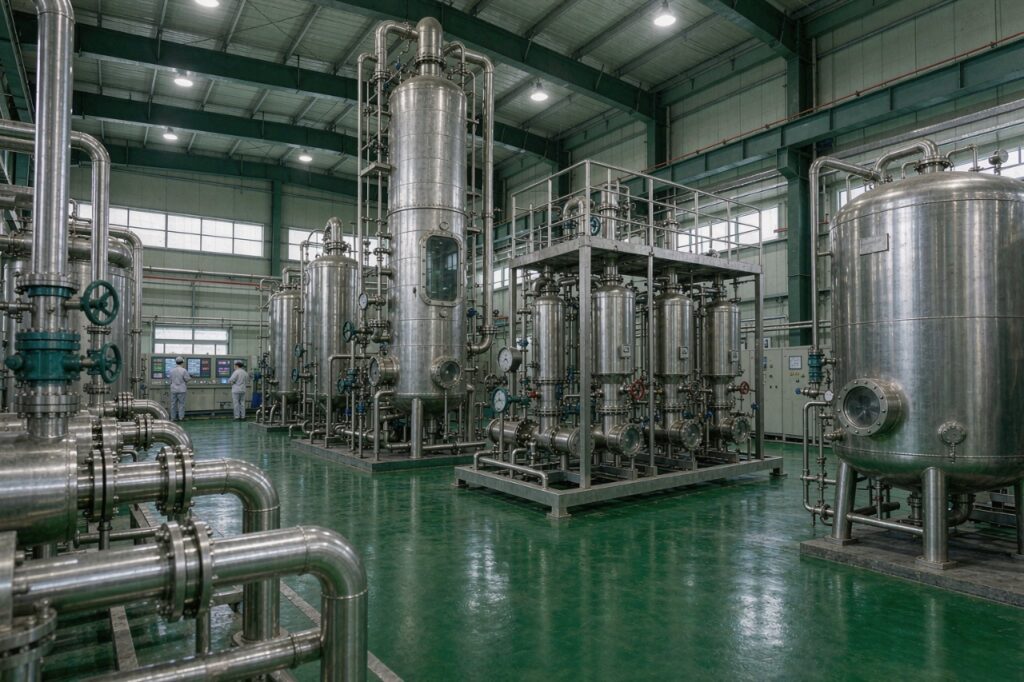
Glycerin leaves a soap plant in two streams: spent lye from the saponification stage (carrying salt, free caustic and soap traces) and, where present, the sweetwater from fatty-acid splitting. The classic soap-plant recovery train converts spent lye into saleable glycerin in five steps:
| Stage | Unit operation | Key parameters & purpose |
|---|---|---|
| 1. Acidification | Acid reaction tank (typically phosphoric acid) | Adjust to pH 4–6 to break soap into fatty acid (recovered as a floating layer) and glycerin liquor; precipitates phosphates for separation |
| 2. Solid–liquid separation | Settling, centrifuge, filter | Removes salt and precipitated solids; salt residue requires proper disposal handling |
| 3. Evaporation | Multi-effect vacuum evaporator | Concentrates glycerin liquor to ~88–92% “crude” glycerin; steam from the evaporator feeds the downstream vacuum still |
| 4. Vacuum distillation | Vacuum still / distillation column | 5–20 mmHg vacuum lowers glycerin’s 290°C atmospheric boiling point to a workable 180–220°C, preventing decomposition; mid-cut collected as pure glycerin |
| 5. Bleaching & polishing | Activated-carbon mixer + filter; ion exchange | Carbon at 0.5–1.2% dosage, 60–75°C, removes colour and organics; ion-exchange resin removes residual salts to reach 99.5%+ USP/food-grade output |
Table 2. The five-stage spent-lye-to-refined-glycerin train. Yield benchmark from published soap-plant practice: 30–35 kg of finished glycerin per tonne of soap produced.
Two equipment-level notes matter for 2026 buyers. First, metallurgy: hot acidified lye and hot glycerin are corrosive; contact parts in SS316L — already the standard for the saponification train — should extend through the recovery train, not stop at the plodder. Second, heat integration: the recovery train is a net consumer of steam, but its evaporator vapour and still condensate can be looped back into plant hot-water duty, and the multi-effect architecture keeps the specific steam demand comparable to the MVR-upgraded evaporation economics covered in this series’ September energy analysis.
3. The Purity Ladder Is the Profit Ladder
The commercial logic of glycerin recovery is a spread, and the spread widens at every purity step:
| Grade | Purity | Indicative 2026 price | Typical outlet |
|---|---|---|---|
| Crude glycerin | 60–82% | ~US$200–440/t (historical range); current export listings ~US$800–1,100/t | Further refining, intermediates |
| Technical / soap grade | 90–95% | Between crude and refined bands | Surfactants, general industrial |
| Refined white | 95–99.5% | ~US$1,200–1,600/t (export listings) | Personal care, food-adjacent |
| USP / pharma-adjacent | 99.5%+ | ~US$700–1,100/t historical; high-purity East China listings ~US$1,300–1,390/t equivalent (RMB 9,600–10,000/t) | Pharma, cosmetics, food |
Table 3. The glycerin price ladder, 2026. Ranges combine published historical grade benchmarks with current export and regional listings; actual contracts vary by volume, incoterm and specification. The direction, not the decimal, is the point: each purity step roughly doubles the unit value.
An illustrative arithmetic — using only the published yield and current refined-band pricing — shows why mid-size plants are revisiting this. A 5 TPH soap line running two shifts produces roughly 80 tonnes of soap per day, hence 2.4–2.8 tonnes of glycerin per day. Sold refined at the middle of the US$1,200–1,600/t band, that is on the order of US$3,000–4,500 per day of co-product revenue — before any credit for the recovered fatty acids skimmed at the acidification stage, which feed straight back into the soap kettle.
For plants starting from cruder feeds, 2026 has delivered two process upgrades worth specifying:
- Molecular-sieve pre-treatment. Reported to lift purification efficiency by about 15 percentage points while cutting energy consumption by roughly 20% versus conventional routes — directly attacking the two cost drivers (yield loss and steam demand) of the distillation step.
- Short-path / molecular distillation. Glycerin carbonises under prolonged high heat, which is why dark, high-salt crude (the typical biodiesel-origin feed) punishes conventional columns. Short-path evaporators running below 1 kPa with scraped-film surfaces cut residence time dramatically and deliver lighter-coloured, higher-purity output — the route to cosmetic-grade material from difficult feeds.
4. Demand-Side Read: Where the Volume Goes Next
The demand rotation inside Table 1 shapes which grade a soap plant should target. Epichlorohydrin — glycerin’s largest traditional outlet in China at 38.5% of consumption — is under environmental compliance pressure and weak pricing, and it will not pull the market. The growth is in pharma- and cosmetics-grade material (8.2%+ CAGR), where buyers pay for colour, conductivity and documentation, not tonnage. Fuel-cell membrane applications using ultra-high-purity glycerin remain a small base with outsized potential.
Regionally, the picture is asymmetric. North America held ~35% of 2025 glycerin revenue on strong pharma and industrial demand; Asia-Pacific held ~27% and is growing fastest on chemicals and personal-care expansion. Production, however, is concentrated where biodiesel and palm processing are — Southeast Asia above all — so trade flows run from production belts to consumption belts, and refined-glycerin importers in South Asia, Africa and the Middle East pay the refined-band price for material that local soap plants frequently export as crude. That disconnect is a standing invitation to recover-and-refine at the source.
There is also a defensive argument. Glycerin prices track the biodiesel cycle: when biodiesel margins are strong, crude supply floods and crude prices sag; when biodiesel curtails, crude tightens and prices firm. A soap plant that sells only crude rides that volatility with zero hedge. A plant with on-site refining sells into the much more stable purity-premium segment — and, in a feedstock squeeze like the current one, every dollar captured from the co-product side offsets the fat-side compression that the plant cannot control.
5. Regional Demand Matrix: Glycerin Recovery as an Equipment Signal
| Region | Glycerin position | Equipment implication |
|---|---|---|
| Southeast Asia | Production core: biodiesel co-product flood + palm refining | Crude is abundant and cheap; refining capacity is the constraint — molecular distillation and IE polishing in demand |
| East Asia (China) | 1.428M t production, >600k t supply gap, import-reliant for high purity | Import substitution premium; pharma/cosmetics grade the growth lane; technology upgrade cycle under way |
| North America | Largest revenue share (~35%), pharma-led | Documentation-grade refining; compliance-linked spec packages |
| South Asia | Net refined-glycerin importer | Soap plants with recovery trains displace imported refined material |
| Africa / Middle East | Fast-growing soap capacity (11.3% regional CAGR, per prior coverage); crude often exported | Modular recovery skids bundled with new saponification lines; Aramco-style large projects aside, mid-size plants are the entry point |
Table 4. Regional asymmetries, November 2026. Africa data point from Applied Market Information-cited coverage of the region’s detergent-equipment growth.
6. Q4 2026 Procurement Checklist: Specifying the Glycerin Line
For buyers packaging a saponification project — new build or retrofit — the glycerin side deserves its own line items, not a footnote. Seven specifications to close before signing:
- 1. Yield guarantee in the contract. Ask the supplier to commit to kg glycerin recovered per tonne of soap at your feedstock’s typical fat blend — the published benchmark band is 30–35 kg/t, and the acceptance test should hold the supplier to a point inside it.
- 2. Target grade, not target tonnage. Decide the commercial end-state first (crude sale, 95% technical, or 99.5%+ USP-route) and size the still, carbon system and ion-exchange step to that grade. Oversizing the distillation for a grade you will never sell is the most common capital error in this segment.
- 3. Vacuum system quality. The still lives or dies on vacuum: specify 5–20 mmHg operating range with instrumentation, and verify the vacuum equipment’s turndown for partial loads.
- 4. Metallurgy through the acid stage. Hot acidified lye is the most corrosive duty in the plant. SS316L or better for all contact parts from the acidification tank forward; document weld procedures.
- 5. Heat integration options. Require the evaporator vapour and condensate routing study as a deliverable — the recovery train should be evaluated on net steam per tonne of glycerin, not in isolation.
- 6. Upgrade path to molecular distillation. Even if Phase 1 is conventional vacuum distillation, reserve plot space, utilities and column tie-ins for a short-path unit, so the purity ladder can be climbed without re-piping the train.
- 7. Analytical and documentation package. In-line refractometer and conductivity monitoring for process control, plus the lab capability to certify purity, colour, ash and chloride per batch — the 8.2% CAGR demand segment buys paperwork as much as chemistry.
The Bottom Line
Soap plants have spent two decades optimising the bar — and leaving roughly a tenth of their feedstock’s value to evaporate with the wastewater or sell at the bottom of the ladder. In November 2026, with fat costs rising, crude glycerin abundant, refined premiums wide and the refining technology cheaper than it has ever been, the glycerin line has stopped being a curiosity and become the most under-priced upgrade in the saponification package. The plants that specify it now will sell purity while their competitors sell crude.
Sources
- Fortune Business Insights — Glycerol (Glycerin) Market Size, Share & Industry Analysis, 2026–2034.
- China crude glycerin industry deep-dive report 2026 — market size, production structure, downstream mix, technology trends.
- China Report Hall — 2026 global glycerin (丙三醇) market status: concentration, natural-glycerin share, biodiesel price linkage.
- China chemical-market weekly outlooks (May–June 2026) — refined glycerin 99.5% regional listing prices (RMB 9,600–10,000/t East China).
- Published soap-plant glycerin recovery practice — spent-lye treatment flow, 30–35 kg/t yield, vacuum distillation parameters.
- Refining process literature — crude glycerin impurity profile, acidification/evaporation/distillation/ion-exchange route, short-path distillation for high-purity output.
- Current export listings for crude (80%) and refined glycerine, 2026 — indicative price bands.
- Financial press, 1–2 November 2026 — Brent above US$117/barrel, WTI above US$104, October energy rally of 13–15%.
STING manufactures soap finishing and saponification equipment for export markets. This weekly analysis tracks the machinery-side economics of the global soap industry.