
For thirty years the rule in bar-soap manufacturing was simple: at scale, saponify your own fats, because noodles carried a 15–20% premium over the oil bill. Late-2026 price data has broken that rule. With Indonesian CPO quoted at USD 1,145/t FOB and crude palm kernel oil at USD 1,860/t, the industry-standard 80:20 fat blend now costs roughly USD 1,288/t — while export-grade soap noodles print at USD 850–1,150/t. Per tonne of actual fatty matter, the two routes have converged to parity, and in several quoted bands the noodle is now the cheaper input. The consequence for equipment buyers is concrete: the melt-and-finish front end, not the saponification train, is where 2027 capital is going.
Key Takeaways
- The spread has closed. Mordor Intelligence reports noodle spot prices above USD 900/t with an 88% correlation to CPO — noodle pricing now tracks feedstock almost one-for-one, erasing the historical saponification premium.
- Per-TFM arithmetic, not per-tonne arithmetic, decides the route. A 72% TFM noodle at USD 940/t equals USD 1,306 per tonne of fatty matter — statistically indistinguishable from the in-house fat blend at USD 1,288/t plus caustic, minus glycerin credit.
- Market growth is real but financing-driven: the soap noodles market is projected from USD 3.0B (2026) to USD 4.02B (2031) at 6.02% CAGR (Mordor), with the neutralization route the fastest-growing production process at 6.31%.
- EUDR raises the stakes for noodle contracts: main obligations bite on 30 December 2026, and Delegated Regulation (EU) 2026/2102 has added palm-based toilet soap bars to scope from 30 December 2027 — plot-level traceability must now pass through the noodle supplier.
- Indonesia’s B60 plan (2027 target) points to a firmer feedstock floor: GAPKI estimates 22–23 Mt of CPO could be diverted to biodiesel, so the noodle contract doubles as a feedstock hedge.
1. The Spread That Went Negative
The November 2026 Indonesian FOB price board makes the feedstock side of the equation unusually easy to read. Lauric oils — the 20% of the 80:20 blend that supplies lather and hardness — trade at a steep premium to palm, and that premium is what the noodle market is currently failing to pass through.
| Input (FOB Indonesia, board of 20 Nov 2026) | USD / tonne | Role in an 80:20 soap base |
|---|---|---|
| Crude palm oil (CPO) | 1,145 | Bulk / hardness (80%) |
| RBD palm oil | 1,135 | Refined variant of the bulk fraction |
| Palm fatty acid distillate (PFAD) | 1,020 | Neutralization-route feedstock |
| Crude palm kernel oil (CPKO) | 1,860 | Lather / lauric fraction (20%) |
| RBD palm kernel stearin | 2,680 | Premium hardness modifier |
| Implied 80:20 fat blend (STING calc: 0.8×1,145 + 0.2×1,860) | ≈ 1,288 | Fat cost before caustic, energy and labour |
Against that, live export listings for soap noodles cluster in a strikingly lower band. A typical Indonesian quotation updated 13 November 2026 offers 80:20 noodles at USD 940/t FOB Belawan (TFM 72%, moisture 20% max, free alkali 0.2% max, NaCl 0.8% max), with full-band quotations at USD 850–1,150/t and 78% TFM “Snow White” grades at USD 1,000–1,200/t. Mordor Intelligence’s 2026 edition corroborates the floor: spot prices have moved above USD 900/t since Indonesia’s biodiesel programme tightened palm allocation, with an 88% correlation between noodle prices and upstream CPO values.
The read-through is not that noodles are permanently “cheap” — quoted marketplace bands carry contract lag and grade mix — but that the spread between noodle and fat has compressed to near zero. The value-add a saponification train historically earned (converting oil into dried, noodled base) is being competed away by the large vertically integrated producers — Wilmar, Musim Mas, KLK Oleo, IOI Oleochemical — whose cost advantage sits upstream. Downstream converters buying noodles are, for now, receiving that margin transfer.
2. Market Sizing: Three Houses, One Direction
Independent estimates of the soap noodles market diverge on absolute size but agree on structure and direction — a familiar convergence pattern this coverage has tracked across equipment segments all year.
| Source (2026 edition) | 2026 size | Horizon | CAGR |
|---|---|---|---|
| Mordor Intelligence | USD 3.00B | USD 4.02B (2031) | 6.02% |
| Research Nester | USD 3.45B | USD 5.51B (2036) | 4.8% |
| Value Market Research | USD 1.72B | USD 2.35B (2034) | 4.00% |
The segment structure behind those headline numbers is what matters for equipment planners. Mordor’s 2026 breakdown:
- Asia-Pacific holds 66.12% of market value (2025) and grows fastest at 7.22% CAGR to 2031 — the noodle trade is, before anything else, a Southeast/South Asian logistics business.
- By process, the saponification route led with 59.22% share (2025), but the neutralization route is the fastest-growing process at 6.31% CAGR — fatty-acid-plus-caustic chemistry gaining on the classic oil-plus-lye kettle.
- Vegetable-oil-based noodles hold 50.31% of type share; specialty syndet and translucent noodles grow at 6.27% CAGR, tracking the premiumization of solid formats.
- Personal hygiene soap is 46.17% of application share, with specialty and hand-crafted bars growing at 6.47% CAGR.
- Direct/bulk contracts carry 60.45% of distribution; online B2B platforms grow fastest at 7.28% CAGR — spot and small-lot noodle buying is being digitized exactly as equipment buying was.
3. The Melt Front End: What the Route Actually Buys
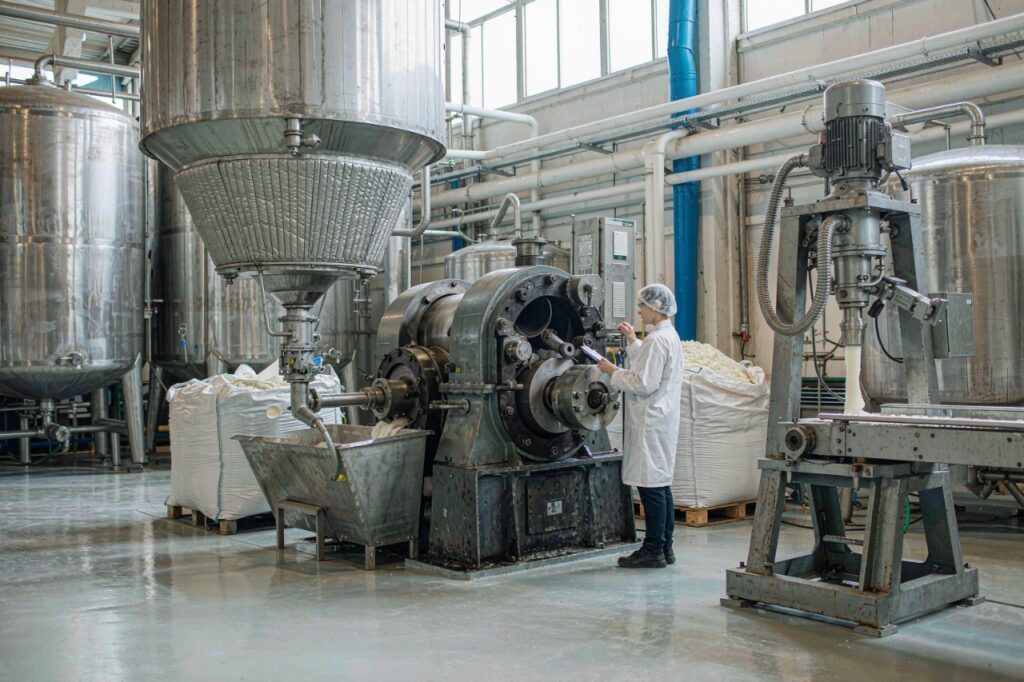
A noodle-route plant replaces the saponification kettle, vacuum dryer and glycerin recovery train with a far shorter thermal train: melt, dose, refine, plod, cut, stamp, wrap. The equipment content is smaller, the permitting simpler (no caustic bulk storage at saponification scale, no glycerin handling), and commissioning faster — which is why the October 2026 small-format wave documented in this series was overwhelmingly a noodle-route wave.
| Stage | Equipment | Key specification points (2026 market) |
|---|---|---|
| Melt & hold | Jacketed melting tank / crutcher, 200–5,000 L working volume; steam or electric heating; agitated; insulated; SS304 body, 316L optional on contact parts | Size to 1–2 hours of output, not the day’s batch — oversizing ages soap by holding it hot; undersizing starves the mill. Insulation is the cheapest energy decision on the line. |
| Dose | Fragrance, colour, TiO2 and additive dosing into the amalgamator; gravimetric or loss-in-weight feeders | Fragrance typically 0.5–2.0% of batch; dosing accuracy and hold temperature decide whether the perfume survives to the wrapper. |
| Refine | Three-roll refiner mill (or simplex refiner) | Homogenizes re-melted noodles with additives; roll-gap discipline sets bar texture and print quality downstream. |
| Extrude | Duplex vacuum plodder | Vacuum chamber removes entrained air from the re-melted mass; final moisture and TFM are locked in here, not corrected later. |
| Cut / stamp / wrap | Servo cutter, stamper with chilled dies, wrapper | Re-melted bases run slightly softer; die cooling and cutter timing tolerances need widening versus a fresh-saponified billet. |
Price points from the 2026 export market frame the capital scale. A complete small finishing line (mixer, three-roll mill, vacuum plodder, cutter, printer, wrapper) running on noodles is quoted at roughly USD 5,000–300,000 depending on automation and capacity (50–2,000 kg/h class, Henan and Hebei export cohorts). For reference, the equipment that produces noodles upstream — oil melting, saponification, vacuum drying, cooling and noodling — quotes at USD 100,000–250,000 for a 500–3,000 kg/h line. The delta between those two numbers is the capital the noodle route never has to spend.
4. Grade Discipline: Price per TFM Tonne, Not per Wet Tonne
The single most common error in noodle procurement is comparing offers on wet tonnage. A 72% TFM noodle and an 80% TFM noodle are not the same product wearing different labels — one is carrying 8 points more water and filler into your warehouse. Normalizing to a per-TFM-tonne basis reorders the price list.
| Grade | TFM | Typical 2026 quote (USD/t) | USD per tonne of TFM | End use |
|---|---|---|---|---|
| Standard export 80:20 | 72% | 940 | ≈ 1,306 | Economy toilet and laundry bars |
| Snow White 80:20 | 78% | 1,000–1,200 | ≈ 1,282–1,538 | Toilet bars; premium/dermo bars specify 80–82% |
| Full band, grade-mixed | 60–80% | 850–1,150 | varies | Laundry (TFM 60–72) through premium |
| In-house 80:20 saponification (materials only) | ~78% | — | ≈ 1,300 | Fat 1,288 + caustic ~48 − glycerin credit ~30 (STING calc, indicative) |
Moisture is the quiet second variable. Noodle contracts typically permit moisture up to 20%, while finished toilet bases run near 12%. At USD 940/t, each moisture point is roughly USD 9.4/t of freight you pay to ship water; the gap between a 20% and a 12% contract is about USD 75/t before a single downstream operation runs. Specify moisture, free alkali (≤0.2%) and salt (≤0.8%) in the contract, and hold suppliers to the COA — re-melting a high-salt noodle shows up weeks later as die corrosion and print defects.
Premiumization is reinforcing grade discipline from the demand side. Mordor notes Google search interest in luxury hand soap has tripled year-over-year, with high-purity, traceable noodle grades commanding a 3–5% premium in Europe and North America. For a finishing plant, that premium is captured only if the line can actually preserve the grade — which brings the discussion to the re-melt penalty.
5. The Re-Melt Penalty and Where the Fragrance Goes
Buying noodles is not free of process risk. The noodle route melts a finished base a second time, and every additional thermal pass costs something measurable:
- Fragrance: dosed at 0.5–2.0% into the amalgamator, volatile top notes are the first casualty of over-hot holding. Melt tanks without agitation scorch the wall layer while the batch centre stays solid — burnt soap cannot be recovered, and a stirred, insulated, correctly sized vessel is the defence. (One stirred hour of holding beats three passive ones; this is the tank vendor’s own sizing guidance, and it is correct.)
- Colour drift: re-melting darkens vegetable bases; TiO2 and optical brightener corrections are cheapest when dosing is gravimetrically controlled rather than scooped.
- Energy: melting a 20%-moisture noodle to a workable amalgam costs a fraction of saponification heat loads, but it is not zero — it is the same steam-versus-electric decision documented in the September energy review, at smaller scale.
- Hardness compensation: low-TFM noodles can be firmed by dosing palm kernel stearin (FOB USD 2,680/t) at the amalgamator — viable because the dose is 1–3%, but a real cost line that belongs in the make-vs-buy model.
None of these penalties reverses the route decision; they price it. A noodle-route plant should carry a slightly wider QC envelope, a gravimetric dosing skid, and a plodder with a properly functioning vacuum chamber — those three items convert “bought base variability” into “specified base performance.”
6. EUDR Extends to Soap: The Dossier Now Rides on the Noodle Contract
The regulatory calendar has just turned the noodle contract into a compliance document. The EU Deforestation Regulation’s main obligations — due diligence statements, plot-level geolocation, legality proofs — apply to large and medium operators and traders from 30 December 2026 (micro and small operators follow on 30 June 2027). And under Commission Delegated Regulation (EU) 2026/2102 of 13 July 2026, the product scope was formally expanded: palm-based toilet soap bars (CN ex 3401 11), other soap forms (ex 3401 20), and palm-synthesized oleic/linoleic/linolenic acids and their salts and esters (ex 2916 15) enter scope from 30 December 2027.
For a noodle buyer this changes the procurement question. The EUDR obligation formally sits with the operator first placing the product on the EU market — typically the EU importer — but the deforestation-free proof (plot geolocation, cut-off date of 31 December 2020, legality records) must be assembled upstream, and downstream operators pass along the original DDS reference numbers rather than filing duplicates. Documentation must be retained for five years. A noodle supplier who cannot hand over plot-level origin data for each lot is now a compliance liability, not just a quality risk.
The equipment consequence is specific: lot segregation and traceability must be engineered into the melt front end. Batch-level genealogy (which noodle lot, which additive lot, which shift produced which pallet of bars) is already the EU DPP ask this series covered in September; EUDR adds raw-material origin to the same data spine. Lines sold into EU-facing supply chains from 2027 onward need batch coding tied to raw-material lots in the MES layer, not on paper travelers. Vertically integrated noodle producers with blockchain traceability and plantation GPS data — as the major Indonesian houses now advertise — are positioning exactly for this.
7. B60 and the 2027 Feedstock Floor
The case for treating a multi-year noodle contract as a feedstock hedge rests on Indonesia’s biodiesel trajectory. B50 became mandatory on 1 July 2026 with full station rollout from 1 October; the Deputy Energy Minister confirmed on 2 September 2026 that B60 is the presidential instruction for 2027, with road tests being accelerated. GAPKI estimates B60 would lift biofuel CPO demand to 22–23 million tonnes annually (versus 16–17 Mt under B50) and could compress exports toward 23 Mt — five to six million tonnes of palm oil removed from world markets. RHB Research forecasts CPO at RM4,400/t for 2026 rising to RM4,500/t in 2027 as a strong El Niño persists through Q1 2027, and notes the palm oil–gas oil spread has already turned positive (US$19/barrel), making diversion economics self-reinforcing.
Two second-order effects matter for route decisions. First, the BPDP export levy rose from 10% to 12.5% in March 2026, and its fund balance halved to IDR 18.5 trillion through 2025 — the financing strain argues for continued firm domestic absorption, i.e., a structural feedstock floor rather than a cyclical spike. Second, India cut import duties in late September 2026 (crude palm oil to 5% from 10%; refined to 27.5% from 32.5%), which improves the economics of in-house saponification for Indian producers specifically — a regional divergence worth watching, since India has been the price-setting bear market for noodles (ChemAnalyst tracked Indian noodle prices in a downtrend through July 2026 on soft rural demand, with festive restocking expected to firm them).
Net: for buyers outside the Indian duty shield, the 88% noodle-to-CPO correlation plus the B60 diversion case argue for locking noodle supply on annual contracts (the 60.45% direct/bulk channel) rather than riding the spot market into 2027.
8. Route Decision Table: Saponify, Buy Noodles, or Neutralize
With the spread at parity, the make-vs-buy decision moves from raw-material arbitrage to capital, timeline and compliance — the terms on which this table compares the three production routes.
| Parameter | Full saponification (oil → noodle → bar) | Noodle route (buy → melt → finish) | Neutralization route (fatty acid + caustic) |
|---|---|---|---|
| Equipment scope | Kettles/continuous loop, vacuum drying, noodling, glycerin recovery, finishing | Melting tank, dosing, refiner mill, plodder, finishing | Fat-splitter feed, neutralization column, drying, finishing |
| Material cost per t TFM (Nov 2026, indicative) | ≈ USD 1,300 (fat 1,288 + caustic − glycerin) | ≈ USD 1,282–1,538 depending on grade | Tracks PFAD/fatty-acid market (PFAD 1,020) |
| By-product | Glycerin 30–35 kg/t — a second P&L if refined | None — the glycerin stays with the noodle maker | None (splitting happens upstream) |
| Capital & timeline | Highest; longest permitting and commissioning | Lowest — USD 5K–300K line quotes; fastest to first bar | Mid; fastest-growing process at 6.31% CAGR |
| Working capital | Oil inventory at USD 1,145–1,860/t exposure | Noodle inventory at USD 940–1,200/t; contract-led | Fatty-acid inventory; oleochemical-led |
| EUDR exposure (EU-facing) | Full — must prove own oil origin | Inherits supplier dossier; contract must demand plot data | Inherits splitter/supplier dossier |
| Fits when | ≥100 t/day scale, glycerin recovery justified, oil access secured | Entry, mid-scale, multi-SKU, import-dependent markets | Fatty-acid proximity, specialty/pure grades |
The table’s quiet headline is the neutralization row: at 6.31% CAGR it is the fastest-growing production process in Mordor’s breakdown, and its feedstock (PFAD at USD 1,020/t; fatty acids) currently sits well below the 80:20 fat blend. Plants splitting their own fats or buying fatty acids are running a different — and currently cheaper — chemistry than the classic kettle. The November 9 pretreatment analysis in this series covered the front of that pipe; the neutralization column is its natural downstream partner.
9. Q1 2027 Specification Checklist for Noodle-Route Lines
- Contract on TFM and moisture, not wet tonnage. Fix TFM (78% minimum for toilet bars), moisture (target ≤14%, accept ≤20% with price adjustment), free alkali ≤0.2%, NaCl ≤0.8% — and normalize supplier offers to USD per tonne of TFM before comparing.
- Insist on lot-level EUDR data in the supply contract. Plot geolocation or a DDS reference per lot, deliverable within the retention window (5 years), as a condition of payment — not a side letter.
- Size the melt tank to 1–2 hours of output, agitated and insulated, steam if a boiler exists, electric otherwise; reject any quotation that omits insulation.
- Specify gravimetric dosing for fragrance (0.5–2.0%), colour and TiO2 with batch-genealogy logging into the MES — this simultaneously serves EU DPP and EUDR lot traceability.
- Hold temperature discipline. Melt-and-hold targets with a controlled band and a stirred vessel; over-heated holding is the top cause of fragrance loss and colour drift on re-melted bases.
- Widen the finishing envelope for bought base: die cooling on the stamper, vacuum integrity on the plodder, and a QC gate that checks bar hardness and TFM on incoming noodle lots, not just outgoing bars.
- Lock noodle supply annually. With 88% price correlation to CPO, a B60-2027 feedstock floor and El Niño through Q1, the spot market is not where a 2027 production plan should buy its base.
Outlook
The noodle route is not a compromise anymore — at November 2026 prices it is the financially rational default below roughly 100 t/day, and a compliance-driven choice for EU-facing supply chains at any scale. What remains genuinely worth building is upstream: saponification and neutralization capacity in Southeast Asia and India, where vertically integrated producers convert feedstock access into noodle margin. Equipment vendors should expect the 2027 order book to keep bifurcating the way October’s small-format wave already showed: compact melt-and-finish trains for new entrants, traceability-ready data layers for everyone, and saponification trains only where glycerin and feedstock economics still clear the bar.
Sources
- Mordor Intelligence, Soap Noodles Market Size & Share Analysis (2026–2031) — market USD 2.83B (2025) / 3.00B (2026) / 4.02B (2031), 6.02% CAGR; spot above USD 900/t; 88% CPO correlation; segment shares (APAC 66.12%, saponification 59.22%, neutralization 6.31% CAGR, direct/bulk 60.45%, online 7.28% CAGR, premium grades +3–5%).
- Indonesia Export Center, Indonesia Palm Oil FOB Price Board, period ending 20 November 2026 — CPO 1,145; RBD palm 1,135; PFAD 1,020; CPKO 1,860; RBD PKO 1,955; RBD PK stearin 2,680 USD/MT.
- Palm oil exchange daily tracking, 18 November 2026 — Malaysian CPO 1,012, CPKO 1,621 USD/t FOB.
- EximNext / PT Mahata Agrimas Perkasa listing updated 13 Nov 2026 — 80:20 noodles, TFM 72%, moisture ≤20%, free alkali ≤0.2%, NaCl ≤0.8%, USD 940/t FOB Belawan; Accio aggregated bands USD 850–1,150/t; 78% TFM Snow White USD 1,000–1,200/t.
- Value Market Research, Global Soap Noodles Market (2026–2034) — USD 1.65B (2025) → 2.35B (2034), 4.00% CAGR; APAC 43.36%; vegetable oil 67.42%.
- Research Nester, Soap Noodles Market (2027–2036), published 31 Aug 2026 — USD 3.45B (2026), 4.8% CAGR to USD 5.51B (2036).
- European Commission, EU Deforestation Regulation (EUDR) — application 30 Dec 2026 (large & medium operators/traders), 30 Jun 2027 (micro/small); Delegated Regulation (EU) 2026/2102 of 13 July 2026 adding palm-based soap bars (ex 3401 11), other soap forms (ex 3401 20) and palm-derived oleic/linoleic/linolenic acids (ex 2916 15) from 30 Dec 2027; COSlaw and BPMA scope analyses.
- Media Biodiesel / GAPKI / USDA / Argus compilations; Indonesian Ministry of Energy (Deputy Minister Yuliot Tanjung, 2 Sept 2026) — B50 mandatory 1 July 2026, stations from 1 Oct 2026; B60 targeted 2027; GAPKI B60 CPO demand 22–23 Mt, exports to 23 Mt; BPDP levy 10%→12.5% (Mar 2026); RHB Research CPO forecasts RM4,400 (2026) / RM4,500 (2027), El Niño through Q1 2027; India duty cuts (CPO 10%→5%, refined 32.5%→27.5%, late Sept 2026).
- Mechcn soap machinery catalogue — melting tank/crutcher 200–5,000 L, jacketed steam/electric, SS304/316L, sizing guidance; Zhonghui ZH-500…ZH-3000 noodle-making lines 500–3,000 kg/h, USD 100,000–250,000; Zhengzhou Sunshine ZZSS180A noodle-route line 50–2,000 kg/h; Shijiazhuang Ruisheng line quotes USD 5,000–300,000.
- ChemAnalyst India soap noodle price tracking, July 2026 (downtrend, festive restocking expected) — via STING Industry archive, 31 August 2026.
Per-TFM tonne conversions, the 80:20 blend cost (USD 1,288/t) and the in-house materials estimate (≈USD 1,300/t TFM) are STING calculations from the quoted price board and noodle specifications; they are indicative for route comparison, not executable offers.